

Police clash with protesters
Peaceful marches turn violent as sun sets
Advertisement
Read this article for free:
or
Already have an account? Log in here »
To continue reading, please subscribe:

Digital Subscription
One year of digital access for only $205*
- Enjoy unlimited reading on winnipegfreepress.com
- Read the E-Edition, our digital replica newspaper
- Access News Break, our award-winning app
- Play interactive puzzles
*First annual payment billed as $205.00 + GST for one year. This annual subscription will automatically renew at $233.00 + GST every 52 weeks (10% off the regular annual price of $259.35). Offer available to new and qualified returning subscribers only. Cancel any time.
To continue reading, please subscribe:
Add Free Press access to your Brandon Sun subscription for only an additional
$1 for the first 4 weeks*
- Enjoy unlimited reading on winnipegfreepress.com
- Read the E-Edition, our digital replica newspaper
- Access News Break, our award-winning app
- Play interactive puzzles
*Your next Brandon Sun subscription payment will increase by $1.00 and you will be charged $17.95 plus GST for four weeks. After four weeks, your payment will increase to $24.95 plus GST every four weeks.
Read unlimited articles for free today:
or
Already have an account? Log in here »
Hey there, time traveller!
This article was published 14/08/2014 (4413 days ago), so information in it may no longer be current.
FERGUSON, Mo. — It’s been night-and-day since Saturday’s fatal police shooting of Michael Brown.
Mostly peaceful protesters march hand-in-hand by day. At night, people splinter, defiance and lawlessness take a firmer grip, and expressions and intentions move into the shadows.
By day, calls for non-violent protest come from black and white activists and politicians.
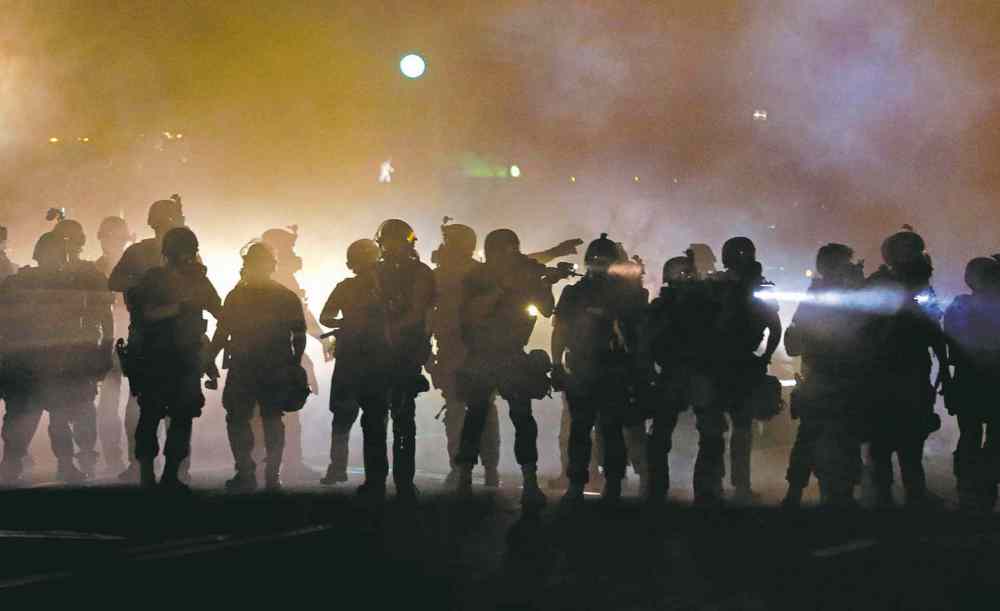
By night, shooting and looting have appeared.
“Night has a way of bringing a different atmosphere,” said the Rev. Damon Lynch III, who helped organize non-violent protests after a police shooting death of a black man in Cincinnati in 2001. “People can do things under the cover of darkness that they readily don’t do during the day.”
In Cincinnati, the same pattern took hold as in Ferguson: mostly peace during the day, violence into the night. Ultimately what resulted in Cincinnati was an agreement to improve policing. Today, Lynch said, “the atmosphere is 10,000 times better, police are more accountable to the community, and the community has greater respect for police officers,” and he wishes that for Ferguson.
Lynch said Wednesday he has watched events in Ferguson by recalling what it was like to be at the head of a march, galvanized by one death, but displaying a multitude of motivations.
“I am a proponent of non-violent social change,” Lynch said, “and I learned that you are going to have within this group of protesters probably every kind of philosophy available.”
From “pacifists to militants to anarchists,” he said, “everyone came out of the woodwork,” even if a vast majority were peaceful. He constantly wondered “if we are going to be peaceful but powerful, how do you keep everybody in line?”
“We just explained to them what our philosophy was and if they couldn’t abide by it they would go on and do what they wanted to do, throwing bricks and all of that sort.”
The curfew, he said, helped calm things down. Ferguson has not done that, although Mayor James W. Knowles III and the Ferguson City Council issued a statement Wednesday asking for peaceful demonstrations during the day. It condemned “those who wish to co-opt peaceful protests and turn them into violent demonstrations… during the evening hours.”
Those same night-and-day dynamics persisted long enough in Cincinnati for the mayor to set a curfew about a week after the shooting death of Timothy Thomas, who at 19, was just a year older than Michael Brown when Thomas was shot by police trying to avoid arrest.
The relationship between Cincinnati authorities and residents of the Over-the-Rhine neighborhood, where Thomas was from, had been combustible long before Thomas was killed, but no action was taken “until they saw the anger spill over.” Some 15 black men had been killed by police over a few years, some unarmed, some of the killings ruled justifiable acts of defense. Two years before Thomas was killed, the ACLU had joined a lawsuit claiming police discrimination.
In Missouri, the Missouri State Conference of the NAACP in November filed a federal civil rights complaint alleging racism in hiring and firing and racial profiling in the St. Louis County Police Department.
Lynch said an “extremely effective” agreement emerged from the Cincinnati protests, including making police shooting investigations more transparent and mandating quick release of information, including the identity of the alleged shooter.
Ferguson authorities have withheld the name of the shooter, citing death threats. Lynch said that may be fuelling some anger.
— St. Louis Post-Dispatch
Related Articles
The danger of being black or brown in America
Advertisement Advertise With Us
Advertisement Advertise With Us