Inventiveness & integrity

WAG exhibition showcases indigenous artists at their peak

Advertisement

Advertise with us

'I don't want to see young artists of native ancestry paint themselves into a box in search for authenticity," Daphne Odjig writes in the catalogue for 7: Professional Native Indian Artists Inc. "It is within you."

Read this article for free:

or

Already have an account? Log in here »

To continue reading, please subscribe:

Subscribe and receive a limited-edition Free Press branded hat or tote.

Digital Subscription

One year of digital access for only $205*

  • Enjoy unlimited reading on winnipegfreepress.com
  • Read the E-Edition, our digital replica newspaper
  • Access News Break, our award-winning app
  • Play interactive puzzles

*First annual payment billed as $205.00 + GST for one year. This annual subscription will automatically renew at $233.00 + GST every 52 weeks (10% off the regular annual price of $259.35). Offer available to new and qualified returning subscribers only. Cancel any time.

To continue reading, please subscribe:

Add Free Press access to your Brandon Sun subscription for only an additional

$1 for the first 4 weeks*

  • Enjoy unlimited reading on winnipegfreepress.com
  • Read the E-Edition, our digital replica newspaper
  • Access News Break, our award-winning app
  • Play interactive puzzles
Start now

*Your next Brandon Sun subscription payment will increase by $1.00 and you will be charged $17.95 plus GST for four weeks. After four weeks, your payment will increase to $24.95 plus GST every four weeks.

Opinion

Hey there, time traveller!
This article was published 28/08/2014 (4340 days ago), so information in it may no longer be current.

‘I don’t want to see young artists of native ancestry paint themselves into a box in search for authenticity,” Daphne Odjig writes in the catalogue for 7: Professional Native Indian Artists Inc. “It is within you.”

Sound advice from an artist who’s lived by example.

Odjig, 95 next month, and the six other like-minded artists who first convened at her Donald Street print shop in 1972 stand as models of inventiveness, integrity and self-determination. Supporting one another’s work in an openly hostile climate, they rejected limiting ideas about what “Indian art” could be, asserting their place as equal players on the national cultural stage. With their work, they forged powerful new esthetic traditions that built on history while embracing contemporary indigenous experience and diverse artistic influences.
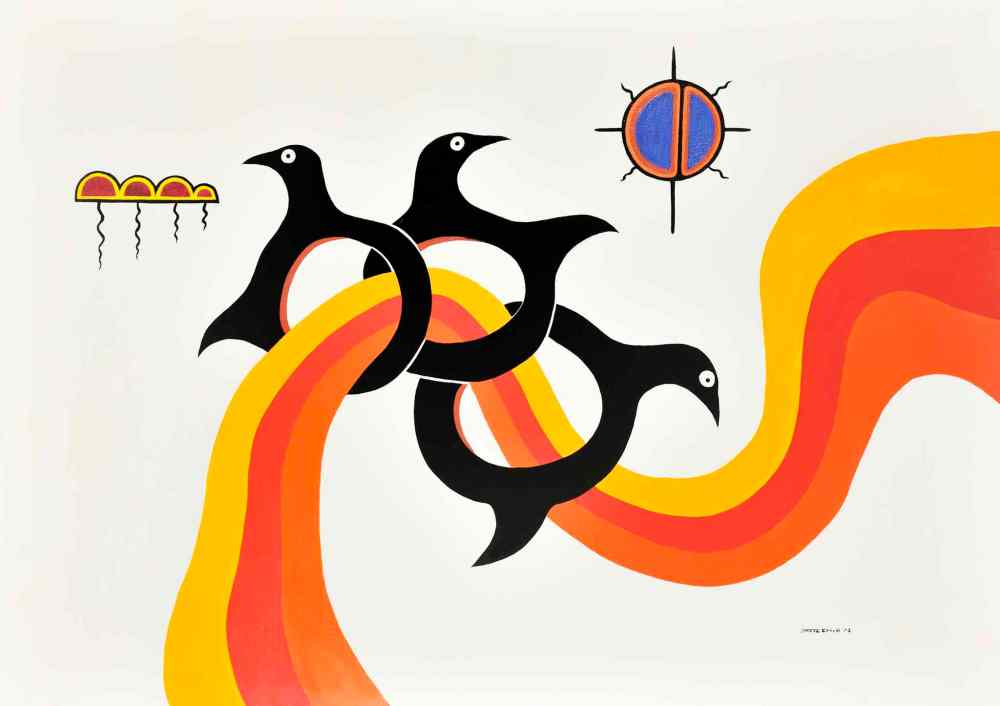
Supplied image
Jackson Beardy, Flock
Supplied image Jackson Beardy, Flock

Dubbed “the Indian Group of Seven” (a moniker that stuck), PNIAI members would eventually join the Order of Canada and win Governor General’s Awards, but 40 years ago, their accomplishments were more often met with indifference or worse. Closing at the WAG Monday after a four-month run, 7 assembles 84 works from the 1970s, a vital early period when ideas and styles were still in flux and many members were at their creative peak.

Norval Morrisseau is justifiably well-represented. In the 1950s and ’60s, the painter worked in relative isolation to synthesize traditional Anishinaabe forms, crafting a distinctive style that mirrored the liberated flatness of modernists like Picasso and Matisse (both of whom drew on indigenous art for inspiration). A self-described “shaman-artist,” Morrisseau worked across artistic and spiritual traditions to explore cultural memory, religious conviction, personal history and inner conflict.

In the show, we see Carl Ray and Jackson Beardy adapt and refine Morrisseau’s Woodlands Style, whose supple linework, bold colour and cutaway perspectives remain hallmarks of Anishinaabe painting and design. Beardy in particular exploited the “x-ray style” to vivid effect: snaking outlines weave together imagery and themes of nature, society, transformation and rebirth.

Trained in the late ’50s at what is now the Alberta College of Art and Design, Alex Janvier pursued abstraction more single-mindedly than any of his peers. Drawing on centuries of Dene abstract design, including quillwork and beading, he crafts serpentine mosaics of colour that unfurl across the canvas with the graphic lyricism of a Mesoamerican codex or Kandinsky painting. Occasionally flirting with representation (a motif from a beaded medallion, the suggestion of a winding river system), the paintings seamlessly fuse disparate esthetic lineages, while Janvier’s titles and statements about the work locate the within a principled, politicized worldview.

Though best known for her swirling, flatly graphic take on Woodlands painting, Daphne Odjig’s work from the ’70s reflected a wider range of influences (but was no less distinctive), marrying sinuous contours and traditional subjects with fragmentary form and shading inspired by early cubism. Dreamlike compositions explore ceremonial, mythological, and personal themes, their gestural handling strongly evocative of abstract expressionism’s surrealistic early days. Also inspired by surrealism, Joseph Sanchez’s drawings and prints have a distinct apocalyptic tenor, interweaving messianic visions of the Ghost Dance and Biblical Revelation with harrowing scenes of sexuality and violence.

Things have improved in 40 years, but even today, indigenous artists risk having their work dismissed as irrelevant on the one hand and inauthentic on the other. It’s an impossible standard, and 7 triumphantly demonstrates that we’re all better off when artists ignore it.


Steven Leyden Cochrane is a Winnipeg-based artist, writer and educator.

History

Updated on Thursday, August 28, 2014 1:59 PM CDT: Replaces image, removes images, adds slideshow
Report Error Submit a Tip

More Stories

Sheriff who died in train collision ‘loved everybody’

Tyler Searle 6 minute read Preview

Sheriff who died in train collision ‘loved everybody’

Tyler Searle 6 minute read Updated: Yesterday at 6:09 PM CDT

Brett Matheson-Maytwayashing was a loving father, hard-working sheriff and proud First Nations man who helped lead traditional ceremonies for a decade before he died in a collision with a train near Portage la Prairie.

Matheson-Maytwayashing, 27, died in the Tuesday morning crash, which occurred on a rural road west of Portage while he and another member of the sheriff’s service were on their way to attend court in Amaranth, his mother, Alissa Matheson-Maytwayashing, told the Free Press.

It was Matheson-Maytwayashing’s first day back at work after taking time off to participate in a sun dance ceremony in northern Saskatchewan last week, his mother said.

“Brett didn’t judge anybody, he would give people chances,” she said, her voice breaking. “He didn’t care what colour you were, he didn’t care your nationality — Brett just loved everybody.”

Read
Updated: Yesterday at 6:09 PM CDT

Inventiveness & integrity

By Steven Leyden Cochrane 4 minute read Preview

Inventiveness & integrity

By Steven Leyden Cochrane 4 minute read Thursday, Aug. 28, 2014

'I don't want to see young artists of native ancestry paint themselves into a box in search for authenticity," Daphne Odjig writes in the catalogue for 7: Professional Native Indian Artists Inc. "It is within you."

Sound advice from an artist who's lived by example.

Odjig, 95 next month, and the six other like-minded artists who first convened at her Donald Street print shop in 1972 stand as models of inventiveness, integrity and self-determination. Supporting one another's work in an openly hostile climate, they rejected limiting ideas about what "Indian art" could be, asserting their place as equal players on the national cultural stage. With their work, they forged powerful new esthetic traditions that built on history while embracing contemporary indigenous experience and diverse artistic influences.

Dubbed "the Indian Group of Seven" (a moniker that stuck), PNIAI members would eventually join the Order of Canada and win Governor General's Awards, but 40 years ago, their accomplishments were more often met with indifference or worse. Closing at the WAG Monday after a four-month run, 7 assembles 84 works from the 1970s, a vital early period when ideas and styles were still in flux and many members were at their creative peak.

Read
Thursday, Aug. 28, 2014

Twelve metres of museum space

Judith Dueck 4 minute read 2:00 AM CDT

It is striking that one of the smallest exhibitions at the Canadian Museum for Human Rights in Winnipeg has generated one of the largest public controversies in the museum’s history. Palestine Uprooted: Nakba Past and Present occupies only about 12 metres within an existing gallery.

Yet it has prompted protests, political statements, passionate public debate and accusations that the museum has somehow abandoned its mission.

This exhibition matters. But I have come to think that the reaction to it matters just as much. It raises a question that reaches well beyond this particular exhibition.

Why has one small gallery space become such a flashpoint?

Poilievre can only smile and nod after Carney’s chess move

Tom Brodbeck 5 minute read Preview

Poilievre can only smile and nod after Carney’s chess move

Tom Brodbeck 5 minute read Tuesday, Jul. 14, 2026

Mark Carney may still be relatively new to elected politics, but he’s proving to be a remarkably quick study in the art of political chess.

Read
Tuesday, Jul. 14, 2026

Buckled concrete gives drivers the heave-ho

Joyanne Pursaga 5 minute read Preview

Buckled concrete gives drivers the heave-ho

Joyanne Pursaga 5 minute read Tuesday, Jul. 14, 2026

Highways, local roads and sidewalks have buckled and broken thanks to extreme heat in recent days, wreaking havoc with travel.

Garth Thomson was driving on the Perimeter Highway, just north of Assiniboia Downs, around 4 p.m. Sunday when he suddenly came upon a major gap in the road.

“There was a big break in the highway, which was the heaving. I had about four seconds to decide what I was going to do. So, I kind of hit my brakes and drove more towards the centre, where the big chunks weren’t (located),” said Thomson. “It happened so fast … there were big chunks (of concrete), probably a foot (per) square, sticking up.”

His convertible had bumper damage and a hole in its gas tank, he said.

Read
Tuesday, Jul. 14, 2026

Manitoba documentary focuses lens on environmental defenders, beauty of prairies

Conrad Sweatman 4 minute read Preview

Manitoba documentary focuses lens on environmental defenders, beauty of prairies

Conrad Sweatman 4 minute read 2:00 AM CDT

Everything We Need Is Here is the latest sumptuously shot Manitoba film rooted in the Prairie landscape.

Though totally unrelated in subject matter, the documentary recalls the 2024 Daughters of the Sun with its saturated and slow-mo sweeps across boreal forests and limestone tinted lakes.

But while Daughters has much murmured narration and arthouse flair, Everything is a plucky film, a can-do sort of doc about the land and its grassroots defenders.

Their voices resonate strong and clear across storylines that weave together the joys of foraging and local environmental protests.

Read
2:00 AM CDT