

Remember the titan?
Man movie was based on is still true to his school
Advertisement
Read this article for free:
or
Already have an account? Log in here »
To continue reading, please subscribe:
Digital Subscription
One year of digital access for only $1.44 a week*
- Enjoy unlimited reading on winnipegfreepress.com
- Read the E-Edition, our digital replica newspaper
- Access News Break, our award-winning app
- Play interactive puzzles
*Billed as $5.77 plus GST every four weeks. After 52 weeks, price increases to the regular rate of $19.95 plus GST every four weeks. Offer available to new and qualified returning subscribers only. Cancel any time.
To continue reading, please subscribe:
Add Free Press access to your Brandon Sun subscription for only an additional
$1 for the first 4 weeks*
- Enjoy unlimited reading on winnipegfreepress.com
- Read the E-Edition, our digital replica newspaper
- Access News Break, our award-winning app
- Play interactive puzzles
*Your next Brandon Sun subscription payment will increase by $1.00 and you will be charged $17.95 plus GST for four weeks. After four weeks, your payment will increase to $24.95 plus GST every four weeks.
Read unlimited articles for free today:
or
Already have an account? Log in here »
Hey there, time traveller!
This article was published 26/10/2014 (4247 days ago), so information in it may no longer be current.
The golf cart swung onto the sidewalk and out stepped a man, 61 years old with salty hair and bad knees. “Alexandria City Public Schools,” read the badge around his neck, which dangled next to a gold cross. “Security officer,” read his polo shirt, underneath the red T.C. Williams High School jacket, which covered the walkie-talkie labeled, “P. Jones.”
It was another school year, another football season, another day defined by the movie that made him famous. Thomas (Petey) Jones had held this job for almost a quarter-century and this morning, as they all did, began by marking down when the school buses arrived at the high school in Alexandria, Va. But he had time, so Jones waited inside the cart, radio tuned to a gospel station, and looked at pictures on his cellphone.
There were his three grown children, all graduates of T.C. Williams, too, though none had been state champions like their father. And his dog, Gizmo, born around the filming of Remember the Titans, the 2000 movie based on the school’s 1971 football team on which Jones played linebacker after switching over from running back.
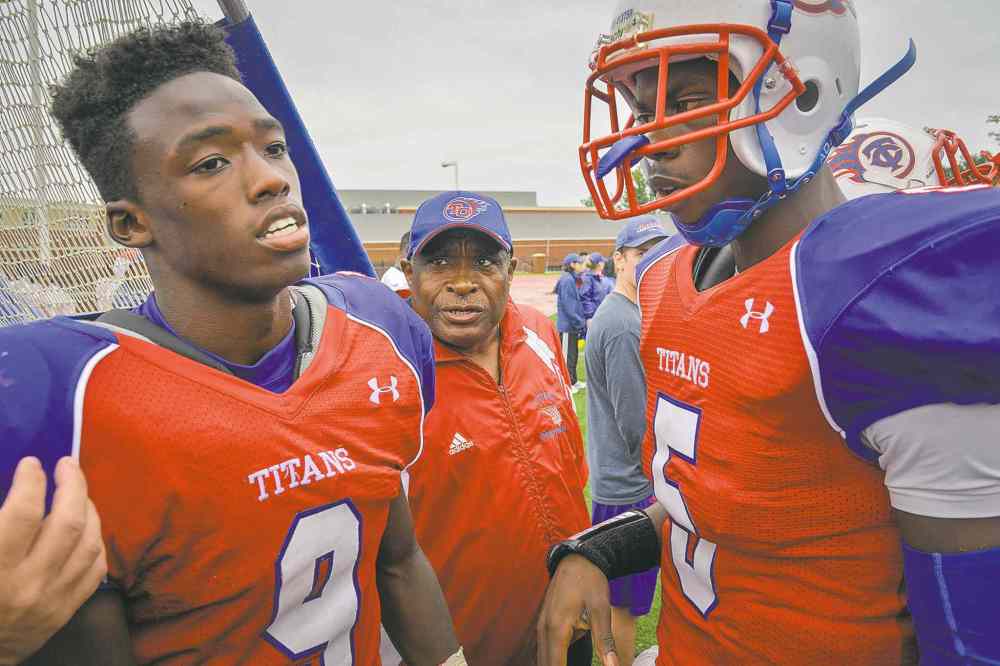
And now here, off the buses, came another crop of high school students who first learned the celluloid image of teenage Petey Jones — the flirtatious, confident, athletic portrayal by actor Donald Faison — and then met the real man, who patrolled the hallways and caught them sneaking to McDonald’s for lunch.
“Bus 48,” Jones muttered as the first one unloaded. “7:55,” he wrote on the clipboard.
The movie portrayed the racial tensions created by the consolidation of Alexandria’s three high schools, which brought the city’s white and black football players together on a single team at T.C. Williams under an African-American head coach.
The male students tended to joke more with Jones about his character in the film, like the famous fumbling problem that got Petey benched in the movie. The girls seemed to ask deeper questions. They wanted stories about racism during desegregation, so Jones told them about the separate water fountains at G.C. Murphy’s in Old Town Alexandria, or the time the team bus got egged at West Springfield High School.
Mostly, though, everyone quoted the catchy lines, like the high school football coach who reprimanded Jones’ youngest child, Marcus, by yelling, “You’re killing me, Petey” — the same line famously screamed by Denzel Washington at Faison during one of the film’s most memorable scenes. Or the Australian tourists who visited T.C. Williams on their first trip to the United States and geeked out when they learned Jones still worked there. Or the school nurse’s aide, who greeted the cart’s driver with a hearty, “Petey Jones. Running back. The running back.”
These were the kinds of interactions he has known for exactly 14 years this fall, the anniversary of the film’s release. They assured him the Titans were still remembered. They amazed him, too, not just that a three decade-old event could change a man’s life, but because despite working each day at the film’s epicentre, his presence still surprised folks who never considered the men whose lives had changed.
“It is now 8:21 and we are waiting on four buses,” Jones said into the radio. “We are waiting on four.”
“Copy,” the radio crackled back. “Ten-four.”
— — —
Fifteen years ago, Jones received a telephone call. Someone had written a movie about the Titans and Disney wanted to shoot it. “Yeah, right,” Jones had responded. The state championship had always been special to him, but why would anyone else care?
“Everyone in the metropolitan area knew,” said Julius Campbell, a former teammate. “Now, all of a sudden, the whole world knew.”
Before long, Jones had flown to Atlanta, where Washington, who portrayed Titans coach Herman Boone, told him, “Aw, man, I’m all over you in the movie.” Then he went to the worldwide premiere at the Rose Bowl, riding in a golf cart beside Faison as people yelled, “Petey! Petey!” though he knew they weren’t calling for him. Then he attended the premiere in Washington, taking pictures of his son with President Bill Clinton, and beaming with pride, because he felt like somebody his children could admire.
“He’s a famous person for something he did as a kid, then all those things went away, only to be brought back again as an adult,” Faison said. “As time goes on people forget about things like that. Then all of a sudden, the movie comes out, and Petey Jones is popular again.”
With came requests to speak, for Jones and his teammates to share their story. The U.S. Coast Guard Academy called, because it showed the movie in officer training. So did factories for Kellogg and Maytag, torn apart by racial issues, and the map-dot town in Kentucky, where autograph seekers wrapped around the block.
The revenue helped fund the ’71 Original Titans Scholarship Foundation, which offered an excuse for everyone to meet one Saturday each month. Many of the movie’s most memorable Titans still lived near Alexandria and now, on his first patrol through the T.C. Williams halls, Jones stopped at the school trophy case, noticed a picture of the state champions celebrating at the airport and thought about them all.
There, he pointed, was Darryl (Big Blue) Stanton, the scholarship foundation’s president who wasn’t so big anymore. And Julius Campbell, the star linebacker who worked in Alexandria animal control but later retired on disability. How about Jerry Harris, the quarterback, now in city payroll? And just look at Frankie Glascoe, the team MVP and its actual star running back who, for reasons Jones never figured out, was absent from the film.
Jones stared through the glass, looking harder at the fading picture, and sighed. There was his signature, near the wing of the airplane, but where was he?
“I can’t never find me in the group,” he said, pressing his nose to the case. “I just know I was there.”
— — —
Several weeks back, at a football scrimmage against Hayfield High School, Jones stood along the fence at halftime. Two women approached. “Excuse me,” one said. “I don’t always do this, but can I take a picture with you?”
She produced a cellphone. Turned out she used to play football, too. Aggressive. Loved to hit. An outside linebacker. “Just like me,” Jones said.
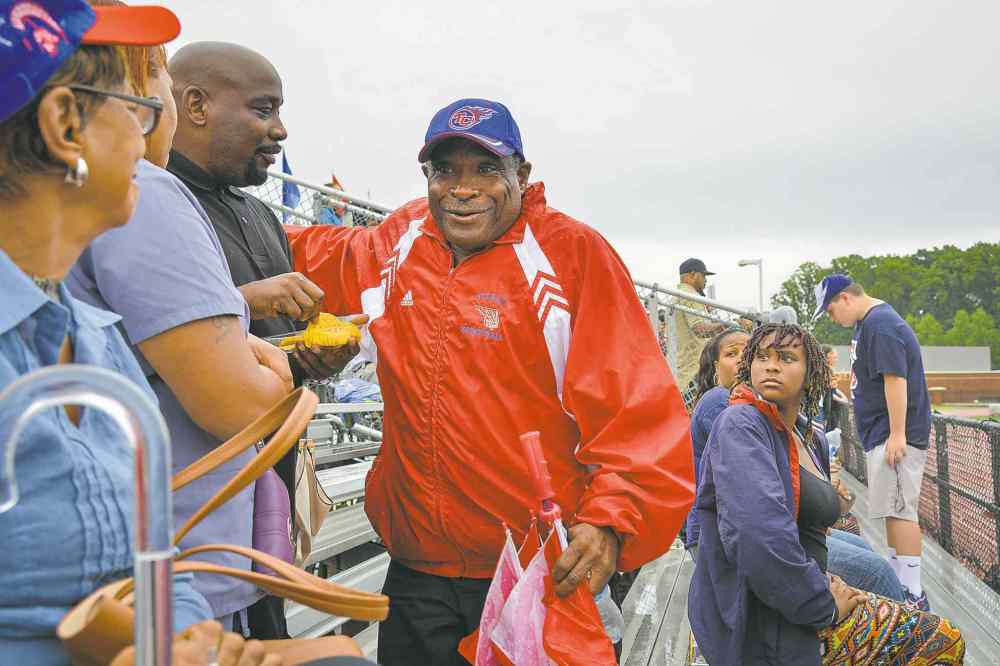
It was one of the movie’s few details about Jones that stayed true to his real story, that during the season he switched from running back to defence. Among the others: He was indeed a jokester, known to organize dice games in the bathrooms, and a flirt. When Alexandria merged its three public high schools in 1971, he came to T.C. Williams from George Washington High School. He wore No. 40.
But his father was not named Eric, as Faison told a teammate. It was Thomas Louis Jones Sr., a fierce fighter for equal housing, and his friends also called him Pete. In real life, Jones was not a junior in 1971; he was a senior, riding out the last days of his football career. Also, he was not moved to linebacker by the altruistic white coach, who hid Jones from Boone’s wrath; after a pre-season injury and a healthy scratch in the opener, Jones requested the move himself.
“And I did not fumble the football,” Jones said. He started opening every conversation with movie fans like this, because he liked them to learn the truth up front.
So, the truth: In high school, Jones was also a three-year varsity basketball player. After graduation, he accepted a four-year scholarship to play football at Norfolk State, as the film’s credits informed, but withdrew midway through his sophomore season, at odds with the demands of college football, having barely seen the field. He later worked for Eastern Airlines, loading planes, until he joined the Alexandria parks department in 1986.
And here’s the thing no fan knew:
When the events depicted in Remember the Titans happened, Jones had already become a father.
He was a sophomore at George Washington then. The mother, a classmate, was 16. They weren’t ready for the responsibility, but both families helped raise baby Keisha, and the new parents pitched in when they could. Petey learned to change diapers, took his daughter for walks after class and practice, taught her a call-and-response game with animal sounds. “Sheep,” he would say. “Baaa,” she would reply.
“All I knew,” Jones said, “was I was a father. I just tried to be a teenager.”
— — —
In the quiet hours between bus duty and lunch, Jones parked his cart out back and opened his Bible, a Christmas present from his daughter covered by football leather. “Witness NFL,” read the label, which stood for “New Found Life.”
Book resting on the steering wheel, Jones put on his glasses and turned to Proverbs 17. He called a friend, the woman who had bought the cross he wore around his neck. “Good morning,” he said. “You got your Bible open?”
He read the verses, two at a time, and she read hers back to compare. It was a Wednesday, which meant Jones also had a noontime prayer call with his church. “Brother Petey,” is how they knew him at Saint John Baptist, which Jones joined several years ago.
He was driven there by a string of legal issues and, subsequently, the nagging desire to become a better role model, not only for his three children — Keisha, Crystal and Marcus — but for the moviegoers and speech-listeners, who had an image of a man he hoped not to betray.
In 2000, according to court records, Jones was charged with drunk driving for a third time. The first two offences, he said, came a decade before, and all three were knocked down to misdemeanors. Jones never served jail time, and though his license was revoked, he kept driving.

“A habitual offender,” he said, echoing a term used by the court, though later he acknowledged those incidents were “a wakeup call.” Tired of hitting the clubs and guzzling beers before bed, even into his mid-50s, Jones joined the church. He moved into his sick grandmother’s house, across the street from George Washington, a middle school since the 1971 merger, to take care of her. He raised his credit, bought a new black Lincoln 300, quit drinking, except for the occasional brew during an NFL game.
It was the life of obedience he needed. The life which helped him through a prostate cancer scare in 2012. The life which made his speeches seem truer, his meetings with fans more meaningful. The life which halted work in the middle of the day so he could read scripture over the telephone as passing students stared into the cart.
“Amen,” Jones said. He closed the Bible. “That’s good stuff. I’m going to read over it again later.”
— The Washington Post