Lord of the strings
California musician lets his fingers do the talking... and they speak many languages

Advertisement
Read this article for free:
or
Already have an account? Log in here »
To continue reading, please subscribe:

Digital Subscription
One year of digital access for only $205*
- Enjoy unlimited reading on winnipegfreepress.com
- Read the E-Edition, our digital replica newspaper
- Access News Break, our award-winning app
- Play interactive puzzles
*First annual payment billed as $205.00 + GST for one year. This annual subscription will automatically renew at $233.00 + GST every 52 weeks (10% off the regular annual price of $259.35). Offer available to new and qualified returning subscribers only. Cancel any time.
To continue reading, please subscribe:
Add Free Press access to your Brandon Sun subscription for only an additional
$1 for the first 4 weeks*
- Enjoy unlimited reading on winnipegfreepress.com
- Read the E-Edition, our digital replica newspaper
- Access News Break, our award-winning app
- Play interactive puzzles
*Your next Brandon Sun subscription payment will increase by $1.00 and you will be charged $17.95 plus GST for four weeks. After four weeks, your payment will increase to $24.95 plus GST every four weeks.
Read unlimited articles for free today:
or
Already have an account? Log in here »
Hey there, time traveller!
This article was published 22/11/2014 (4291 days ago), so information in it may no longer be current.
David Lindley has built his entire music career on curiosity.
The 70-year-old multi-instrumentalist — or “maxi-instrumentalist” as Acoustic Guitar magazine famously dubbed him — has always had a thirst for learning and experimenting. He started out as a banjo picker in 1960s southern California; now, his arsenal includes not only acoustic and electric guitar, upright and electric bass guitar, lap steel guitar, mandolin and zither, but exotic instruments he’s picked up from around the world. Like the Norwegian hardanger fiddle, the Greek bouzouki, the Turkish baglama, gumbus and cºmbºs, the Andean charango and the oud.
His curiosity led him to experiment with world music in the context of a rock band with El Rayo-X. It led him to Jordanian percussionist Hani Naser, with whom he toured in the 1990s. It led him to work with the likes of Bob Dylan, Jackson Browne, Crosby and Nash, Warren Zevon, Ry Cooder and Bonnie Raitt.
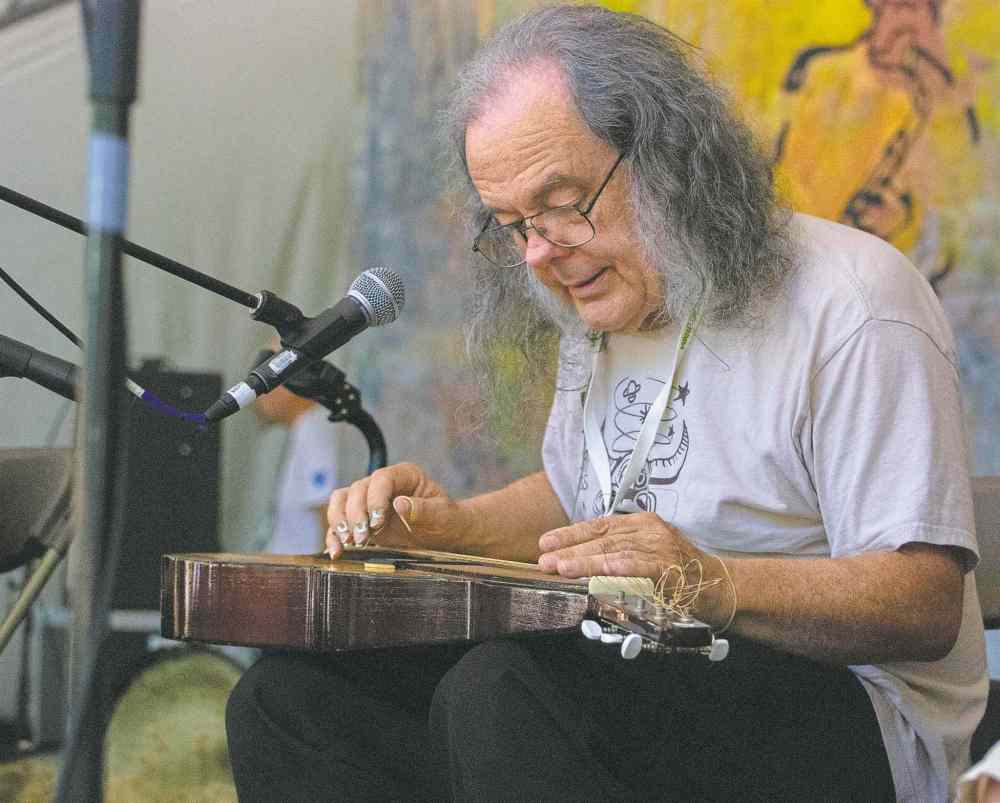
And, in the late 1980s and early ’90s, it led him to the stages of the Winnipeg Folk Festival, which honoured him with the 2014 Artistic Achievement Award at its annual Folk Festival in the City event on Friday night. Lindley will perform at the Park Theatre tonight; tickets are almost sold out.
During an interview at the Fairmont on Thursday afternoon, Lindley was visibly touched by the award.
“It’s wonderful. I was very impressed. It’s an official recognition of all those hours of practice, of the nine-hour drives. All that stuff. The one thing about lifetime achievement awards, they come later on. Am I supposed to die next? Is that what comes?” he says with a laugh. “But no, it’s a wonderful thing — especially coming from Canada.”
Lindley has family in Canada — his mother’s side hails from the Guelph, Ont., area — but he also has a strong emotional connection to the Winnipeg Folk Festival and, in particular, its former artistic director, the late Rosalie Goldstein. “She was a real important influence in my musical life,” he says of the irrepressible Queen of Chutzpah.
“I remember one year, Rosalie took me by the ear — literally — and she says, ‘We’re going to listen to this guy.'” Turns out “this guy” was venerated Malian singer and multi-instrumentalist Ali Farka Touré.
“He was playing with just a single electric guitar and a percussionist who played a calabash,” Lindley recalls, “and it was a revelation. It was big little music as opposed to little big music. You get two players or one player that makes an entire universe — but with these two guys it was low-key. It wasn’t tremendously loud. It wasn’t bombastic. And that’s what Rosalie wanted me to hear. I talked to her about it years afterwards and she said, ‘Oh yeah, you needed to see that because you can go out and do that.’ And I did. Because of her.”
Indeed, he credits her — and that fateful folk-fest gig — with inspiring his collaborations with percussionists such as Naser as well as reggae percussionist Wally Ingram, with whom he’s recorded and toured.
“It’s always been the best one,” he says of the Winnipeg Folk Festival. “There was one set that El Rayo-X did that was recorded, and it was mind-blowing. No mistakes, no hesitation. Just straight down the middle. I listened to it afterwards and thought, ‘This is what happens when you’re on. When you’re right there in the moment and your brain is working perfectly with your hands.’ I’ll never forget that one.”
The musical education of David Lindley was an unorthodox one. Growing up in San Marino, Calif., he was introduced to world music via his dad’s record collection, which was populated by Korean vocalists and Nigerian drum ensembles.
“I was learning to play guitar, and he’d get me records,” Lindley recalls. “He’d say ‘Listen to this guy’ — and it was (flamenco guitarist) Sabicas. Everything just blew up from that. It was his record collection that got me going.”

Lindley was also raised on Bartòk and Brahms. His uncle was a classical pianist and taught at the University of California, San Diego. “When I was four years old, I would walk under the Steinway, and I would put my head up against the soundboard on the bass end,” Lindley remembers, laughing. “I know that did something to me.”
Still, despite his obsession with music, there was a time when he thought he might be a painter. His mother was a gifted artist, a talent he inherited. “At one point, I had to decide. Am I going to be an artist, an architect, a commercial artist or am I going to play the banjo at Disneyland and teach at the music store in Pasadena?” he says. “And I sat there on the couch, just like I am now, and decided, ‘No, I’m going to play music.’ I wanted to see what would happen.”
That last sentence could serve as Lindley’s personal mission statement.
“That’s the biggest thing there is,” he says. “‘What will happen?’ Those results were more fun for me, when I said, ‘I’m going to see what happens.’ And there were all sorts of things that happened. This (award) is one of them.”
jen.zoratti@freepress.mb.ca
Jen Zoratti is a columnist and feature writer working in the Arts & Life department, as well as the author of the weekly newsletter NEXT. A National Newspaper Award finalist for arts and entertainment writing, Jen is a graduate of the Creative Communications program at RRC Polytech and was a music writer before joining the Free Press in 2013. Read more about Jen.
Every piece of reporting Jen produces is reviewed by an editing team before it is posted online or published in print – part of the Free Press‘s tradition, since 1872, of producing reliable independent journalism. Read more about Free Press’s history and mandate, and learn how our newsroom operates.
Our newsroom depends on a growing audience of readers to power our journalism. If you are not a paid reader, please consider becoming a subscriber.
Our newsroom depends on its audience of readers to power our journalism. Thank you for your support.
CONCERT PREVIEW
David Lindley
Saturday, Nov. 22, 8 p.m.
Park Theatre
Tickets are $39.50 at Ticketmaster
Jen Zoratti is a columnist and feature writer working in the Arts & Life department, as well as the author of the weekly newsletter NEXT. A National Newspaper Award finalist for arts and entertainment writing, Jen is a graduate of the Creative Communications program at RRC Polytech and was a music writer before joining the Free Press in 2013. Read more about Jen.
Every piece of reporting Jen produces is reviewed by an editing team before it is posted online or published in print – part of the Free Press‘s tradition, since 1872, of producing reliable independent journalism. Read more about Free Press’s history and mandate, and learn how our newsroom operates.
Our newsroom depends on a growing audience of readers to power our journalism. If you are not a paid reader, please consider becoming a subscriber.
Our newsroom depends on its audience of readers to power our journalism. Thank you for your support.
Advertisement Advertise With Us
Advertisement Advertise With Us