Alberta to declare first spring snow goose hunt in province: official
Advertisement
Read this article for free:
or
Already have an account? Log in here »
To continue reading, please subscribe:

Digital Subscription
One year of digital access for only $205*
- Enjoy unlimited reading on winnipegfreepress.com
- Read the E-Edition, our digital replica newspaper
- Access News Break, our award-winning app
- Play interactive puzzles
*First annual payment billed as $205.00 + GST for one year. This annual subscription will automatically renew at $233.00 + GST every 52 weeks (10% off the regular annual price of $259.35). Offer available to new and qualified returning subscribers only. Cancel any time.
To continue reading, please subscribe:
Add Free Press access to your Brandon Sun subscription for only an additional
$1 for the first 4 weeks*
- Enjoy unlimited reading on winnipegfreepress.com
- Read the E-Edition, our digital replica newspaper
- Access News Break, our award-winning app
- Play interactive puzzles
*Your next Brandon Sun subscription payment will increase by $1.00 and you will be charged $17.95 plus GST for four weeks. After four weeks, your payment will increase to $24.95 plus GST every four weeks.
Read unlimited articles for free today:
or
Already have an account? Log in here »
Hey there, time traveller!
This article was published 06/01/2015 (4261 days ago), so information in it may no longer be current.
EDMONTON – Alberta plans to declare its first spring snow goose hunt this year in an attempt to help deal with a species that has grown so numerous that it is destroying its own habitat.
“They’ve been overabundant for the last 15 years,” Duncan MacDonnell of Alberta Environment says. “They’re causing damage to their home range in the Arctic.”
Over the last 20 years improved farming methods have resulted in better food supply along the big, white birds’ migration routes, says a report on Environment Canada’s website.
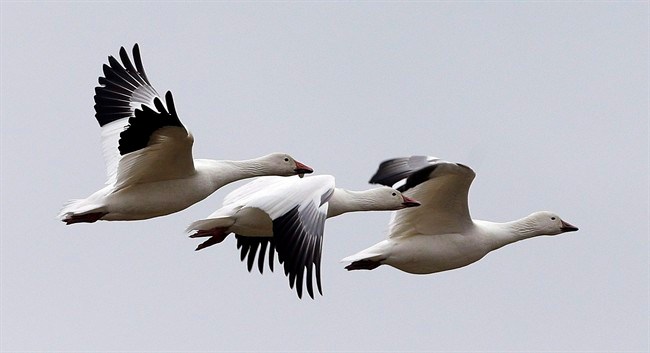
Snow geese tend to nest in large colonies of thousands of individuals, which can overgraze the delicate Arctic tundra they scour for grasses and sedges.
“Grazing and grubbing by geese not only permanently removes vegetation, but also changes soil salinity, nitrogen dynamics and moisture levels,” says Environment Canada. “The result is the alteration or elimination of the plant communities, which in all likelihood will not be restored.”
Suitable nesting grounds are limited and some areas used by the geese are likely to take decades to recover.
Jurisdictions across Canada and in the United States have been moving to increase hunting of the birds in an effort to reduce their numbers. Saskatchewan and Manitoba already have spring hunts; Ontario and Quebec have also tried to increase the harvest.
The current snow goose population is about 1 million birds — roughly twice the number scientists believe nesting grounds can support over the long term.
Alberta, which already has a fall hunt, plans to add a lengthy spring season from March 15 to June 15. It is to include both snow geese and the very similar Ross’s geese.
MacDonnell said the actual length of the hunt will depend on how quickly the winter snow melts and how long the birds stay in Alberta before migrating north.
“Nobody knows when those birds are going to be flying through. They’ll move as the snow line goes further north. They could be here for a while or they could be here for a cup of coffee.”
Details on licensing for the hunt are still being worked out, MacDonnell said.
Hunters will be allowed to shoot up to 50 birds a day, with no limit on how many they can have in their possession.