

Putin AND AUTISM
Think-tank believes Russian president suffers from Asperger's
Advertisement
Read this article for free:
or
Already have an account? Log in here »
To continue reading, please subscribe:
Monthly Digital Subscription
$1 per week for 24 weeks*
- Enjoy unlimited reading on winnipegfreepress.com
- Read the E-Edition, our digital replica newspaper
- Access News Break, our award-winning app
- Play interactive puzzles
*Billed as $4.00 plus GST every four weeks. After 24 weeks, price increases to the regular rate of $19.95 plus GST every four weeks. Offer available to new and qualified returning subscribers only. Cancel any time.
Monthly Digital Subscription
$4.99/week*
- Enjoy unlimited reading on winnipegfreepress.com
- Read the E-Edition, our digital replica newspaper
- Access News Break, our award-winning app
- Play interactive puzzles
*Billed as $19.95 plus GST every four weeks. Cancel any time.
To continue reading, please subscribe:
Add Free Press access to your Brandon Sun subscription for only an additional
$1 for the first 4 weeks*
*Your next subscription payment will increase by $1.00 and you will be charged $16.99 plus GST for four weeks. After four weeks, your payment will increase to $23.99 plus GST every four weeks.
Read unlimited articles for free today:
or
Already have an account? Log in here »
Hey there, time traveller!
This article was published 08/02/2015 (4084 days ago), so information in it may no longer be current.
WASHINGTON — A study from a Pentagon think-tank theorizes Russian President Vladimir Putin has Asperger’s syndrome, “an autistic disorder which affects all of his decisions,” according to the 2008 report obtained by USA Today.
Putin’s “neurological development was significantly interrupted in infancy,” wrote Brenda Connors, an expert in movement-pattern analysis at the U.S. Naval War College in Newport, R.I. Studies of his movement, Connors wrote, reveal “that the Russian president carries a neurological abnormality.”
The 2008 study was one of many by Connors and her colleagues, who are contractors for the Office of Net Assessment (ONA), an internal Pentagon think-tank that helps devise long-term military strategy. The 2008 report and a 2011 study were provided to USA Today as part of a Freedom of Information Act request.
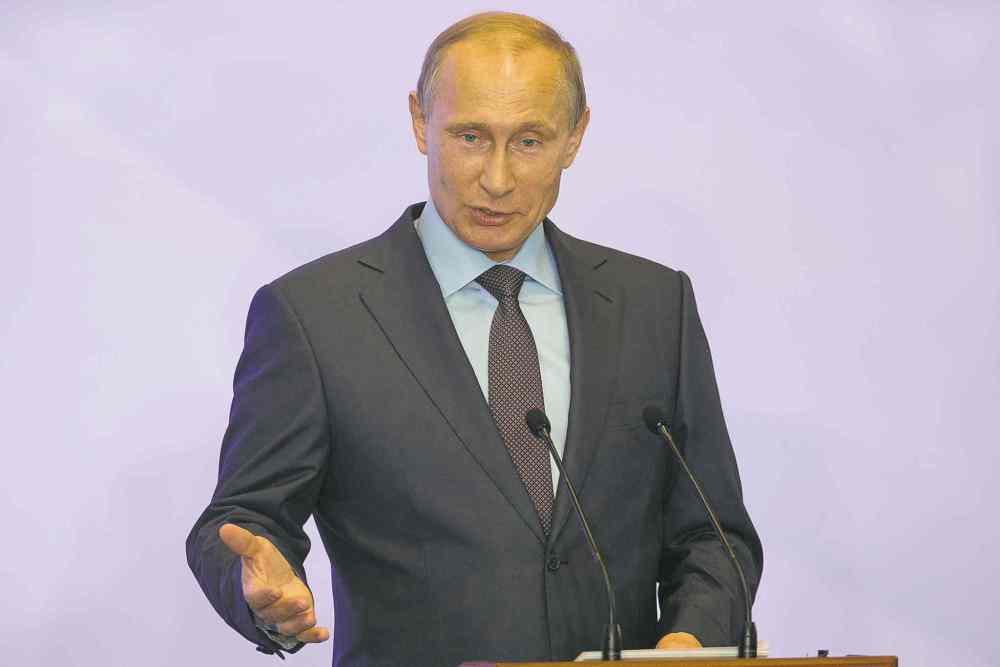
Researchers can’t prove their theory about Putin and Asperger’s, the report said, because they were not able to perform a brain scan on the Russian president. The report cites work by autism specialists as backing their findings. It is not known whether the research has been acted on by Pentagon or administration officials.
The 2008 report cites Dr. Stephen Porges, who is now a University of North Carolina psychiatry professor, as concluding that “Putin carries a form of autism.” However, Porges said Wednesday he had never seen the finished report and “would back off saying he has Asperger’s.”
Instead, Porges said, his analysis was that U.S. officials needed to find quieter settings in which to deal with Putin, whose behaviour and facial expressions reveal someone who is defensive in large social settings. Although these features are observed in Asperger’s, they are also observed in individuals who have difficulties staying calm in social settings and have low thresholds to be reactive. “If you need to do things with him, you don’t want to be in a big state affair but more of one-on-one situation someplace somewhere quiet,” he said.
Putin’s actions have been under particular scrutiny since early 2014, when Russian annexed Crimea from neighbouring Ukraine. Since then, Russia has backed Russian separatists in eastern Ukraine while the United States and European allies have started a series of economic sanctions that have weakened the Russian economy.
USA Today reported in March 2014 about the Office of Net Assessment’s support for the research, but the Pentagon did not release the details of its studies. At the time, Pentagon officials said the research did not reach Defence Secretary Chuck Hagel or his predecessors. That is still true, said Lt.-Col. Valerie Henderson, a Pentagon spokeswoman.
The Office of Net Assessment provides long-range plans for the Pentagon and helps shape future strategy. It has been particularly active in developing the military’s “pivot to Asia,” which has emphasized strategies for dealing with China.
Connors’ team has done several studies on Putin for the ONA beyond those from 2008 and 2011, Henderson said.
Connors’ program is called Body Leads. Military contract records show the Pentagon has paid at least US$365,000 on outside experts to work with her since 2009. The two reports mention other work she and associates have done since Putin’s rise to power, including a 2005 study called An Act of Trust to Move Ahead and studies in 2004-05 and 2008 by movement-pattern-analysis pioneer Warren Lamb.
Both reports, the 2008 study of Putin and a 2011 analysis of Putin and then-president Dimitry Medvedev, cite Putin’s physical difficulties as shaping his decision-making and behaviour. “His primary form of compensation is extreme control,” which “is reflected in his decision style and how he governs,” the report said.
Military analysts first noticed Putin’s movement patterns on Jan. 1, 2000, “in the first television footage ever seen of the then, newly appointed president of Russia,” wrote Connors, who has been studying movement patterns for the Pentagon since 1996.
“Today, project neurologists confirm this research project’s earlier hypothesis that very early in life perhaps, even in utero, Putin suffered a huge hemispheric event to the left temporal lobe of the prefrontal cortex, which involves both central and peripheral nervous systems, gross motor functioning on his right side (head, rib cage, arm and leg) and his micro-facial expression, eye gaze, hearing and voice and general affect,” the report said.
MPA’S HISTORY
MOVEMENT pattern analysis means studying an individual’s movements to gain clues about how he or she makes decisions or reacts to events. First developed in Great Britain in the 1940s by Rudolf Laban, a Hungarian movement analyst and dance instructor, the practice was expanded after the Second World War by Lamb, Laban’s protege and a British management consultant.
Experts believe each individual has a unique “body signature” that tracks how one body movement links to the next. These “posture/gesture mergers” can lead investigators to learn more about a person’s thinking processes and relative truthfulness when combined with the person’s speaking.
Lamb, who died last year at age 90, believed the patterns were unique as DNA to each person.
Since July 2011, the war college had paid more than $230,000 to Richard Rende, a Brown University psychiatrist and specialist in the field of movement-pattern analysis, federal spending records show. Rende received a no-bid contract last year for his work on the Body Leads project.
‘His primary form of compensation is extreme control’
Timothy Colton, a Harvard University expert on Russia, has been paid $113,915 since 2009 for his research with Connors, military contract records show.
Rende, Connors and Colton published in September 2013 a paper in the academic journal Frontiers in Psychology that detailed the uses of movement-pattern analysis to determine leaders’ decision-making processes. Such analysis, they wrote, “offers a unique window into individual differences in decision-making style.”
“The premise of Body Leads,” Connors wrote in 2011, “is that meticulous attention to non-verbal signals — to the physical movement of the body and its parts, as distinct from speech — yield insights into the behaviour of individuals, including for present purposes political leaders.”
TANDEM STYLE
IN 2011, Connors finished a study for Net Assessment on the interactions between Putin and Medvedev, who succeeded Putin as president between 2008 and 2012 and who is now Russia’s prime minister.
The difficulty in getting accurate, real-time information about Russia and its leaders made the use of movement-pattern analysis critical for U.S. officials, Connors wrote. Lamb, she wrote, analyzed Medvedev in the spring and summer of 2008, and they worked together to develop their analysis of the two leaders.
Medvedev, she wrote, is an “Action Man,” who “is inclined to size up situations quickly and to do so in black-and-white terms, shunning subtler shades of grey.”
Putin, on the other hand, “has very different predilections,” and “methodically cycles back to aspects of the problem facing him, continuing revising data to verify his research and confirm his priorities,” the report said.
U.S. officials should present “the information-craving” Putin with “meaty policy research and white papers,” Connors recommended. “Putin the private decision-maker cannot be expected to enter into public exchanges with others on information interpretation or a final course of action.”
Medvedev, she wrote, should be presented with “priorities that both resonate with his values and declared objectives and contain a timeline for commitment, the stage where he is most at home.”
— USA Today