

Famous Five deserve a little more credit

Advertisement
Read this article for free:
or
Already have an account? Log in here »
To continue reading, please subscribe:
Digital Subscription
One year of digital access for only $75*
- Enjoy unlimited reading on winnipegfreepress.com
- Read the E-Edition, our digital replica newspaper
- Access News Break, our award-winning app
- Play interactive puzzles
*Billed as $5.77 plus GST every four weeks. After 52 weeks, price increases to the regular rate of $19.95 plus GST every four weeks. Offer available to new and qualified returning subscribers only. Cancel any time.
Monthly Digital Subscription
$4.99/week*
- Enjoy unlimited reading on winnipegfreepress.com
- Read the E-Edition, our digital replica newspaper
- Access News Break, our award-winning app
- Play interactive puzzles
*Billed as $19.95 plus GST every four weeks. Cancel any time.
To continue reading, please subscribe:
Add Free Press access to your Brandon Sun subscription for only an additional
$1 for the first 4 weeks*
- Enjoy unlimited reading on winnipegfreepress.com
- Read the E-Edition, our digital replica newspaper
- Access News Break, our award-winning app
- Play interactive puzzles
*Your next Brandon Sun subscription payment will increase by $1.00 and you will be charged $17.95 plus GST for four weeks. After four weeks, your payment will increase to $24.95 plus GST every four weeks.
Read unlimited articles for free today:
or
Already have an account? Log in here »
Hey there, time traveller!
This article was published 11/02/2015 (4118 days ago), so information in it may no longer be current.
I walk by them all the time, but I never stop to visit.
I’m talking about the Famous Five — Henrietta Muir Edwards, Emily Murphy, Irene Parlby, Louise McKinney and Nellie McClung — the inimitable women whose challenge to the Supreme Court of Canada in 1929 got women recognized as persons under the British North America Act, and who have been immortalized in bronze by Helen Granger Young on the grounds of the Manitoba Legislative Building.
Despite the falling snow, when everything is still and muted — and the fact these women, with their oxidizing noses and snow-blanketed hats, look, quite literally, frozen in time — there’s a striking liveliness about Young’s statue. You can almost hear their laughter — because you know there would be laughter. They’re just five strong-willed broads, gathered around a table, “getting the thing done and letting them howl,” to loosely paraphrase McClung. The scene will feel familiar to anyone lucky enough to have sat at tables with indomitable ladies, as I have many times. Sure, we might not have been changing government — and there’s invariably more wine involved — but we make things happen.
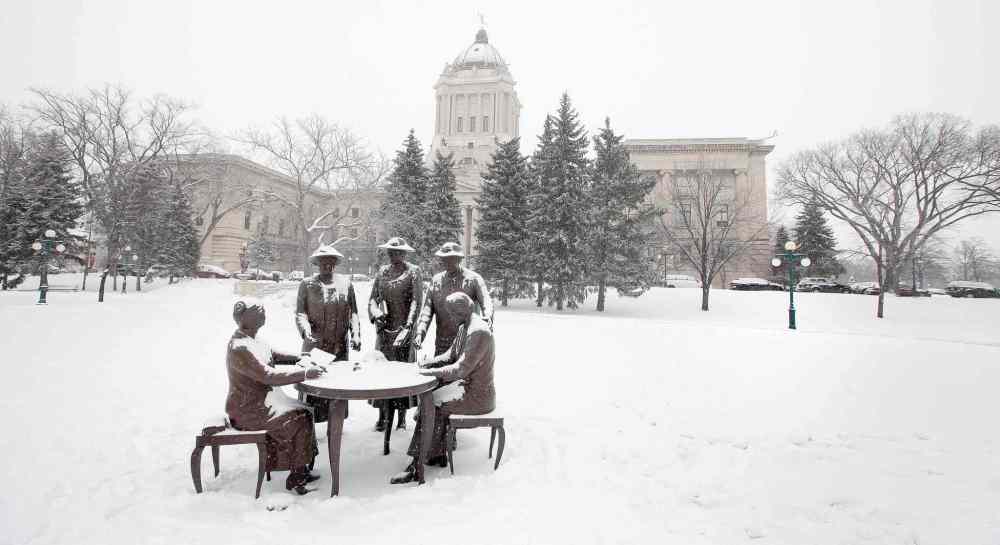
It’s easy to take Young’s statue for granted, just as it’s easy to take the work these women did for granted. McClung was a woman who refused to accept the scraps she was given. She didn’t buy into the idea that “nice women don’t want the vote,” as Manitoba Conservative Premier Sir Rodmond Roblin infamously said. Nellie would play the role of Roblin in her satirical 1914 mock parliament at what is now the Burton Cummings Theatre. The message that nice women — or at least pretty women — don’t want the vote was also echoed throughout anti-suffrage propaganda, the cartoonish misogyny of which would be shocking if it wasn’t so familiar. Just replace “suffragettes” with “feminists” and you get the idea.
In 1916, Manitoba’s women became the first in Canada to get the vote. Well, some of Manitoba’s women, anyway. It would be another 36 years before indigenous people — both men and women — could vote.
The statue at the legislature isn’t the only monument to McClung and the Famous Five. In 2000, after much lobbying, they became the first women to be honoured with a statue on Parliament Hill — a big deal, since that honour was previously reserved for monarchs and dead prime ministers. They also were, briefly, the first women from Canadian history to appear on Canadian currency — the $50 bill — until they were rather unceremoniously replaced by an icebreaker. The Famous Five made it into the new Canadian passports but I expect they’ll eventually be replaced by some other large boat.

As the 100th anniversary of Manitoba women getting the vote edges closer — we’re under a year away — it’d be great to see the Famous Five, and other great Canadian ladies, immortalized on polymer. Victoria’s Merna Foster started a change. org petition in 2013 to get the Bank of Canada to add more women — who aren’t British monarchs — to our currency. Currently, it has 53,643 supporters. A similar campaign worked in the U.K.; Caroline Criado-Perez successfully got Jane Austen on the 10-pound note — mind you, she was viciously attacked on social media in the process. If we can have the Famous Five on the Hill, surely we can get them back in our wallets?
Statues and prominent placement on currency are one way to preserve a legacy, but they are static and almost impossible to interact with (I should know, I tried this afternoon). That’s why I’m eagerly anticipating the Manitoba Museum’s forthcoming exhibit, Nice Women Don’t Want the Vote, which will open in November. Curator of history Roland Sawatzky put out a call for artifacts a few weeks ago, hoping to collect both ephemera from the suffragette movement, but also related everyday things such as dresses, pens and shoes.
“I had no idea what the response would be, but it’s been quite good — and the calls keep coming in,” Sawatzky tells me. He’s received everything from pottery made by Mae Irene Whyte, who marched with Nellie to part of the side of a house from near Portage la Prairie. “On it, someone had written ‘Votes For Women,’ and someone else wrote, ‘No,’ ” Sawatzky said. (Back before there were comment sections, there were old houses.) Sawatzky hopes the exhibit will not only provide context for the events of 100 years ago for people but also serve as a reminder many of the rights we have today still elude many others in our world. The exhibit will run at the Manitoba Museum until February 2016. After that, it will be shown throughout Manitoba before opening at the Canadian Museum of History in Ottawa in November 2016.
Maybe by then we’ll be able to pay our admission with updated currency.
jen.zoratti@freepress.mb.ca
Jen Zoratti is a columnist and feature writer working in the Arts & Life department, as well as the author of the weekly newsletter NEXT. A National Newspaper Award finalist for arts and entertainment writing, Jen is a graduate of the Creative Communications program at RRC Polytech and was a music writer before joining the Free Press in 2013. Read more about Jen.
Every piece of reporting Jen produces is reviewed by an editing team before it is posted online or published in print – part of the Free Press‘s tradition, since 1872, of producing reliable independent journalism. Read more about Free Press’s history and mandate, and learn how our newsroom operates.
Our newsroom depends on a growing audience of readers to power our journalism. If you are not a paid reader, please consider becoming a subscriber.
Our newsroom depends on its audience of readers to power our journalism. Thank you for your support.
Jen Zoratti is a columnist and feature writer working in the Arts & Life department, as well as the author of the weekly newsletter NEXT. A National Newspaper Award finalist for arts and entertainment writing, Jen is a graduate of the Creative Communications program at RRC Polytech and was a music writer before joining the Free Press in 2013. Read more about Jen.
Every piece of reporting Jen produces is reviewed by an editing team before it is posted online or published in print – part of the Free Press‘s tradition, since 1872, of producing reliable independent journalism. Read more about Free Press’s history and mandate, and learn how our newsroom operates.
Our newsroom depends on a growing audience of readers to power our journalism. If you are not a paid reader, please consider becoming a subscriber.
Our newsroom depends on its audience of readers to power our journalism. Thank you for your support.
Advertisement Advertise With Us
Advertisement Advertise With Us