

The map-maker
Artist Réal Bérard creates canoe route masterpieces
Advertisement
Read this article for free:
or
Already have an account? Log in here »
To continue reading, please subscribe:
Digital Subscription
One year of digital access for only $1.44 a week*
- Enjoy unlimited reading on winnipegfreepress.com
- Read the E-Edition, our digital replica newspaper
- Access News Break, our award-winning app
- Play interactive puzzles
*Billed as $5.77 plus GST every four weeks. After 52 weeks, price increases to the regular rate of $19.95 plus GST every four weeks. Offer available to new and qualified returning subscribers only. Cancel any time.
To continue reading, please subscribe:
Add Free Press access to your Brandon Sun subscription for only an additional
$1 for the first 4 weeks*
- Enjoy unlimited reading on winnipegfreepress.com
- Read the E-Edition, our digital replica newspaper
- Access News Break, our award-winning app
- Play interactive puzzles
*Your next Brandon Sun subscription payment will increase by $1.00 and you will be charged $17.95 plus GST for four weeks. After four weeks, your payment will increase to $24.95 plus GST every four weeks.
Read unlimited articles for free today:
or
Already have an account? Log in here »
Hey there, time traveller!
This article was published 16/05/2015 (4179 days ago), so information in it may no longer be current.
How fitting that Réal Bérard, whose canoe-route maps of Manitoba have guided tens of thousands of canoeists, should live on a former riverbank of the ancestral Red River.
Bérard lives on Enfield Crescent in Norwood, where houses on the south side are elevated about four metres above street level.
Why is that? I asked, stepping inside his one-and-a-half storey, clapboard home, built in 1912. It’s because his side of the street is the shore of a former oxbow of the Red River, Bérard explains. The oxbow is a loop of the river that was abandoned when the river ate through riverbank and created a new channel.
You can follow Enfield Crescent as it traces the ancestral Red, and you can also see its other shore one block over on Kitson Street, just off St. Mary’s Road. In its entirety, the former river channel starts at the Norwood Bridge and runs in a U-shape to the north side of St. Boniface Hospital.
“If I sit on my verandah and drink quite a bit of wine, I can see the canoes passing by,” Bérard says.
It’s not surprising Bérard sees imaginary rivers and canoes. He’s been our unofficial Voyageur du Manitoba for more than half a century. He’s charted more rivers than most of us have crossed on bridges.
He has detailed a labyrinth of canoe routes criss-crossing the province, and inspired countless people to discover Manitoba’s wilderness via its river byways. Many of those canoeists are digging out their Bérard canoe routes now, along with their laminated topographic maps, with the arrival of spring.
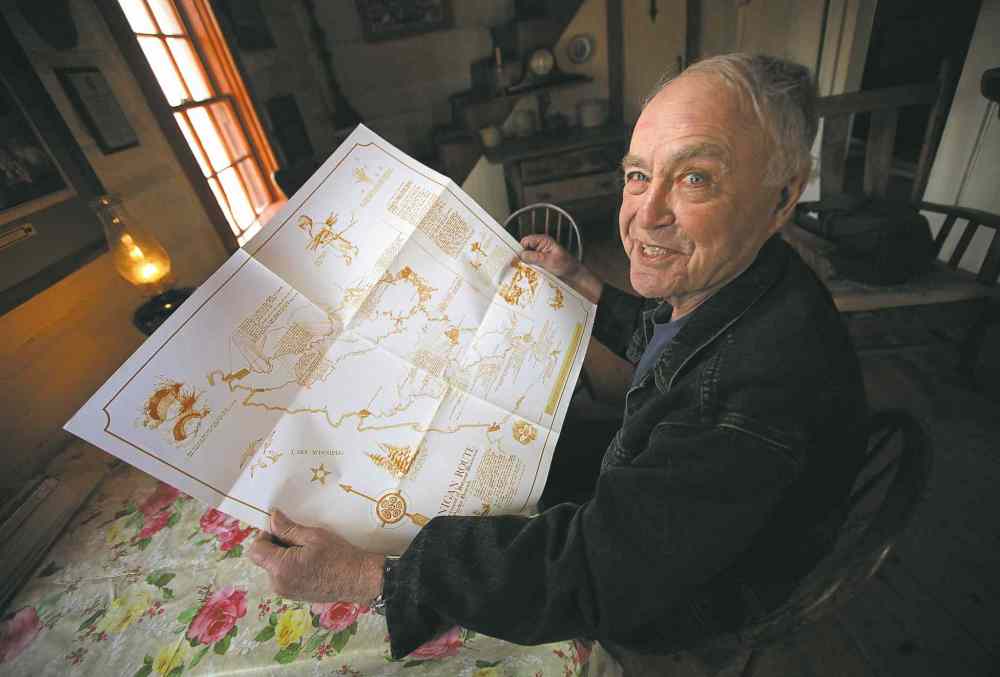
Bérard’s canoe maps don’t just inform. They are regarded as minor works of art. They are filled with Bérard’s illustrations, old trapper songs, botanical notes, recipes, historic anecdotes, biographies, as well as markings for every waterfall, rapid, and portage — measured out in paces like the voyageurs — along Manitoba’s rivers.
Did he ever lose track when counting out the paces on a portage? “That happens,” he says. “Then I B.S.”
His maps have drawn raves from people across the continent.
“His work is an inspiration to me,” said Jonathan Berger of Philadelphia, in a 2012 interview with the Free Press. Berger has paddled the breadth of Canada’s north, and authored the extraordinary book, The Canoe Atlas of the Little North.
What Berger likes about the maps is they are “very trapperly.”
“When I first put my hands on one of his maps, I was transported to the rivers,” Berger elaborated in a recent email. “His drawings give me my aesthetic lens through which I view the North. To me, his work is as significant as the Group of Seven.”
Bérard wouldn’t go that far but he is an artist, working in a variety of mediums. His abstracts look very much like aboriginal art, and most Manitobans have seen them either on the front of provincial park maps, or on provincial park road signs.
“I steal,” Bérard says about his style, borrowed from aboriginal rock art. In oils, his landscapes are typically contoured, like the earth after a fresh snowfall. “I like for things to be moving.”
Then there’s a third facet to Réal Bérard. Bérard has drawn the weekly political cartoon in local French newspaper, La Liberte, for 30 years. He signs the cartoon ‘Cayouche,’ a French term for a small Métis horse. His Cayouche, a white horse, sports a patch over one eye, and surfaces periodically to serve as Bérard’s voice.
His cartoons uphold French Canadian heritage while skewering politicians. In Bérard’s cartoons, Prime Minister Stephen Harper has a Pinocchio-like nose that keeps getting longer, and longer, and lonager, until, in one cartoon, it has transformed into the Keystone pipeline.
“I think the more Mike Duffy talks, the longer Stephen Harper’s nose gets,” Bérard says.
Liberal Leader Justin Trudeau is made to look like a youngster always trying to up-stage Harper. In one cartoon from last fall, when Harper was basking in the discovery of Sir John Franklin’s ship, the HMS Erebus, Bérard portrays Trudeau claiming to have found Noah’s Ark, and holding up a floaty bathtub toy.
“He’s a good guy,” Bérard says of Trudeau, “but I think he would make a good minister of cultural affairs.”
Being a cartoonist is how Bérard came to have a school named after him, âcole Communautaire Réal-Bérard, in St. Pierre-Jolys, where Bérard is from originally. You can see it from Highway 59 as you drive through St. Pierre. Two decades ago, officials decided to let the senior students of the K-12 school pick its name. The kids liked Bérard’s cartoons. Apparently, nobody told teachers Bérard spent a year in reform school, and failed Grade 8 twice, and only passed it on his third try before quitting.
How many people still living have schools named after them? Bérard shrugs, saying he couldn’t understand why he was chosen. “He was shy when they asked him if they could name the school after him,” said friend, Nicole Forest Lavergne. “‘Now I’ll have to be good,’ he said.”
***
Bérard grew up the eighth of 10 children, all boys except the oldest, on a small farm near St. Pierre. His father was a local blacksmith, shoeing horses. Their home was not 20 metres from the Rat River, and Bérard would frequently take a row boat out on the river.
He was always late for school because he was checking his trap line, so he was sent to reform school to complete Grade 7. St. Joseph College, where the Providence College is now, was not officially a reform school but everyone called it that. When he arrived, Bérard got the strap just on reputation. An instructor tapped him on the shoulder in study room on the third floor, took him downstairs, and strapped him. When Bérard returned to the study room, he put on a fake smile for the other students, as if it didn’t hurt, not realizing the teacher was behind him. He was taken downstairs and strapped again. The next year he attended school in St. Boniface for three years — three years of Grade 8 — before packing it in.
“I wanted to go to art school,” he says. His father was none too pleased. “A man going to art school was kind of a sissy.”
His artistic bent is obvious in the way he talks. His conversation is splashed with metaphors, unique ones he makes up himself. I like them so much I later discovered I’d written many of them down in my notebook but not the context.
He talks about needing “a little spice in your Christmas cake” as a metaphor for life; that inspiration “is like fishing. Sometimes you can’t get a nibble, and sometimes it’s so big you can’t bring it in the boat.” Another time he described something as being “like a wet dog. He comes out and shakes the water off but can’t shake it all off.” (I have no idea what he was talking about there, and neither did he when I asked him about it later.)
Bérard’s career as canoe route mapper began in 1962. He was hired as a summer student at Manitoba Natural Resources, now called Manitoba Conservation. He was attending art school at the time. He would study art in Winnipeg, Montreal and Mexico, where he met his future bride, Eva Navarrette.
That summer was very dry with many forest fires. Walter Danyluk was Director of Parks for the province. Danyluk had piloted Lancaster bombers on night-bombing missions over Germany during the Second World War, and was one of many veterans hired to civil service jobs when they returned.
Danyluk made Bérard part of the fire patrol that summer, then told him to go paddle the rivers on the eastern side of Lake Winnipeg with two companions. If they encountered a fire, they were to put it out.
It made no sense other than to give a summer students the experience of a lifetime. Bérard and two others packed fire fighting equipment, including spades and five-gallon pack pumps, into a leaky old freighter canoe, and paddled away. They covered almost 500 kilometres. They paddled north from Wallace Lake, near Bissett, all the way to Berens River, then west to Lake Winnipeg. They never did encounter a fire. Bérard was gone a month, completely cut off from his employer and the outside world. He loved it.
To Bérard, Danyluk was a dream boss, and it’s easy to see why. Danyluk fully supported Bérard’s artistic endeavours. “When I told him I was going to art school, he said to never quit. ‘If you need money, just let me know,’ he told me.”
In addition to canoeing, it was also Danyluk’s idea to promote snow sculpting in Manitoba. Bérard and some other forest rangers, while stationed at Falcon Lake one winter, were instructed to develop a method for making snow sculptures. They made the first ones out of slush and they were awful. They eventually perfected the method, and Danyluk sent the individuals around the province to make sculptures for festivals and promote snow sculpting as an outdoor activity. Bérard helped launch snow sculpting with Festival du Voyageur and The Pas Trappers Festival. He was also sent up to northern schools to teach kids how to make sculptures. Bérard still helps out making snow sculptures for various festivals, including in The Pas.
The forest rangers in Natural Resources in the 1960s were required to keep work diaries, and Bérard kept an intricate record of his 1962 canoe trip. Several years later, during a slack time in winter — Bérard was now a full-time employee –Danyluk approached him again.
Danyluk had another one of his big ideas. He asked Bérard to produce a map of his paddling experience. Bérard had always sketched plants and wildlife he encountered, and he was to include them on the map. Then Danyluk would have them printed and distributed free of charge, as a way to promote Manitoba, and get Manitobans out into the wilderness exploring their province. Bérard’s first map is called the Kautunigan Route, an aboriginal word for “perch” fish, Bérard says.
Bérard would spend the next 20 summer canoeing Manitoba’s waterways, and working on maps in winter, as a salaried government employee. He was living the dream. Some rivers took three or four trips to make a map. For example, he returned to the Kautunigan area to chart the nearby Bloodvein River, too.
Can you imagine the outrage if this was done today? Times have changed, of course, including compensation to the public sector versus the private sector.
* * *
Bérard is one of those rare people who is as comfortable around people as he is with solitude. He thoroughly enjoyed his first job with the province manning fire towers, and read the complete works of Jules Verne and other writers. He has little or no ego, and that’s one of the reasons people are attracted to him.
“He likes to say, ‘I’m one of seven billion,'” says friend, Bernard Bocquel, acting editor of La Liberte, filling in for Sophie Gaulin while she is on maternity leave.
Over the years, Bérard’s had a few companions go “bushy” on him on canoe trips. He means the bush and solitude gets to them, and they breakdown emotionally. In two cases, he had companions who were reduced to bouts of crying and had to be dropped off at the nearest re-entry point to civilization.
Not Bérard. He can go from being in a crowd to living like a hermit at his “shack in the woods,” as he calls it, near St. Pierre.
He showed us the “shack.” It’s a cabin built in 1875 out of oak logs.
Bérard took it apart years ago and, with his brother, built a fieldstone foundation, and re-chinked the logs, using a mix of concrete and granulated Styrofoam. The new chink works remarkably well for keeping out the cold, he says. The exterior is a limestone whitewash, like its original coating, but with latex paint mixed in so it binds better and doesn’t need repainting every year.
By coincidence, it’s also situated on an oxbow, but a much smaller one, off the Rat River.
I was told by others that Bérard like to go to his shack to be alone and paint. People probably like to think of it that way. But he says that isn’t correct. He paints at home. He comes here for solitude, and to read and do research, he says. Sometimes his friends come out. Although it isn’t insulated, he and friends will go out in winter for extended periods. It has no electricity or indoor plumbing (other than a pail, as he points out).
That it’s the dwelling of an interesting mind is very apparent.
Two beehives are out front, each four boxes high. In one, he kept honey bees. In the other, he kept hooch. “No one would look in there,” he explains. The hives are still up but he doesn’t keep bees anymore.
He’s nailed a few old boots to trees. Wrens love nesting in them, he says.
Then there’s his unusual chimes. The chimes are a bunch of old metal pots and pans, basins, a coffee pot and a roaster lid, with the enamel chipped or overtaken by rust, hanging from the branch of an old oak tree. He collected the ancient cookware from old mining sites on his canoe trips. “It’s like a sickness. It’sstupid but it doesn’t hurt anyone,” he says.
Bérard embodies a fading Franco Manitoban identity, says Bocquel. “He represents Manitoba in its early stages” and the French minority that fought to retain their rights and heritage, he says.
“He’s a museum,” says Nicole Forest Lavergne, who sells Bérard’s artwork at (www.galerieriviereauxrats.com).
“You are in for a treat,” she says, when told the Free Press was going to visit him. “He’s unique. There’s only one Réal Bérard.”
His awards and accomplishments are too long to list. He’s illustrated many books, including the later books of writer Gabrielle Roy, whom he got to know when she was still alive, and many books by historian George Lalor.
He’s also sculptor. He sculpted two large statues of the resurrected Jesus Christ, one in St. Boniface Cathedral, and one outdoors at St. Boniface Cemetery, as well as other religious statues at the cathedral.
* * *
He produced 13 maps in total for the province, often charting several rivers per map. They include dominant rivers like the Assiniboine and Winnipeg, northern rivers like the Grass and Hayes, well-known canoeing rivers like the Bird and Manigotagan rivers, and many lesser known canoe routes like the Rat River and Mistik Creek.
The province initially gave the maps away but now charges a nominal fee. It doesn’t have a record of how many maps have been distributed but there are few canoeists not familiar with them.

He is still making maps, too. He just completed one of the Roseau River, starting from Lake of the Woods, through the United States, to the Red River, and then north along the Red to Winnipeg. He asked Manitoba Conservation if it wanted the map to distribute, but it declined. He is now in the process of getting it into local wilderness equipment stores.
And he still canoes. Last year, Bérard, 79, and a friend, an 82-year-old trapper, paddled for a week on a loop that starts on the Nelson River. He is making a map of the little known route, which is an easy canoe trip in the north, accessible by road, and with no rapids. He’s returning to the Nelson River again this summer to finish gathering data for his map. He expects to be away perhaps 10 days or more. He’s going with his grandson this time.
When asked if he isn’t a little old to be making such treks, he responds with a metaphor again.
“I’d rather be eaten by wolves and ravens, than by maggots.”
bill.redekop@freepress.mb.ca