

Haunted by the past
Advertisement
Read this article for free:
or
Already have an account? Log in here »
To continue reading, please subscribe:
Digital Subscription
One year of digital access for only $1.44 a week*
- Enjoy unlimited reading on winnipegfreepress.com
- Read the E-Edition, our digital replica newspaper
- Access News Break, our award-winning app
- Play interactive puzzles
*Billed as $5.77 plus GST every four weeks. After 52 weeks, price increases to the regular rate of $19.95 plus GST every four weeks. Offer available to new and qualified returning subscribers only. Cancel any time.
To continue reading, please subscribe:
Add Free Press access to your Brandon Sun subscription for only an additional
$1 for the first 4 weeks*
- Enjoy unlimited reading on winnipegfreepress.com
- Read the E-Edition, our digital replica newspaper
- Access News Break, our award-winning app
- Play interactive puzzles
*Your next Brandon Sun subscription payment will increase by $1.00 and you will be charged $17.95 plus GST for four weeks. After four weeks, your payment will increase to $24.95 plus GST every four weeks.
Read unlimited articles for free today:
or
Already have an account? Log in here »
Hey there, time traveller!
This article was published 29/06/2015 (4000 days ago), so information in it may no longer be current.
George Washington and Thomas Jefferson owned slaves. John A. Macdonald championed the forced assimilation of First Nations. William Lyon Mackenzie King wrote negatively about Jews, Asians and blacks in his diary.
And Nellie McClung was a proponent of eugenics.
The past haunts us still. Where do we draw the line in honouring leaders whose achievements were noteworthy, yet who shared morals of the era in which they lived that today we regard as repugnant? It is a difficult dilemma with no simple answer.
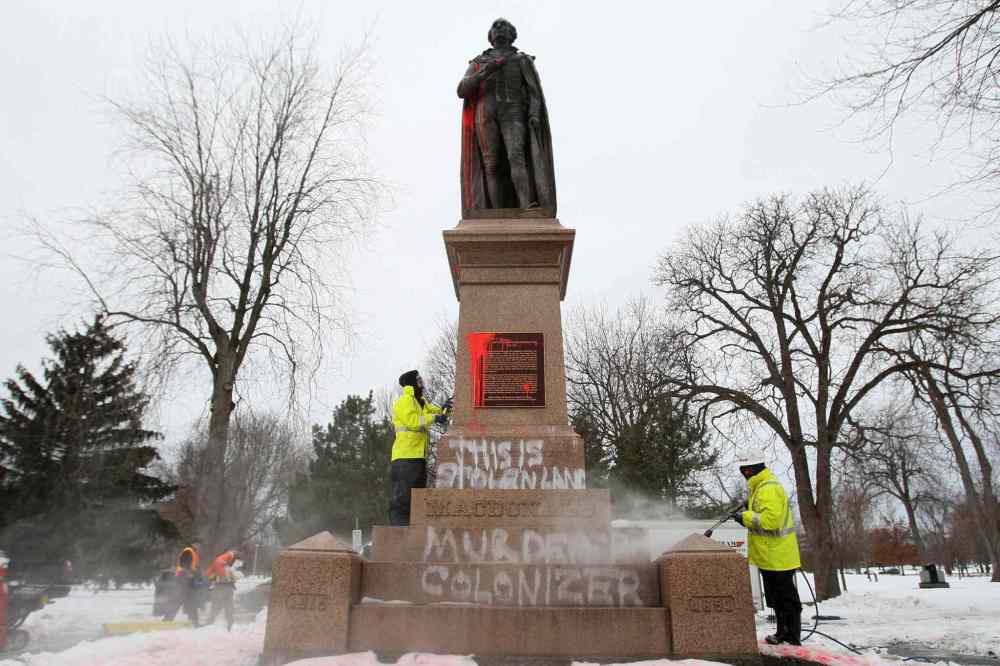
We tend to live in the present, more with an eye on the future than on the past. As such we do not truly appreciate just how much the western world has changed, especially when it comes to moral values and social beliefs. This is not to say that racism and discrimination have vanished, because they surely have not. But at least we acknowledge and condemn these attitudes and actions.
If a person from 1910 could travel forward through time to 2015 and take stock of official government apologies for historic abuses, women’s and gay rights, and the way in which we cherish diversity and equality (female CEOs, gay politicians, Jewish mayors), he or she would think the world has been turned upside down.
In 1910, and for decades after, Canada was a country in which white Anglo-Saxon Protestant values were dominant. Children were taught in schools about the “civilizing” of the natives and the righteous power of the British Empire. Women were second-class citizens who not only could not vote but who had few legal rights; they were expected to obediently serve their husbands.
Immigrants from English-speaking and northern European countries were favoured, while those from southern European countries, as well as Jews, Asians and blacks, were considered degenerate. Anti-Semitism was entrenched in North America and Jews were barred from certain neighbourhoods, clubs, social resorts and professions.
Homosexuality was against the law and regarded as a dangerous perversion.
And advocates of eugenics, a popular mainstream movement until the Nazis took it to the extreme, preached that social engineering was the true-and-tested way to breed a stronger and fitter (white) human being.
From our current perspective these views and norms are offensive. So do we therefore denounce all of our ancestors as evil? Many historians argue you should judge a figure’s attitudes and actions based on the values he or she lived in. Still, it is complicated.
Violence and persecution were wrong in any age. Slavery, for instance, was condemned in the 18th and 19th centuries. Thomas Jefferson acknowledged this in his writings, but he still refused to free a majority of his slaves while he was alive and almost certainly had children with Sally Hemings, a mulatto 30 years his junior.
Adrien Arcand was a rabid anti-Semite, the head of a Quebec fascist party in the 1930s. Though leaders such as King, the longest serving prime minister in Canadian history, deemed Arcand a dangerous fanatic, he, like most English- and French-Canadians, still did not want any Jews as neighbours and believed they were generally “undesirable.” Does that make King as objectionable as Arcand?
In the same vein, it was not that John A. Macdonald and two generations of Canadian politicians wanted to assimilate First Nations and established residential schools to accomplish it — that is how nearly every white North American perceived the issue. No, the reason why residential schools were abhorrent was because politicians and church leaders knowingly turned a blind eye to reports about high disease and death rates, underfunded the schools, cared little for the children’s welfare or needs or their distraught parents, punished children for not assimilating quickly enough and permitted terrible abuse to occur for decades.
That’s wrong today, and it was wrong a century-and-a-half ago.
Judging the legacy of such individuals as King and Macdonald is not easy. We cannot completely ignore their failings or those of a significant personality such as the suffragette McClung.

As we approach the centennial of women achieving the vote in Manitoba, there is sure to be articles and reflections about McClung’s life and her role in this landmark historical event. Recently, the Nellie McClung Foundation in partnership with the Winnipeg Free Press established the “Nellies” to recognize Manitoba women who have made significant contributions in social justice and human rights. In a letter to the editor, as well as in online comments, Free Press readers have pointed out McClung was also a eugenics advocate.
True enough. But for a good 40 years, eugenics, with its selective breeding, campaign for sterilization of the “feeble-minded” and fitter family contests, was integral to mainstream, liberal thinking. That McClung, like hundreds of thousands of others, accepted eugenics makes her a literate woman of her times and all too human.
She wasn’t perfect, but that reality hardly makes her a less-worthy historical figure or undeserving of the accolades bestowed upon her. In this case, as in others, context is everything.
Now & Then is a column in which historian Allan Levine puts the events of today in a historical context.
History
Updated on Monday, June 29, 2015 6:56 AM CDT: Replaces photo