

Cuba stuck in the past when it comes to Internet access
Tangled web
Advertisement
Read this article for free:
or
Already have an account? Log in here »
To continue reading, please subscribe:
Monthly Digital Subscription
$1 per week for 24 weeks*
- Enjoy unlimited reading on winnipegfreepress.com
- Read the E-Edition, our digital replica newspaper
- Access News Break, our award-winning app
- Play interactive puzzles
*Billed as $4.00 plus GST every four weeks. After 24 weeks, price increases to the regular rate of $19.95 plus GST every four weeks. Offer available to new and qualified returning subscribers only. Cancel any time.
Monthly Digital Subscription
$4.99/week*
- Enjoy unlimited reading on winnipegfreepress.com
- Read the E-Edition, our digital replica newspaper
- Access News Break, our award-winning app
- Play interactive puzzles
*Billed as $19.95 plus GST every four weeks. Cancel any time.
To continue reading, please subscribe:
Add Free Press access to your Brandon Sun subscription for only an additional
$1 for the first 4 weeks*
*Your next subscription payment will increase by $1.00 and you will be charged $16.99 plus GST for four weeks. After four weeks, your payment will increase to $23.99 plus GST every four weeks.
Read unlimited articles for free today:
or
Already have an account? Log in here »
Hey there, time traveller!
This article was published 30/08/2015 (3837 days ago), so information in it may no longer be current.
HAVANA — Julio Hernandez is a telecommunications engineer, but like almost anyone else in Cuba who wants to get on the Internet, to do so he must crouch on a dusty street corner with his laptop, inhaling car exhaust and enduring sweltering heat. That privilege costs him US$2 an hour, expensive in a nation where the average state-paid salary is US$20 a month.
The Internet is essential for business, finance, communications and information, but today hasn’t dawned in Cuba, which still has some of the worst Internet access in the world.
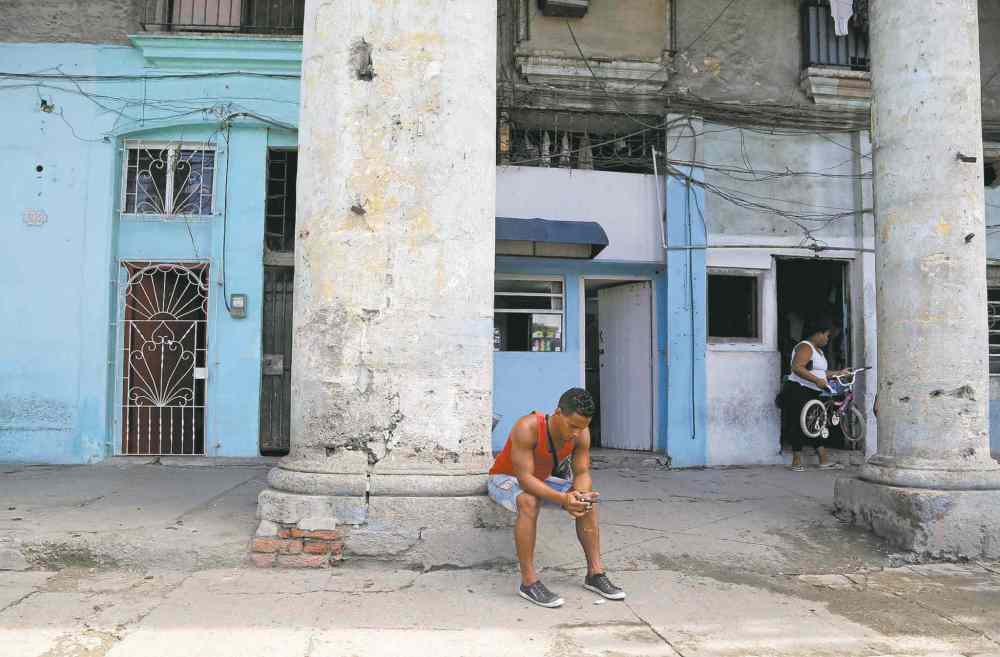
It’s restricted to a few workplaces and fewer than four per cent of homes, including those of senior officials, foreign executives, members of the media, doctors and artists. It’s unavailable on the country’s 1991-vintage 2G mobile-phone network.
President Raù Castro’s government recognizes the problem but faces a dilemma: how to expand Internet access to boost its economy and satisfy its population while maintaining control of information. Cuban officials say at least 50 per cent of the population will have residential Internet service and 60 per cent will have mobile phones by 2020, without saying how they’ll achieve that.
“It’s stupid how much they’ve delayed the inevitable,” said Carlos Alzugaray, a former Cuban ambassador to the European Union and professor at the University of Havana. “Meanwhile, we’re losing ground — we’re in the Stone Age.”
The Internet was used by 30 per cent of Cuba’s population in 2014, according to the International Telecommunication Union, compared with 57 per cent in its ally Venezuela and 87 per cent in the United States.
Key government ministries, joint ventures, universities and hospitals have Internet access, but using it is a slow trip back in time with a dial-up modem. Forget about streaming video or downloading or uploading large files.
For the lucky few with access at work or home, email and an intranet of approved sites downloaded to local servers is as good as it gets. A file that would take four minutes, 10 seconds to download in Cuba would be instantaneous in most North American homes and workplaces.
Broadband service is restricted to top tourist hotels, select business centres and approved media outlets.
That’s slowly starting to change. State-run cyber cafés opened two years ago, charging US$4.50 an hour. Last month, the state telecom monopoly Etecsa created 35 broadband Wi-Fi hot spots across the island, where the public can surf the web, as Hernandez does.
It’s not as fast as broadband in the U.S., but it’s a huge improvement.
“Before this, we had nothing,” said Ramon Mazon, a pizzeria worker who travelled 25 kilometres to an outdoor hot spot in central Havana for a video chat with relatives in the U.S.
“In this day and age, we should have access to Internet a few hours a day, just like we have food ration cards.”
Thanks to new regulations issued by U.S. President Barack Obama as part of his push to normalize relations with Cuba, U.S. companies — from IT giants such as Google Inc. to mobile phone providers AT&T and Verizon Communications — could help lift Cuba out of the Internet Stone Age.
But it’s not clear the Castro government wants a lift from them, at that might risk ceding some control and influence to American companies.
In the rare broadband Wi-Fi oases — the lobbies of top tourist hotels — tech-savvy young Cubans discreetly surf on their phones, circumventing log-on fees as high as US$17 an hour at one Spanish chain hotel. They share Wi-Fi connections or use apps to tap into servers overseas. They’re doing what’s needed to “resolver” — overcome the barriers to online access in Cuba.
Etecsa is testing 3G and 4G cellphone service that could provide Internet access, although there’s been no indication of who could get it.
The Castro government has long blamed the U.S. trade embargo for “blockading” Cuba, condemning it to being a technology backwater. That barrier disappeared in January, when Obama made it legal for U.S. telecommunications companies to do business in Cuba — from erecting mobile phone towers and positioning satellites to laying fibre-optic cable and selling iPhones.
‘To open or not open the Internet is a silly argument because Cuban censors have already lost control of the information people have’
— journalist Fernando Ravsberg
In the past several months, U.S. companies have made quiet visits, assessing the market and weighing opportunities, though none has yet made a deal with the government.
A team from Google visited in June and suggested it could provide antennas to bring high-speed connections to 70 per cent of homes within three years at little to no cost to Cuba, according to journalist Fernando Ravsberg, who writes the blog Cartas Desde Cuba (Letters from Cuba.)
The idea has been met by questions from the Cuban government, suspicious Google may have ties to the U.S. State Department and fearful the U.S. could use the technology to spy on Cuba or scheme for regime change, according to Cuban officials who asked not to be identified. Google spokeswoman Niki Christoff declined to comment.
Harold Cardenas, co-founder of the blog La Joven Cuba (Young Cuba), said he wants an open Internet as soon as possible, but he understands why his government may be hesitant to make deals with U.S. companies.
“If you were in a dispute with your neighbour for 50 years and now you’re friends, it’s a little risky to give your neighbour access to your whole garden, because you might be fighting again tomorrow,” he said. “A country’s telecommunications is a matter of national security.”
At the same time, Cardenas added: “The government has to give Internet to the people or it’s going to lose the hearts and minds of Cuban youth. And that’s already happening.”
Cuba may turn to China for an answer.
A document was leaked last month that purports to be Etecsa’s plan to build residential broadband using Chinese telecommunications companies ZTE Corp. and Huawei Technologies Co. rather than American companies.
Critics say the Castro government is slow-rolling broadband to restrict access to information. Cuba blocks pornography and anti-Castro websites, but there are fewer firewalls than there are in China.
Websites including those of Yahoo, the State Department and blogs such as Cartas Desde Cuba and La Joven Cuba, which sometimes are critical of the government, were easily accessible this month to those who could reach the Internet. Cubans can travel freely now and have access to foreign television via memory sticks sold widely on the black market.
“To open or not open the Internet is a silly argument because Cuban censors have already lost control of the information people have,” Ravsberg said.
— Bloomberg News
History
Updated on Sunday, August 30, 2015 9:39 AM CDT: Tweaked headline