When you wish upon a knish…
Practice makes sort of perfect with tasty filled pastry domes

Advertisement
Read this article for free:
or
Already have an account? Log in here »
To continue reading, please subscribe:

Digital Subscription
One year of digital access for only $205*
- Enjoy unlimited reading on winnipegfreepress.com
- Read the E-Edition, our digital replica newspaper
- Access News Break, our award-winning app
- Play interactive puzzles
*First annual payment billed as $205.00 + GST for one year. This annual subscription will automatically renew at $233.00 + GST every 52 weeks (10% off the regular annual price of $259.35). Offer available to new and qualified returning subscribers only. Cancel any time.
To continue reading, please subscribe:
Add Free Press access to your Brandon Sun subscription for only an additional
$1 for the first 4 weeks*
- Enjoy unlimited reading on winnipegfreepress.com
- Read the E-Edition, our digital replica newspaper
- Access News Break, our award-winning app
- Play interactive puzzles
*Your next Brandon Sun subscription payment will increase by $1.00 and you will be charged $17.95 plus GST for four weeks. After four weeks, your payment will increase to $24.95 plus GST every four weeks.
Read unlimited articles for free today:
or
Already have an account? Log in here »
Hey there, time traveller!
This article was published 28/10/2015 (3939 days ago), so information in it may no longer be current.
I have eaten knishes with great pleasure. My mother-in-law’s knishes are terrific, and in Winnipeg you can buy good versions at many delis and bakeries.
I have never made them, however, until this week, in response to Annette Mowat’s request for a good basic recipe. Thanks to Linda Snider from Glenboro for her offering.
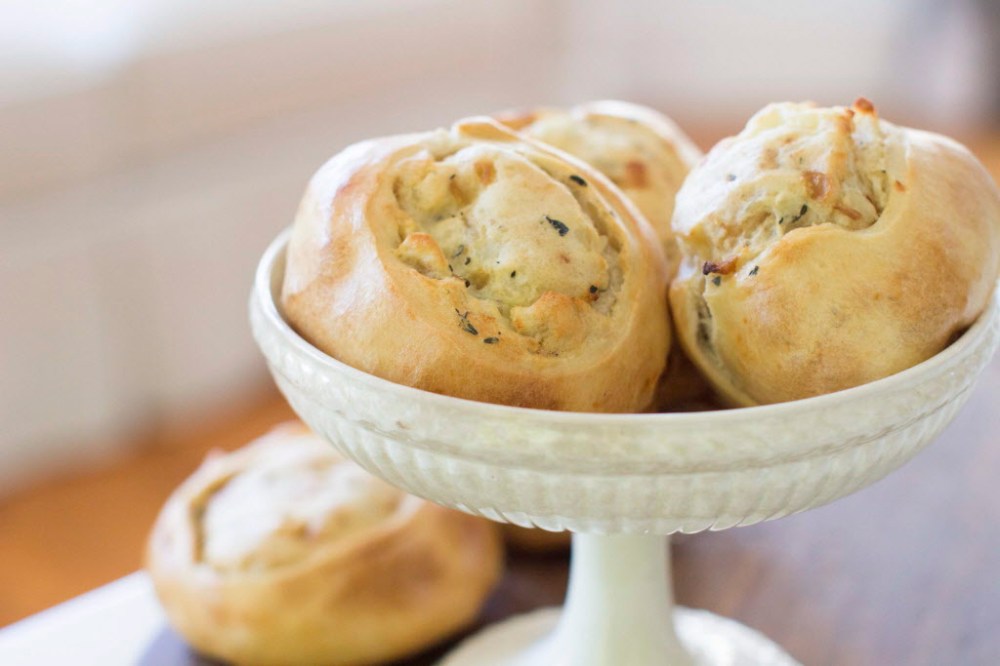
Knishes are fiddly, and it takes a bit of practice to get the hang of rolling, filling and forming. (This is the kind of recipe that’s best to learn hands-on from a mother or aunt, if at all possible.) Still, I somehow ended up with recognizably knish-like results — tasty little pastry domes wrapped around two different potato fillings.
If you can help with a recipe request, have your own request, or a favourite recipe you’d like to share, send an email to recipeswap@freepress.mb.ca, fax it to 204-697-7412, or write to Recipe Swap, c/o Alison Gillmor, Winnipeg Free Press, 1355 Mountain Ave., Winnipeg, MB, R2X 3B6. Please include your first and last name, address and telephone number.
Potato and Sauerkraut Knishes
Dough:
625 ml (21Ñ2 cups) all-purpose flour
5 ml (1 tsp) baking powder
2 ml (1/2 tsp) salt
1 egg
125 ml (1/2 cup) vegetable oil
125 ml (1/2 cup) water
5 ml (1 tsp) white vinegar
Filling:
750 g or about 11Ñ2 pounds (about 3 medium) Yukon Gold potatoes, peeled and quartered
175 ml (3/4 cup) sauerkraut
30 ml (2 tbsp) vegetable oil
2 ml (1/2 tsp) caraway seeds
1 ml (1/4 tsp) salt
Freshly ground black pepper
To finish:
1 egg yolk, beaten
5 ml (1 tsp) water
Making the dough: In a large bowl, whisk together flour, baking powder and salt. In a small bowl, whisk together egg, oil, water and vinegar. Pour wet ingredients over dry ingredients and stir to combine. Remove dough from bowl and knead on a lightly floured surface until smooth, about 2 minutes. Place the dough back in the bowl, cover it with plastic wrap and set aside for at least 45 minutes.
Meanwhile, make the filling: In a medium pot of boiling salted water, cook potatoes until tender, about 12-20 minutes, depending on size. Drain well, return to pot and mash well. Remove mashed potatoes to a medium bowl to cool slightly and then add sauerkraut, oil, caraway seed, salt and pepper. (If sauerkraut is very wet, drain first in a fine-mesh sieve for a few minutes.)
Assemble knishes: Preheat oven to 190 C (375 F) and line a large cookie sheet with parchment paper. If the dough has released beads of oil, lightly knead again. Divide the dough in half. On a floured surface, roll the first half of the dough into a very thin rectangle, roughly 25 by 30 cm (10 by 12 inches).
Place half the potato-sauerkraut filling in a 5 by 5 by 5 cm (2 by 2 by 2 inches) log across one long end of the dough. Roll up longways, not too tightly, so that filling has been wrapped twice in dough. Trim any unrolled length of dough. Repeat the process with the second half of dough and second half of filling. (You might have a small amount left over.)
Trim the ends of the logs so that dough is even with the filling. Then, make indentations to divide the logs into equal portions, roughly every 7.5 cm (3 inches) for four large knishes from each log or every 5 cm (2 inches) for six smaller knishes from each log. Cut the logs with a sharp knife at each mark, and pinch together one end of each portion to form a sealed base. Gently using your palm, flatten the top of the knish slightly so that it forms a squat, rounded shape.
Pinch together the top to seal — indenting with a small dimple to keep them from opening while baking — or gently press the dough over the filling but leave a gap. Arrange knishes on prepared baking sheet so they don’t touch. In a small bowl, whisk together egg yolk and water and brush each knish. Bake for 30-45 minutes, rotating at the halfway point, until an even golden brown. (Baking time will depend on size.)
Tester’s notes: A tasty filling, with a tender, flaky dough. The dough was surprisingly easy to work with, except for its tendency to shrink back while being rolled out. (Some knish experts suggest stretching can be minimized with a longer rest time — about two hours, in fact — and three sessions of kneading spread through that time.)
I know I’m a bit of a parchment-paper junkie, but it really helps with this recipe: The egg wash tends to get all over, so the paper will keep the knishes from sticking and will simplify clean-up.
If you want to be really old world, you can replace the vegetable oil in the dough with shmaltz (rendered chicken fat). Among knish lovers, there are doctrinal differences about whether to seal them or leave them open. Another point of controversy is whether to eat them with hot mustard, which some people swear by and others find baffling.
Potato and Onion Knishes
Dough:
1 egg
125 ml (1/2 cup) warm water
60 ml (1/4 cup) vegetable oil
5 ml (1 tsp) white vinegar
2 ml (1/2 tsp) salt
About 500 ml (2 cups) all-purpose flour
Filling:
1.25 kg (21Ñ2 lbs) Russet potatoes, peeled and cubed
60 ml (1/4 cup) vegetable oil
1 large onion, chopped fine
Salt and pepper, to taste
To finish:
1 egg yolk, beaten
5 ml (1 tsp) water
Making the dough: In a large bowl, whisk together egg, water, oil, vinegar and salt. Gradually add in flour until dough is stiff enough to remove from bowl and then turn out onto a lightly floured surface and knead for 5 minutes. Let dough rest, for at least 10 minutes, and more if possible.

Making the filling: In a large pot of boiling salted water, cook potatoes until soft, about 8-12 minutes, depending on size. Drain, return to pot, mash well and then remove to a large bowl. Meanwhile, in large skillet over medium heat, add oil and cook onions until softened and translucent. Mix onions and their oil into the mashed potatoes and season generously with salt and pepper.
Assembling the knishes: See above recipe for directions on rolling out dough and filling and forming knishes.
Make egg wash by whisking egg yolk and water in small bowl. Brush knishes with egg wash and bake on baking sheets lined with parchment paper at 190 C (375 F) for 30-45 minutes or until golden brown. (Baking time will depend on size.)
Tester’s notes: I love the filling in this version. If you have the time, I would recommend really caramelizing the onions by lowering the heat slightly and cooking for at least 30-45 minutes. It will add deeper colour and richer flavour. Also, while that 60 ml (1Ñ4 cup) seems like a lot of oil, remember that it will be used to moisten and flavour the potato mix. This version yields a thinner, crisper pastry, which is a little less forgiving, so make sure it isn’t too thick and don’t overbake it. For a flakier pastry, use the first recipe.
Studying at the University of Winnipeg and later Toronto’s York University, Alison Gillmor planned to become an art historian. She ended up catching the journalism bug when she started as visual arts reviewer at the Winnipeg Free Press in 1992.
Our newsroom depends on a growing audience of readers to power our journalism. If you are not a paid reader, please consider becoming a subscriber.
Our newsroom depends on its audience of readers to power our journalism. Thank you for your support.
Studying at the University of Winnipeg and later Toronto’s York University, Alison Gillmor planned to become an art historian. She ended up catching the journalism bug when she started as visual arts reviewer at the Winnipeg Free Press in 1992.
Our newsroom depends on a growing audience of readers to power our journalism. If you are not a paid reader, please consider becoming a subscriber.
Our newsroom depends on its audience of readers to power our journalism. Thank you for your support.
Advertisement Advertise With Us
Advertisement Advertise With Us
History
Updated on Wednesday, October 28, 2015 7:35 AM CDT: Photo changed, format fixed.