

Gen-X in cabinet
Younger cabinet, gender balanced and ethnically diverse
Advertisement
Read this article for free:
or
Already have an account? Log in here »
To continue reading, please subscribe:
Digital Subscription
One year of digital access for only $1.44 a week*
- Enjoy unlimited reading on winnipegfreepress.com
- Read the E-Edition, our digital replica newspaper
- Access News Break, our award-winning app
- Play interactive puzzles
*Billed as $5.77 plus GST every four weeks. After 52 weeks, price increases to the regular rate of $19.95 plus GST every four weeks. Offer available to new and qualified returning subscribers only. Cancel any time.
To continue reading, please subscribe:
Add Free Press access to your Brandon Sun subscription for only an additional
$1 for the first 4 weeks*
- Enjoy unlimited reading on winnipegfreepress.com
- Read the E-Edition, our digital replica newspaper
- Access News Break, our award-winning app
- Play interactive puzzles
*Your next Brandon Sun subscription payment will increase by $1.00 and you will be charged $17.95 plus GST for four weeks. After four weeks, your payment will increase to $24.95 plus GST every four weeks.
Read unlimited articles for free today:
or
Already have an account? Log in here »
Hey there, time traveller!
This article was published 06/11/2015 (4001 days ago), so information in it may no longer be current.
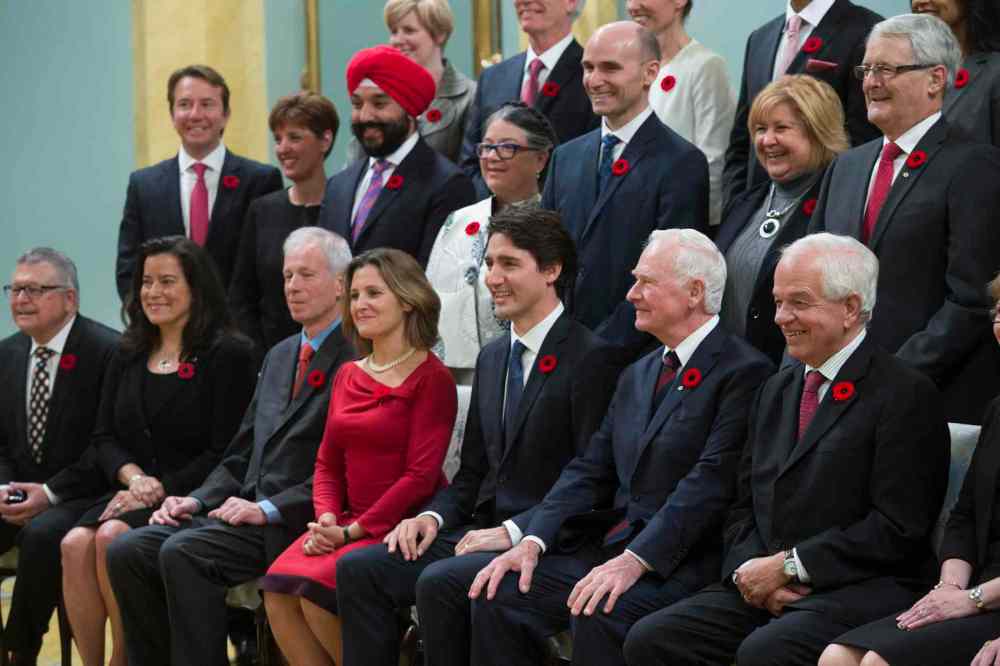
Prime Minister Justin Trudeau and the 30 ministers sworn in to his new cabinet represent the face of Canada like never before.
For the first time ever, half of the people sitting at the cabinet table are women.
Diversity is also evident. An indigenous woman, Jody Wilson-Raybould, is our country’s new justice minister. A Sikh military commander and former police officer, Harjit Singh Sajjan, is the new minister of national defence. A visually impaired former paralympian, Carla Qualtrough, is the new minister of sport. There are four Canadians of Indo-Canadian descent at the cabinet table, as well as a first-generation immigrant from Afghanistan and the second quadriplegic MP ever elected to the House of Commons.
Leading up to the cabinet unveiling, there was a great deal of focus on the fact that the prime minister mandated 50 per cent of the cabinet would be female. This led to stupid criticisms from some quarters that this would be Canada’s first “affirmative action” cabinet, with the implication that more qualified (read: old, white and male) MPs would be left on the sidelines while others lucky enough have two X chromosomes would become ministers. Gender equality is an extremely important step, especially considering that women continue to be underrepresented in the House of Commons and provincial legislatures.
Beyond crafting a gender-balanced and ethnically-diverse cabinet, the other thing Trudeau did by bringing in so many new faces was to bring in a significant number of younger people to his cabinet. At an average age of 51.2 years, the Trudeau cabinet is two years younger than Stephen Harper’s final Conservative ministry, which had an average age of 53.1 years.
Although there are a number of old hands holding senior portfolios in the Trudeau cabinet, the bulk of the new ministers are from Generation X (born between 1965 and 1984). There is even a true representative of the Millennial generation (those born between 1984 and 2004) in Democratic Reform Minister Maryam Mossef. She is only 30 years old and will be tasked with overseeing potential changes to Canada’s first-past-the-post voting system.
Stephen Harper’s cabinet also had its fair share of young stars, including Manitoba-born Michelle Rempel, Pierre Poilievre and James Moore. But the majority of Harper’s cabinet comprised baby boomers and those from the older generation, and it showed to some extent in its policy priorities, such as income-splitting for seniors. This was also perhaps a function of the fact the Conservatives typically drew higher levels of support from older adults, but in many ways the Harper government’s outlook very much reflected the values and priorities of the boomer generation.
Cabinets are like a board of directors for the country. They set the priorities of government and oversee the implementation of these policy directives. A cabinet that includes a higher proportion of Gen-X and millennial members is likely to look at issues through the lens of their generational life experiences. This means they will have a different and more direct understanding of what it is like to struggle through difficult economic periods and to deal with the consequences of the complex, far-reaching global problems that are affecting our time, such as climate change and terrorism.
The Baby Boom generation has profoundly shaped public policy in Canada for the past 50 years. The country’s social welfare system assisted them through the creation of new hospitals, schools and universities in the 1960s and 1970s. This generation was more economically established than Gen-Xers when the brutal recession of the early 1990s hit, and it has experienced a tremendous increase in wealth by being able to buy homes at relatively affordable prices and invest for their retirement. Now, in their older years, the boomers stand to do relatively well while younger generations are almost guaranteed to have a worse quality of life thanks to a weak economy with uncertain job prospects, skyrocketing housing prices (particularly in Toronto and Vancouver) and crumbling transportation infrastructure — all made worse by the cost of dealing with the effects of climate change.
Having people at the cabinet table who have lived through these challenges in a different way — and who understand the realities Canadians under the age of 50 are facing today and will face in the future — will go a long way towards creating policies that can deal with these problems.
Having younger people as ministers also sends an important message to younger adults, many of whom are less likely to vote and be generally disengaged from politics. If a 30-year-old sees other 30-year-olds making decisions that may benefit them, it sends a powerful message and may encourage higher levels of political participation.
Trudeau, who at 43 is one of the youngest people at the cabinet table, pushed this theme ever further by awarding himself the symbolic youth portfolio and engaging in a Google Hangout with school children following the swearing-in ceremony. On a day laden with symbolism, the new prime minister sent a clear message the priorities of younger Canadians will be reflected by their new government.

Curtis Brown is a late Gen-X/early millennial who works as the vice-president of Probe Research, a Winnipeg-based market research firm. His views are his own.
curtis@probe-research.com
Twitter: @curtisatprobe