

Stolen, burned, forgotten, ignored: the colourful history of the CFL’s top trophy
Advertisement
Read this article for free:
or
Already have an account? Log in here »
To continue reading, please subscribe:

Digital Subscription
One year of digital access for only $205*
- Enjoy unlimited reading on winnipegfreepress.com
- Read the E-Edition, our digital replica newspaper
- Access News Break, our award-winning app
- Play interactive puzzles
*First annual payment billed as $205.00 + GST for one year. This annual subscription will automatically renew at $233.00 + GST every 52 weeks (10% off the regular annual price of $259.35). Offer available to new and qualified returning subscribers only. Cancel any time.
To continue reading, please subscribe:
Add Free Press access to your Brandon Sun subscription for only an additional
$1 for the first 4 weeks*
- Enjoy unlimited reading on winnipegfreepress.com
- Read the E-Edition, our digital replica newspaper
- Access News Break, our award-winning app
- Play interactive puzzles
*Your next Brandon Sun subscription payment will increase by $1.00 and you will be charged $17.95 plus GST for four weeks. After four weeks, your payment will increase to $24.95 plus GST every four weeks.
Read unlimited articles for free today:
or
Already have an account? Log in here »
Hey there, time traveller!
This article was published 28/11/2015 (3948 days ago), so information in it may no longer be current.
It’s easily one of the most recognizable and beloved Canadian icons of all time.
We’re talking about the Grey Cup, the famed silver chalice that symbolizes supremacy in the Canadian Football League.
For most Canadians, however, the CFL’s coveted trophy has come to represent much more than just a football game.
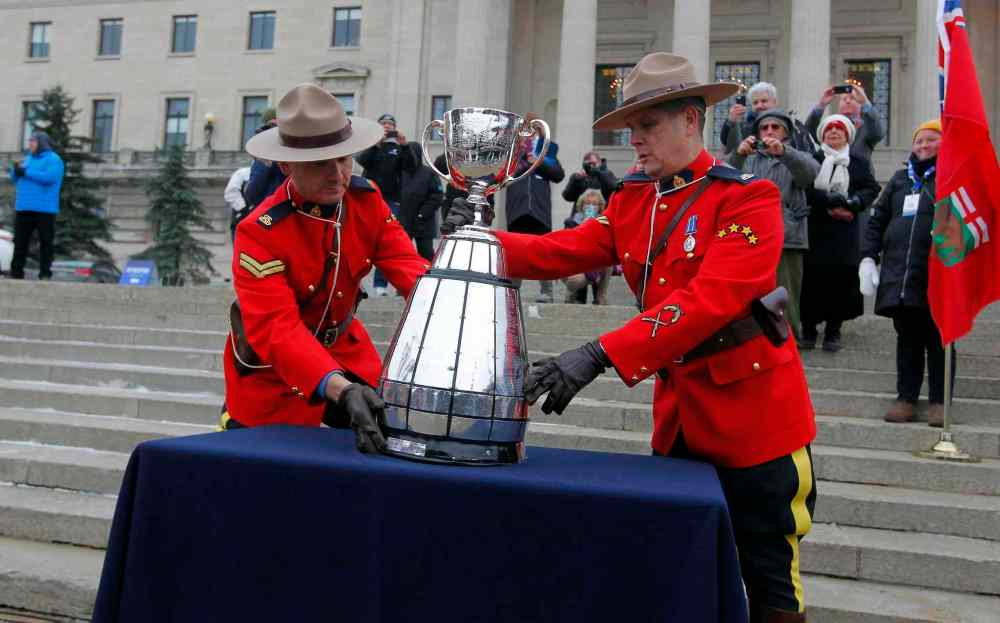
Tightly sewn into our cultural fabric for more than 100 years, it’s a shining beacon that beckons Eastern Canada and Western Canada to join together in an annual ritual — and then bash each other’s brains out on a frozen field.
So, OK, it’s mostly about football, but it’s also a beloved bit of shiny silverware that young Canadian athletes dream of getting their hands on.
The thing is, getting your greasy mitts on the Grey Cup is a big no-no in the eyes of the whitegloved volunteers who guard the trophy on its travels around Canada.
“If you touch the Cup without the gloves, oil from your fingers can tarnish the silver,” Cup escort Dan Maloney explained in June when the trophy visited the Free Press to promote Sunday’s 103rd Grey Cup game in Winnipeg.
“When we travel with it, we treat it like a museum piece, so we don’t want people picking it up and touching it. The more it gets handled, the more easily it gets broken.”
But you already knew that, didn’t you? Well, Super Fan, here’s the Top Five Things You Didn’t Know About The Grey Cup:
5) Promises, Promises
You’d think it would be hard to forget something as important as the Grey Cup, wouldn’t you? Well, you could not be more wrong. Commissioned in 1909 by governor general Albert Grey, the fourth Earl Grey, it was meant to be awarded to Canada’s top senior hockey team, but Sir Montague Allan beat Earl Grey out of the starting blocks when he donated the Allan Cup for that purpose. Which prompted our governor general to offer the trophy for the “Canadian Dominion Football Championship.”
On Dec. 4, 1909, the first Grey Cup game was held, with the University of Toronto Blues defeating the dreaded Parkdale Canoe Club 26-6 before 3,800 fans at Toronto’s Rosedale Field. So how did the first Grey Cup champions feel about this sparkly new bauble?
Well, they didn’t feel anything, because, as it turns out, getting the trophy made had kind of slipped Earl Grey’s mind. “Having decided to offer the trophy, the governor general promptly forgot about his promise and the Cup was not ready to present to the first senior Dominion Champions, the University of Toronto, in December 1909,” sniffs the website of the Canadian Football League Hall of Fame.
“Two weeks prior to the championship game, a series of letters was exchanged and a hurried order placed with the silversmiths (Birks Jewellers) to produce a sterling silver cup, on a wooden base, total cost: $48. Three months later, in March 1910, the Grey Cup was presented to the University of Toronto.” There is no mention of whether the university remembered to send a thank-you card.
4) Thanks For The Invitation
You probably haven’t heard about Winnipeg’s big Grey Cup victory in 1924. Want to know why not? Because THEY DIDN’T EVEN BOTHER GOING TO THE GAME!
Historically speaking, Western Canada started competing for the Cup in 1921, when the Edmonton Eskimos were hammered 23-0 by the Toronto Argonauts in the ninth Cup matchup and the first shutout in Cup history. In 1924, the Winnipeg Victorias had an undefeated season — beating such foes as the Winnipeg Tammany Tigers and the University of Manitoba Varsity — and became the first Winnipeg team to qualify for the national championship.
What happened next? According to the CFL Hall of Fame: “The Winnipeg Victorias became embroiled in a massive dispute, which eventually prevented them from competing. They could not agree which railway to travel on; the players favoured CNR and the club executive chose CPR. The feud dragged on until the executive determined the club would forgo the contest. The players decided to go anyway, and the executive informed them they would not be allowed to use the team name.”
By the time things were ironed out, it was too late to go. For the record, in the 12th Cup game in 1924, Queen’s University defeated one of the more colourful squads in Canadian history, Toronto’s Balmy Beach Beachers, 11-3. “Queen’s became just the second team to win three consecutive Grey Cup titles,” the CFL site notes. “It would mark the end of an era for the Intercollegiate Union, as the students from Kingston were the last university team to win the coveted trophy.”
3) Does Anyone Smell Smoke?
It was bitterly cold in Ottawa in December 1939 when the Blue Bombers squared off against the Rough Riders in the 27th edition of the Grey Cup. Back in 1935, Winnipeg became the first team to bring a Grey Cup championship to the West when our side, then known as the Pegs, beat the Hamilton Tigers 18-12. In 1939, Winnipeg squeaked by the Ottawa Rough Riders 8-7 at Lansdowne Park on a last-minute punt single by Art Stevenson.
His last-gasp heroics gave the Winnipeg squad its second Cup championship, and first under the name city fans have come to love — Blue Bombers. But you already knew that, right? What you might not have known is that, according to several online reports, the field was rock-hard thanks to freezing temperatures, and in an effort to soften the turf, the groundskeepers poured 400 gallons of gasoline on the field and lit it ablaze.
“But sub-zero overnight temperatures rendered the field a frozen block by morning,” recalls CBC.ca. “The playing conditions were so bad at the 1939 Grey Cup, Ottawa was not allowed to host the championship again until 1967.” Speaking of fire, eight years later, in 1947, the iconic trophy had a fiery close call while on display at the Toronto Argonaut Rowing Club. That was the year the Argonauts nipped the Bombers 10-9 in the Cup. By the way, the 1947 Argos were the last all-Canadian team to capture the Cup.
“The teams almost didn’t have a trophy to play for,” recalls CFL.ca. “Earlier in the year, a fire gutted the Toronto Argonaut Rowing Club. All the trophies in the building were either melted or burnt by the flames, except for one. The Grey Cup got caught on a large nail, and never fell to the floor. Although it received minor damage, the mug survived.” It was the first official nail-biter in Cup history.
2) Somebody Call 911
It’s hard to put a price on history, but the value of our beloved sterling silver mug is currently pegged at about $75,000, up from its original purchase price of $48 in 1909. So it would be a nice addition to your bar in the basement. Not that you would ever snitch a piece of Canadian history, would you?
The thing is, the Cup has been stolen at least three times. It disappeared for three days in 1967 when it was taken from the Hamilton Tiger-Cats as a prank. In December 1969, it was swiped from the offices of the Ottawa Rough Riders.
The thieves famously tried to ransom the trophy, but the CFL refused to play ball and made plans to replace the original with a duplicate. In the end, an anonymous phone call led to the recovery of the trophy two months later in a locker at Toronto’s Royal York Hotel.
More recently, in November 1997, the Canadian Press notes former Toronto kicker Mike Vanderjagt lost the Cup when he took it to a bar in Oakville, Ont., where it was stolen. “Early the next morning, a college student who reportedly joked she’d give $100 to have the Cup in her apartment found it in her kitchen,” CP noted. Thievery we can almost understand, but misplacing it is a bit hard to swallow.
The First World War led to the cancellation of the championship game from 1916 to 1918, during which time the Cup got lost. According to the Montreal Gazette, the trophy was later rediscovered as “one of the family heirlooms” of an employee of the Toronto trust firm where it had been sent for storage.
In 1998, after the Calgary Stampeders beat the Tiger-Cats 26-24 in Winnipeg, the victors almost fled our city without the Cup in tow. It seems the Stamps returned to their hotel for a reception after the game, then headed to the airport to fly home, leaving the Cup at the hotel. “As panic set in, salvation arrived in the form of the trophy, which someone had placed on a bus headed to the airport,” according to the Canadian Press. Which is a shame, because it would have looked great on our bar.
1) It’s Nice To Touch, It’s Nice To Hold, But If It Breaks
It seems bones aren’t the only things that get broken on a football field.
Over its lengthy history, the Cup has been sent to the ER on more than one occasion. In 2006, for instance, this columnist was rejoicing in the stands when his beloved B.C. Lions beat Montreal in Winnipeg. We looked on in shock when offensive lineman Kelly Bates lifted the Cup above his head during post-game celebrations and (yikes!) the trophy broke in two. A local welder later reattached the Cup to its base.
That was one of about six times the Cup has been injured in postgame celebrations. An Edmonton player accidentally dropped it in 1978, then an Eskimo sat on it in 1987 and, in 1993, Eskimos offensive lineman Blake Dermott (Why not?) head-butted the iconic chalice. More recently, one of the handles broke off as the Argos celebrated their 2012 victory.
Last year, the Stamps were so excited after beating Hamilton 20-16, they broke the historic silverware again. “I grabbed it and was excited and all of a sudden, it got a little loose,” chirped Calgary linebacker Juwan Simpson at the time.
“Some glue and some duct tape and it’ll be good.”
Fortunately, the CFL commissioned a replica in 2008. Even more harrowing was the Cup’s escape from a missile attack during a 2008 visit to the Canadian Forces base in Kandahar, Afghanistan.

While there, according The Canadian Press correspondent Dan Ralph, the base came under attack from the Taliban.
“The air sirens went off just like you hear it, you have to grab the ground for 90 seconds, they blow a whistle and you run into a cement bunker,” Mark DeNobile, executive director of the CFL Hall of Fame, recalled in 2012.
“After all that, (country singer) George Canyon went back on and played, but the Cup stayed on stage throughout the attack.” Two years later, the Cup returned and endured another close call. “So the Grey Cup is 2-for-2 in Kandahar,” DeNobile boasted to CP.
Our football playing days are done, but one day, even if it’s just in our dreams, we plan to hoist that beautiful trophy over our swollen head while screaming with joy. We promise to wear white gloves, because we’d hate to leave a mark.
doug.speirs@freepress.mb.ca
Related Articles
No fan, I’m but still part of the tribe
_2.jpg?w=100)
_2.jpg?w=100)



Advertisement Advertise With Us
Advertisement Advertise With Us