

Stemming the violence
Legislation would make it easier for victims to obtain protection orders
Advertisement
Read this article for free:
or
Already have an account? Log in here »
To continue reading, please subscribe:

Digital Subscription
One year of digital access for only $205*
- Enjoy unlimited reading on winnipegfreepress.com
- Read the E-Edition, our digital replica newspaper
- Access News Break, our award-winning app
- Play interactive puzzles
*First annual payment billed as $205.00 + GST for one year. This annual subscription will automatically renew at $233.00 + GST every 52 weeks (10% off the regular annual price of $259.35). Offer available to new and qualified returning subscribers only. Cancel any time.
To continue reading, please subscribe:
Add Free Press access to your Brandon Sun subscription for only an additional
$1 for the first 4 weeks*
- Enjoy unlimited reading on winnipegfreepress.com
- Read the E-Edition, our digital replica newspaper
- Access News Break, our award-winning app
- Play interactive puzzles
*Your next Brandon Sun subscription payment will increase by $1.00 and you will be charged $17.95 plus GST for four weeks. After four weeks, your payment will increase to $24.95 plus GST every four weeks.
Read unlimited articles for free today:
or
Already have an account? Log in here »
Hey there, time traveller!
This article was published 01/12/2015 (3903 days ago), so information in it may no longer be current.
The Selinger government has introduced legislation to make it easier for victims of domestic violence to obtain protection orders and to require the subjects of such orders to surrender firearms they may possess.
The measures come in the wake of two high-profile deaths in the province this fall.
Manitoba has the second-highest rate of spousal homicide in Canada, next to Saskatchewan, Attorney General Gord Mackintosh said Monday in announcing several administrative and proposed legislative changes.
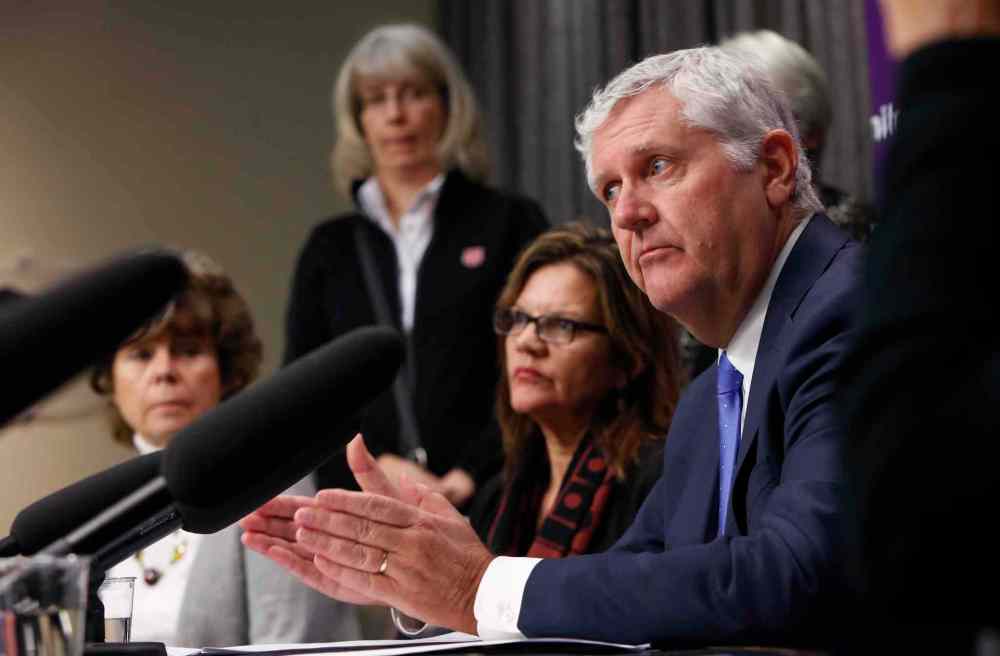
“We have to do better,” he said. “We have to end this terror.”
Mackintosh said amendments he introduced in the legislature to the Domestic Violence and Stalking Act will set a less onerous standard for obtaining protection orders.
Currently, the orders are granted if the victim requires imminent and immediate protection. With the proclamation of Bill 11, judicial justices of the peace would have to consider specific factors related to the risk of domestic violence or stalking when considering a protection order — a threshold more in line with what is required in other provinces, Mackintosh said.
If a protection order is granted and the justice of the peace is satisfied the person against whom the order is made possesses firearms, they will be required to surrender them as well as any ammunition.
The amended law would also require the immediate referral of every protection order to federal officials, who would flag existing firearms licences and begin an investigation that would potentially revoke those licences.
Over the last two years, more than 1,200 protection orders have been granted in Manitoba, but another 1,700 have been dismissed.
Mackintosh said the success rate is too low.
‘We have to open wider the doors of justice, particularly for those women and children living in fear’
— Attorney General Gord Mackintosh
The minister cited two specific Manitoba cases in unveiling his proposed changes — the Oct. 8 beating death of Selena Keeper, 20, who was denied a protection order against her ex-boyfriend despite his violent history, and the Oct. 30 shooting death of Camille Runke, 49, whose estranged husband is believed to have killed her before fatally shooting himself days later when police tried to pull him over. Runke was granted a protection order against Kevin Runke in July and specified on her application he had access to a rifle, but the court did not impose a firearms restriction.
Mackintosh said the province would also streamline court application forms to make them easier to understand and increase supports to those applying for protection orders. There will be better training for protection order designates (PODs) who assist applicants, there will be more such PODs, and they will be allowed to participate in hearings.
Mackintosh said he also wants to explore enhanced use of monitoring bracelets incorporating GPS technology that could alert victims of the offender’s location. A “GPS monitoring expansion team” that includes Winnipeg police Chief Devon Clunis and University of Manitoba law professor Karen Busby are to report back to the minister by spring.
But defence lawyer Scott Newman, a spokesman for the Criminal Defence Lawyers Association of Manitoba, said there are legal concerns around some of the province’s proposals, including mandatory firearm bans and GPS tracking, which he said is also very expensive. These kinds of measures are typically put in place after someone has been convicted of a crime, not before.
“Certainly there is no real restriction on liberty to say that a person has to stay away from another person — but as soon as the government starts ordering someone to turn in their firearms, or certainly by the time you’re getting into GPS proposals, you’re talking about a serious impairment of a person’s liberty. I think there would be severe constitutional questions as to whether or not such proposals are valid,” Newman said in an email.
“Those concerns are exacerbated when the order is made in the absence of the person, without an opportunity to respond to allegations being made against them — before you put a tracking collar on someone, you have to give them a right to appear in court and explain why it should not be granted.”

Instead of strengthening protection orders — which are ineffective if someone is intent on attacking their victims — the province could give victims more tools to protect themselves, he said.
“At the end of the day, it seems to me the government needs to focus more on the victim side of the equation — what steps can the government take to ensure that victims are safe, whether it is a policy that the police have to respond to 911 calls within a certain time, to giving silent panic button alarms to victims — that seems to me it would be more likely to produce a positive outcome in a high stress domestic situation, rather than what is being proposed, which is seemingly expensive, inefficient and ineffective,” Newman wrote.
— with file from Katie May
larry.kusch@freepress.mb.ca
Victim’s sister applauds increased GPS tracking
A vocal proponent of Monday’s proposed legislation regarding domestic violence says she’s happy her advocacy in her sister’s honour apparently caught the ears of the provincial government.
Maddie Laberge proposed an increase in GPS tracking for high-risk offenders after her sister, 49-year-old Camille Runke, was believed to have been shot to death by her estranged husband, Kevin Runke, Oct. 30.
Laberge said she is happy with Attorney General Gord Mackintosh’s work, saying he has “stepped up and brought forward what victims have been demanding.”
“Mr. Mackintosh did the research and came to the conclusion that GPS monitoring is, in fact, a method that can be explored further and applied to high-risk offenders,” Laberge said in a prepared statement.
“Women are living in fear, women are being beaten and some women are being murdered,” she said. “I have received several emails from women who are currently living in terror every day, and they are asking for my help, specifically asking how we can make GPS tracking a reality in their world.
“Intimidation can no longer be a tool abusers use to scare women into coming back to them. Fear of bodily harm (even death) for oneself or for family members cannot be tolerated.”
Runke had a protection order against her husband, but court did not impose a firearms restriction despite her efforts to tell court her husband had access to a rifle.
— Scott Billeck
Related Articles
Most of city's homicides in 2015 considered solved
Advertisement Advertise With Us
Advertisement Advertise With Us
History
Updated on Tuesday, December 1, 2015 7:39 AM CST: Replaces photo