

Researchers may have found the reason rodents cheat
Philandering male Prairie voles may simply be lost: study
Advertisement
Read this article for free:
or
Already have an account? Log in here »
To continue reading, please subscribe:
Monthly Digital Subscription
$1 per week for 24 weeks*
- Enjoy unlimited reading on winnipegfreepress.com
- Read the E-Edition, our digital replica newspaper
- Access News Break, our award-winning app
- Play interactive puzzles
*Billed as $4.00 plus GST every four weeks. After 24 weeks, price increases to the regular rate of $19.95 plus GST every four weeks. Offer available to new and qualified returning subscribers only. Cancel any time.
Monthly Digital Subscription
$4.99/week*
- Enjoy unlimited reading on winnipegfreepress.com
- Read the E-Edition, our digital replica newspaper
- Access News Break, our award-winning app
- Play interactive puzzles
*Billed as $19.95 plus GST every four weeks. Cancel any time.
To continue reading, please subscribe:
Add Free Press access to your Brandon Sun subscription for only an additional
$1 for the first 4 weeks*
*Your next subscription payment will increase by $1.00 and you will be charged $16.99 plus GST for four weeks. After four weeks, your payment will increase to $23.99 plus GST every four weeks.
Read unlimited articles for free today:
or
Already have an account? Log in here »
Hey there, time traveller!
This article was published 13/12/2015 (3748 days ago), so information in it may no longer be current.
If the male prairie vole were a human guy, we might call him “highly evolved.” Among the world’s 5,500 mammalian species, he’s among the roughly five per cent who, for the most part, mate for life and stick around to protect and raise offspring with his mate. He might even pick up a stick or twig around the burrow once in a while.
Ah, but evolution is a journey, not a destination. And it turns out some male prairie voles actually have habits that, if they were human guys, we might not consider so “evolved” at all. They’re chronic philanderers.
But the promiscuous forays of these voles may be adaptive behaviour after all: their wandering, and the genetic and behavioural diversity it fosters, has probably helped promote the rodent species’ long-term survival, a new study published Friday in Science states.
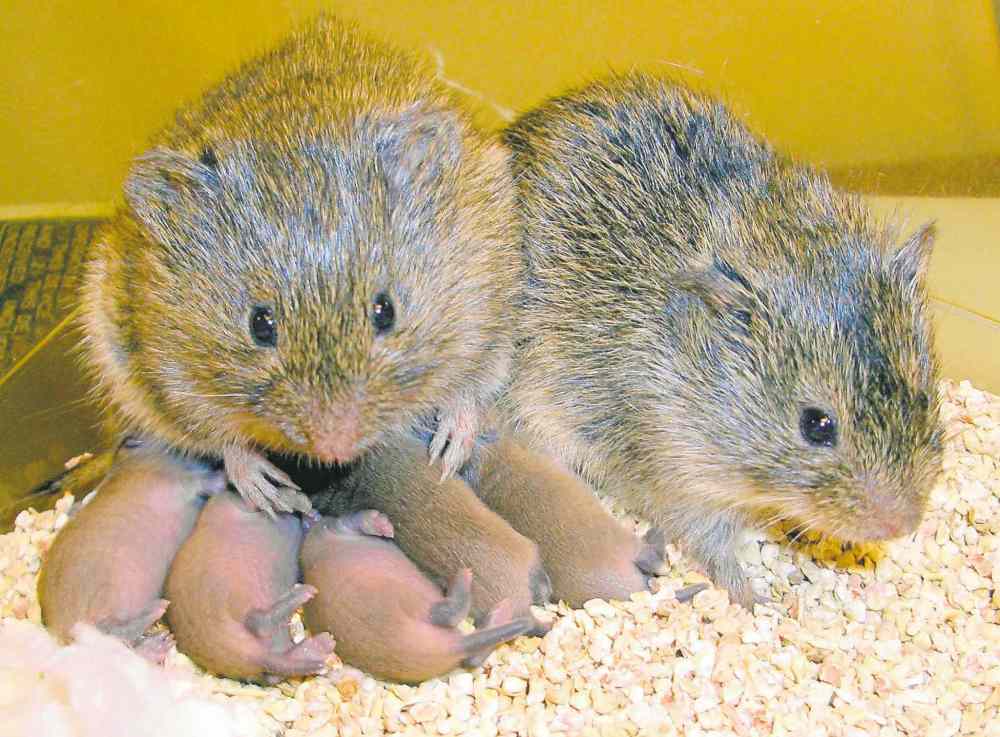
The new research set out to explore a pattern of behavioural variance in male prairie voles: while most stay close to home, some tend to travel farther afield, almost as if they’re lost. These meandering prairie voles are more likely to leave their vulnerable broods unattended and their mates available to other prairie voles who are also straying.
But rather than stop and ask someone for directions, these wandering voles have sex with females who are not their lifelong partners.
Researchers at the department of integrative biology at the University of Texas at Austin studied prairie voles living in experimental enclosures that mimic their natural environment. They looked for links between a male vole’s tendency to wander and variations at three genetic sites that influence brain regions responsible for spatial memory.
Reporting their findings, the researchers said the most common constellation of genetic settings at those sites was linked both to sexual fidelity and a well-functioning navigational sense.
But voles with a slightly different set of genetic variants at those sites seemed to get lost quite readily. The study’s authors speculated these voles have fuzzier memories of where, in their past wanderings, they have intruded on other male voles’ territory and gotten into a scrap. These voles were also the players, siring offspring with females who aren’t their life partners.
While scientists have long speculated unfaithful prairie voles were more risk-taking or reward-seeking than their faithful peers, the new research suggests a far more prosaic explanation for their philandering: some voles have inherited a mental GPS system that doesn’t work so well.
One in four prairie vole babies is born “outside a pair bond,” said the study’s authors.
Sure enough, they found, such offspring are more likely to have the genetic variances linked to poor spatial memory than voles born to fathers who sired them and stayed close to home.
If there were really such a thing as being “fully evolved,” we might expect vole populations to display a narrow range of variation in their spatial memories — and a narrow range of behaviour that springs from that.
But our environments change constantly, putting new evolutionary pressures on us all, and there is no end to evolution. In species such as the prairie vole, which live in groups, a wide range of variance in brain function and behaviour very likely improves the group’s likelihood of survival, the authors of the study suggest.
‘We may find this to be a common pattern in social behaviour,
including personality differences, in lots of species’
— Steven Phelps, the study’s lead investigator
In the wild, vole colonies show a cyclical pattern of expanding and contracting. As colonies of voles live more densely in close quarters, lost (and philandering) voles appear more likely to wander into each others’ burrows and mate, and genetic diversity reigns. In the resulting baby boom, colonies spread out.
With more space between neighbouring burrows, the faithful voles may gain a reproductive advantage, and their offspring are less prone to wandering.
“This brain variation isn’t just there by chance. It isn’t random,” says Steven Phelps, associate professor of integrative biology and the study’s lead investigator.
“It’s actually something that selection has kept around for a very long time. When it comes to social behaviour, maybe there isn’t a normal brain.”
Researchers have long studied voles to glean insights into a range of human behaviours, not least those related to nurturance and monogamy. That their tendencies toward monogamy vary widely — and that those variances have genetic underpinnings — might offer broader insights about brain and behavioural diversity in other species. Maybe even humans.
“We may find this to be a common pattern in social behaviour, including personality differences, in lots of species,” said Phelps.
— Los Angeles Times