Brainy brawling: Your introduction to the world of chess boxing
Advertisement
Read this article for free:
or
Already have an account? Log in here »
To continue reading, please subscribe:
Monthly Digital Subscription
$1 per week for 24 weeks*
- Enjoy unlimited reading on winnipegfreepress.com
- Read the E-Edition, our digital replica newspaper
- Access News Break, our award-winning app
- Play interactive puzzles
*Billed as $4.00 plus GST every four weeks. After 24 weeks, price increases to the regular rate of $19.95 plus GST every four weeks. Offer available to new and qualified returning subscribers only. Cancel any time.
Monthly Digital Subscription
$4.99/week*
- Enjoy unlimited reading on winnipegfreepress.com
- Read the E-Edition, our digital replica newspaper
- Access News Break, our award-winning app
- Play interactive puzzles
*Billed as $19.95 plus GST every four weeks. Cancel any time.
To continue reading, please subscribe:
Add Free Press access to your Brandon Sun subscription for only an additional
$1 for the first 4 weeks*
*Your next subscription payment will increase by $1.00 and you will be charged $16.99 plus GST for four weeks. After four weeks, your payment will increase to $23.99 plus GST every four weeks.
Read unlimited articles for free today:
or
Already have an account? Log in here »
Hey there, time traveller!
This article was published 04/01/2016 (3745 days ago), so information in it may no longer be current.
Sean Mooney is either one of the most athletic geeks or one of the most cerebral boxers in the world. Or maybe both.
Now working as a banker in New York, the 30-year-old Winnipegger is also the World Chess Boxing Association’s middleweight champion.
Seriously. It’s a thing.
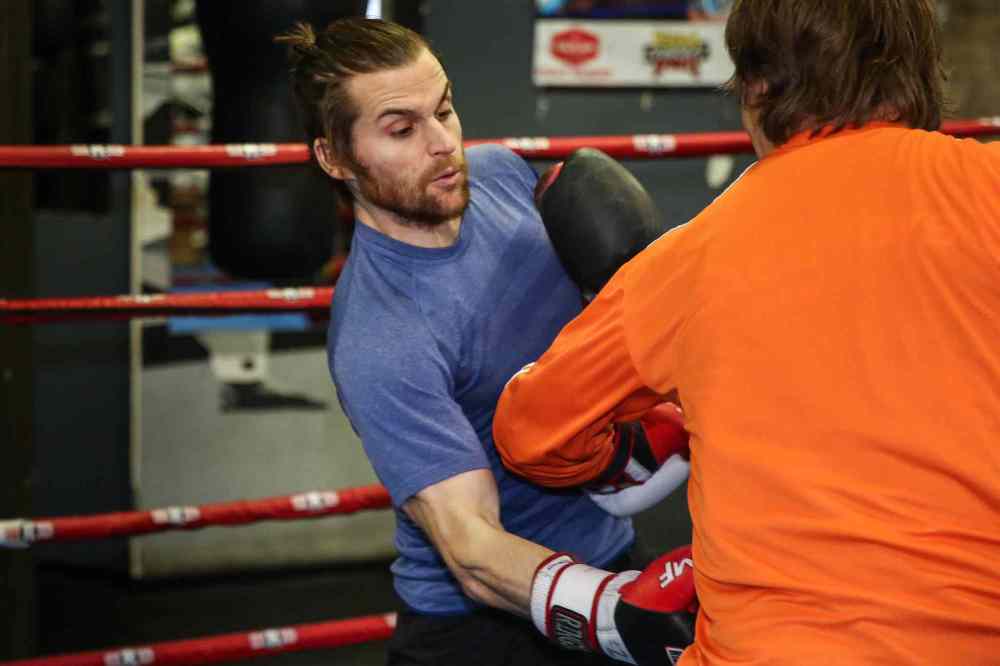
Chess boxing might be the oddest and coolest sport you’ve never heard of. It combines two completely opposite activities — boxing and chess — in a competition that requires the use of both brains and brawn.
Mooney started out at Pan Am Boxing Club as a 13-year-old. A soccer player, he read that some of his favourite players took up boxing as a way to improve core strength and get tougher.
He fought in a few “white-collar” charity events once he entered the real world and got a job, but took things to a new level once he moved to London a few years ago and was introduced to chess boxing.

The sport has been around for about a decade and is particularly popular in Germany, the U.K., India and Russia. There are several hundred active participants in the sport.
In some ways, chess boxing can be compared to biathlon, which combines the disparate activities of cross-country skiing and target shooting into a highly specialized pursuit.
Mooney knew how the chess pieces were moved on the board, but admits he wasn’t very good when he first started.
“They wouldn’t let me fight on two or three cards because my chess wasn’t good enough yet,” he says. “They said it wouldn’t be that entertaining if you sit down in the ring and the guy can beat you in four moves and you never get to fight.”
Mooney’s chess improved to the point where he was allowed in the ring. He is now known as “the Machine” and is undefeated in three fights in London, the most recent one for the middleweight title.
He’s even fought in Royal Albert Hall, one of that city’s most famous venues — the Beatles played there in the early 1960s — while hundreds of people cheered and jeered him live and tens of thousands more chimed in online.
Mooney says if boxers aren’t throwing enough punches, the crowd will start chanting, “Chess! Chess!” to get them pick up the pace in the ring.
Of course, some people are considerably better at one discipline than the other and if a competitor is getting smoked on the chess board, he’ll try to hang on until the end of the round and then come out throwing haymakers once the gloves are back on.
“It doesn’t matter about points anymore at that point. They have to knock him out. It’s a lot of heavy shots, big overhand rights and big uppercuts. Their only hope is to knock them out,” Mooney says.

The adjustment from chess to boxing and boxing to chess is, as one might imagine, difficult. Mooney says the first move or two on the chessboard after each round of boxing is often terrible.
“It’s like picking up a new game. When you leave the board, you start to think a couple of moves ahead but if you got hit at all that round, your head isn’t really in it,” he says. “You’re kind of dazed. Remembering what you were thinking before isn’t there. You see a lot of pieces given away accidentally.”
And switching to boxing from chess is hazardous to one’s health.
“In boxing, sometimes your head isn’t in it for the first 30 seconds of every round,” he says. “Your hands aren’t up and you see people eat big punches.”
Training for boxing requires commitment and the right gym.
Chess, on the other hand, can be a little trickier. Mooney says he usually has a couple of games going at any one time on his phone, but says there’s no substitute for the hustlers at Washington Square Park in New York.
“It’s a great, fun environment. They trash-talk you while they play you. They’ll find ways to get you to think you’re good and you’ll win a game and then lose the next three,” he says.
geoff.kirbyson@freepress.mb.ca