

Actions on field speak louder than interviews
Advertisement
Read this article for free:
or
Already have an account? Log in here »
To continue reading, please subscribe:

Digital Subscription
One year of digital access for only $205*
- Enjoy unlimited reading on winnipegfreepress.com
- Read the E-Edition, our digital replica newspaper
- Access News Break, our award-winning app
- Play interactive puzzles
*First annual payment billed as $205.00 + GST for one year. This annual subscription will automatically renew at $233.00 + GST every 52 weeks (10% off the regular annual price of $259.35). Offer available to new and qualified returning subscribers only. Cancel any time.
To continue reading, please subscribe:
Add Free Press access to your Brandon Sun subscription for only an additional
$1 for the first 4 weeks*
- Enjoy unlimited reading on winnipegfreepress.com
- Read the E-Edition, our digital replica newspaper
- Access News Break, our award-winning app
- Play interactive puzzles
*Your next Brandon Sun subscription payment will increase by $1.00 and you will be charged $17.95 plus GST for four weeks. After four weeks, your payment will increase to $24.95 plus GST every four weeks.
Read unlimited articles for free today:
or
Already have an account? Log in here »
Hey there, time traveller!
This article was published 14/03/2016 (3788 days ago), so information in it may no longer be current.
Imagine signing up for a speed-dating exercise, and when you sit down, not only are you across from a potential suitor you’ve never met before, but their entire extended family is with them and each one is prepared to ask you an aggressive and probing question about your intentions. How defensive or forthcoming would you be?
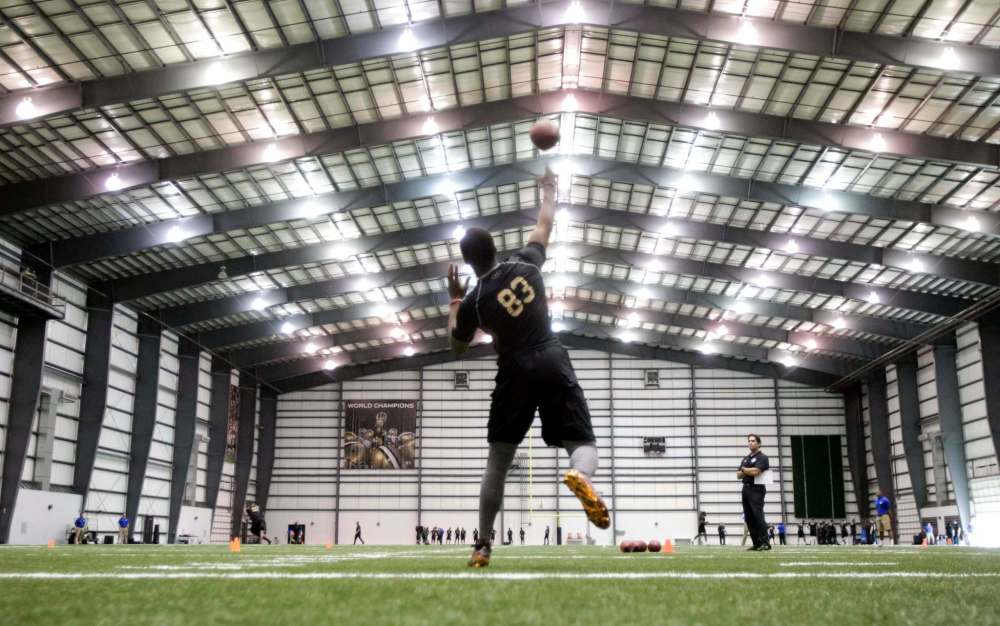
Welcome to the modern day football combine, where many of today’s top CFL executives consider the player interview to be one of the most important and telling measurables from this past weekend in Toronto.
For the most part, I happen to believe it to be an exercise in futility.
First off, today’s pro-football prospect knows he is going to be verbally challenged, and many of them admit they go online to see what the previous year’s questions have been, and prepare for them. This is really not very different than the standard job-interview preparation: you practise going over potential questions and work on how to give the best impression with your answers.
The last thing on your mind is giving the most authentic window or revealing insight into who you are as a person. You want to show yourself in the best possible light — whether it’s true or not — so you respond in the manner you feel will best reflect this.
It is also important to understand the type of environment these kids are walking into, most for the first time in their lives. Dressed up in their most dapper duds, they enter a hotel suite and are usually greeted by a lion’s den of CFL executives, general managers, and quite often, Hall of Fame players turned coaches. They take a seat and are peppered with questions from people they have only seen before on television who are trying to stress and squeeze them to see what happens, and who have a huge hand in determining their futures.
These people are looking for red flags and reasons why you might not be a good fit with them, so to say the prospects have their defensive mechanisms up is an understatement. The teams might as well add a single light bulb swinging from a chain in the ceiling to complete the interrogative mood and vibe in the room.
Having watched a number of these interviews online, one of the most common inquiries seems to be the, “How much do you really love the game of football?” question.
Maybe this is just the ice breaker, maybe this allows everybody in the room to warm up, or maybe they just like to see how a prospect responds to a stupid question from the get-go. What, exactly, do you expect to learn from a draft prospect who has been flown to Toronto to be poked, prodded and tested while walking around in a fiery printed spandex suit for two days? “Ummm, well I guess football is OK. I’m mainly just here for the free swag and to stay in a hotel room with another player I’ve never met before.” They don’t all love the game, to be sure, but good luck finding that out.
It never hurts the credibility quotient of an opinion piece if you get an expert to back your assessment, so I dialed up Dr. Kate White, who holds a PhD in social psychology and is the chair of the marketing and behavioural science division at the Sauder School of Business at U.B.C. She said, “You aren’t likely to tap into the nuanced aspects of someone’s personality in 15 minutes, and I think in this case, the athlete is probably prepared to answer these particular questions in a way that allow him to come off positively. Psychologists call this impression management.”
It wasn’t always this way, however, with all the top brass from a franchise playing football therapist with a new recruit for a quarter of an hour. When I went through the CFL combine, back in the late ’90s, there were no interviews other than what you did on the field, and the film you had spoke louder than anything you might say behind closed doors.
Back then, if you needed to know how much a player loved the game of football, all you had to do was watch and see whether they got after it every snap — without prompting — and whether they improved from year to year, which told you they worked on their craft in the off-season.
If you wanted to see whether a prospect was a team first, or a me first guy, all you had to do was tally up the number of selfish penalties they took over a season, and see whether that changed as they matured.
If you were concerned about how they would fit into your locker room, all you had to do was watch whether they celebrated with their teammates after a big play, or ran away from them to be alone in the spotlight.
If you wanted to see the kind of personality that emerged under pressure, you just had to watch how a player reacted and responded after he made a mistake or had a bad play in adverse circumstances on the field.
To spend a few minutes paying lip service to an athlete or two that your team is going to invest in for the future certainly helps everybody to sleep at night. That being said, the only time you get to see the essence of who a player is, with all of his walls down, is when he is in the thick of it on the field surrounded by his teammates and coaches in a natural football setting.

Putting a player in a completely artificial environment, in a button-down suit, where his guard is up and he understands what is at stake, for the most part, is only going to tell you exactly what he thinks you want to hear.
Doug Brown, once a hard-hitting defensive lineman and frequently a hard-hitting columnist, appears weekly in the Free Press.
Twitter: @DougBrown97
Related Articles
Bombers sign import wideout Tevin Reese
Advertisement Advertise With Us
Advertisement Advertise With Us