Marathon masters of the air
Knowledge of currents enables frigate birds' amazing endurance
Advertisement
Read this article for free:
or
Already have an account? Log in here »
To continue reading, please subscribe:

Digital Subscription
One year of digital access for only $205*
- Enjoy unlimited reading on winnipegfreepress.com
- Read the E-Edition, our digital replica newspaper
- Access News Break, our award-winning app
- Play interactive puzzles
*First annual payment billed as $205.00 + GST for one year. This annual subscription will automatically renew at $233.00 + GST every 52 weeks (10% off the regular annual price of $259.35). Offer available to new and qualified returning subscribers only. Cancel any time.
To continue reading, please subscribe:
Add Free Press access to your Brandon Sun subscription for only an additional
$1 for the first 4 weeks*
- Enjoy unlimited reading on winnipegfreepress.com
- Read the E-Edition, our digital replica newspaper
- Access News Break, our award-winning app
- Play interactive puzzles
*Your next Brandon Sun subscription payment will increase by $1.00 and you will be charged $17.95 plus GST for four weeks. After four weeks, your payment will increase to $24.95 plus GST every four weeks.
Read unlimited articles for free today:
or
Already have an account? Log in here »
Hey there, time traveller!
This article was published 09/07/2016 (3722 days ago), so information in it may no longer be current.
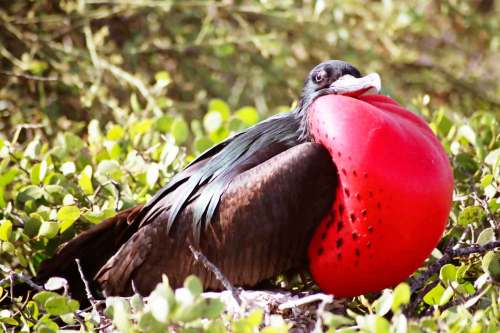
Europeans named the birds “frigate” for their resemblance to the swift warships. They look powerful, with their forked tails and long, slender wings; the shadows they cast on the sea surface could just as easily belong to a flock of pterodactyls. They make incredible feats of endurance — flying for two months without once setting foot on land, for instance — seem almost effortless: they ascend to altitudes of 2,000 feet and drop back down to sea level again with just a single flap of their wings.
“It is impressive,” said Henri Weimerskirch, an ornithologist at the National Centre for Scientific Research in France. “There is no other bird species like them.”
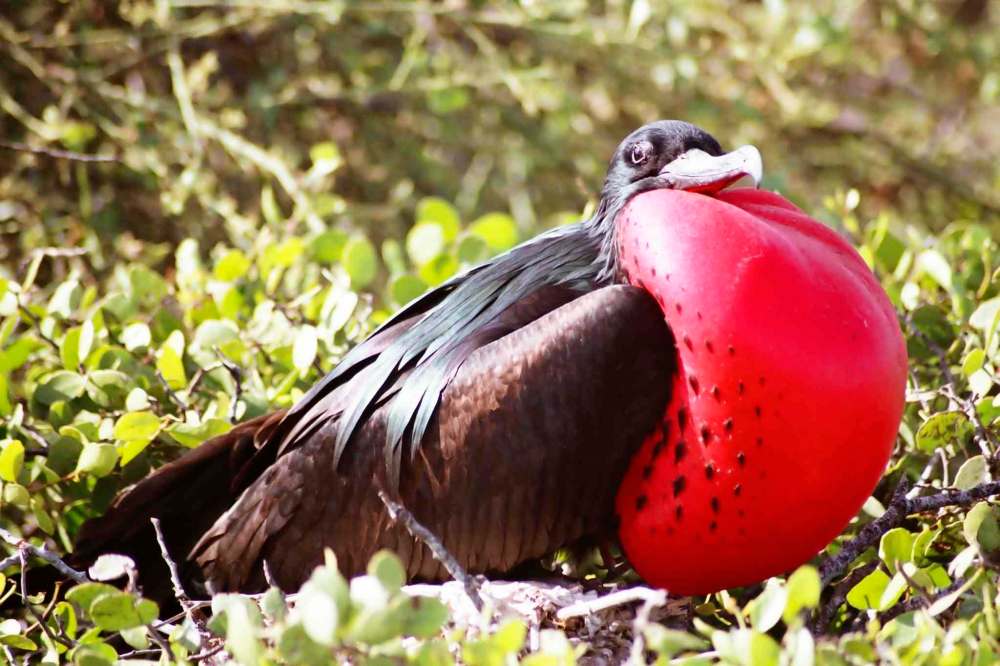
Weimerskirch would know — he spent two years tracking 80 frigate birds to understand their behaviour, which seems to defy all laws of gravity and biology. Though they feed exclusively on fish, the creatures cannot swim. Instead they fly for weeks, even months, across the oceans of the tropics in search of food that swims close enough to the surface for them to snatch it out of the water.
They’re able to do this, Weimerskirch reported last week in the journal Science, because of an incredible, intuitive mastery of air currents. Combining data from GPS trackers, heart-rate monitors and accelerometers affixed to the birds with local weather reports, he and his colleagues figured out how frigate birds take advantage of thermals and trade winds to fly over vast distances for long periods of time — all without expending much more energy than they would sitting in a nest.
Frigate birds are the only seabirds that lack waterproof feathers — if they dive into the ocean or even land on its surface, the water will soak their plumage and prevent them from taking flight again. This should be a death knell to a species that dines exclusively on fish, but it’s not. Frigate birds can soar high above the ocean, eyes peeled for movement in the water below — a sign a large predator, such as tuna or dolphin, is scaring fish to the surface.
“When it sees its prey, it flies down head foremost to the water’s edge, very swiftly takes its prey out of the sea with his bill and immediately mounts again as swiftly; never touching the water with his bill,” a 17th-century observer wrote.
“It’s a very, very specific niche and way of attacking prey,” said Weimerskirch. “But the prey are very patchy… it takes days and days to encounter one opportunity. So they have to cover very long distances to find it.”
That’s where the birds’ soaring abilities come in. Their large, lightweight wings (their wing surface-area-to-body-mass ratio is higher than any other bird’s) allow them to take advantage of the slightest breezes. They soar upward on thermals, much the way hang-gliders do, and then glide back down gradually over the course of many kilometres. Unlike gliders, they also take advantage of the air currents within clouds to rise even higher when they need to; inside a cloud, they can ascend as fast as four to five metres per second. Few other birds and even most planes wouldn’t attempt this because of the potential for turbulence.
The birds also know to avoid the “doldrums,” equatorial regions of the Atlantic and Pacific where light, capricious winds, unpredictable calms and sudden storms could spell doom for ancient mariners and modern birds.
Allowing air currents to do the work of lifting them makes frigate birds’ flight hugely efficient. The heart-rate monitors Weimerskirch and his colleagues attached to the birds showed they didn’t flap their wings at all while gaining altitude — the energy costs of ascending thousands of feet in the air were the same as when they were sitting still.
And that, in turn, allowed them to travel vast distances over unimaginable periods of time. An adult bird can fly continuously for more than a month, covering 400 kilometres per day, without stopping once. Some crossed the Indian Ocean several times without setting a single foot on land.
It’s still not clear how the birds sleep during these epic journeys. Weimerskirch said there’s evidence they can shut down half their brains as they ascend on updrafts.
“They are probably getting small bouts of sleep at this time — maybe two to three minutes,” he said. A subsequent study with miniature loggers that monitor sleep will test this hypothesis.
Juvenile birds were especially strong endurance fliers — likely because they are going through a “dispersal phase,” in which they journey as far as possible from their home nests, like 18-year-olds who insist they must fly to the other side of the country to go to college. One juvenile stayed aloft for more than two months. Another flew nearly 56,000 kilometres (a distance greater than the circumference of the Earth) in 185 days. On only four of those days did it land on an island to rest, and even then, only for a few hours.
But these birds owe a lot to their parents, who spend more time teaching their young the ways of the world than any other bird. Young frigate birds spend six to eight months flying with their parents before setting out on their own.
“That’s a very long period,” said Weimerskirch. “And it’s probably because it’s complicated to learn how to fly. It takes time to learn to deal with all the conditions and all the constraints they have.”
“When you see the flight pattern of a frigate bird,” he added, “you understand.”
But scientists are worried about how climate change might affect frigate birds’ flight; shifting weather patterns could disrupt the flight techniques frigate birds spend so long learning. Warming oceans will likely become less productive, and the infrequent appearances of food that frigate birds depend on may disappear.
— Washington Post