Museum a portal to Guatemala
Virtual-reality exhibit a cultural immersion

Advertisement
Read this article for free:
or
Already have an account? Log in here »
To continue reading, please subscribe:

Digital Subscription
One year of digital access for only $205*
- Enjoy unlimited reading on winnipegfreepress.com
- Read the E-Edition, our digital replica newspaper
- Access News Break, our award-winning app
- Play interactive puzzles
*First annual payment billed as $205.00 + GST for one year. This annual subscription will automatically renew at $233.00 + GST every 52 weeks (10% off the regular annual price of $259.35). Offer available to new and qualified returning subscribers only. Cancel any time.
To continue reading, please subscribe:
Add Free Press access to your Brandon Sun subscription for only an additional
$1 for the first 4 weeks*
- Enjoy unlimited reading on winnipegfreepress.com
- Read the E-Edition, our digital replica newspaper
- Access News Break, our award-winning app
- Play interactive puzzles
*Your next Brandon Sun subscription payment will increase by $1.00 and you will be charged $17.95 plus GST for four weeks. After four weeks, your payment will increase to $24.95 plus GST every four weeks.
Read unlimited articles for free today:
or
Already have an account? Log in here »
Hey there, time traveller!
This article was published 20/07/2016 (3674 days ago), so information in it may no longer be current.
They say you don’t know a person until you’ve walked a mile in her shoes. The first 3-D virtual reality exhibit at the Canadian Museum for Human Rights transports visitors 5,000 kilometres away into the lives of Mayan artisan women in Guatemala.
“It’s incredible!” said master weaver Amparo de León, who travelled to Winnipeg for the exhibit’s opening with her colleague Oralia Chopen. Wearing traditional indigenous garb, they donned virtual reality goggles at the museum Tuesday for a 360-degree look inside their TRAMA Textiles Women’s Weaving Co-operative in Guatemala and the lives of fellow members.
“I’m able to see this grandmother like she’s talking to us,” de Leon said enthusiastically through a translator.
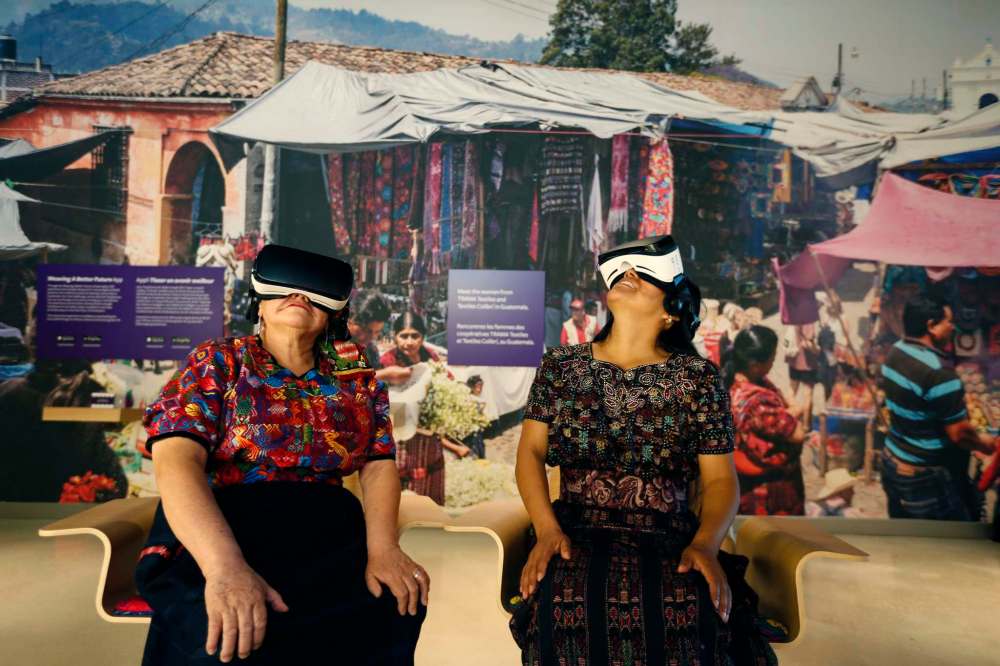
“I feel great,” said Chopen who represents 400 women from 17 villages who formed the co-op in 1988 after their men disappeared during the worst of the civil war in Guatemala. “I feel so proud.” Their ancient Mayan weaving skills helped them survive and joining forces gave them strength.
Their experience is part of the exhibit Empowering Women: Artisan Co-operatives That Transform Communities that opens this weekend. It tells stories of how grassroots collaboration advanced human rights, such as the right to work, to obtain an adequate standard of living, to reclaim culture, and to live in health and safety. It looks at co-ops in Africa, Asia, South America and focuses on Guatemala where museum curator Armando Perla once worked. He developed a connection with the women’s co-op and led a trio from Winnipeg to the Central American country to create the museum’s first virtual reality exhibit. Viewers experience the beauty of the terrain and the craft that came out of the ugliness of what happened to them.
The women’s co-op was born of pain from Guatemala’s civil war that lasted from 1960 to 1996 and left 200,000 dead — 83 per cent of whom were indigenous Mayan, said Perla.
“There were many women who were widowed,” Chopen said through an interpreter. “People were burned alive, kidnapped and their bodies never found,” she said. “I lost a lot of family,” said Chopen, who saw her grandparents burned alive. “I was six at the time. I witnessed it all.”

De León said in her village, residents were caught in the fight between the military and the guerrillas. The army would make them do their laundry and the guerrillas seeing the soldiers’ uniforms on the clothesline would punish them for supporting the military. Guerrillas would trade canned goods for the villagers’ fresh fruits and vegetables and when the military showed up and found the cans of food, they’d accuse the villagers of backing the guerrillas.
“Every Friday night they would come and kidnap two or three men,” said de Leon. “Their bodies were never found.” Forming the co-operative, women were able to support one another emotionally and economically, said de León. They still face challenges of poverty and discrimination as indigenous people, said Chopen. It was only until recently they felt comfortable wearing their traditional clothes in Guatemala when they were away from home, she said.
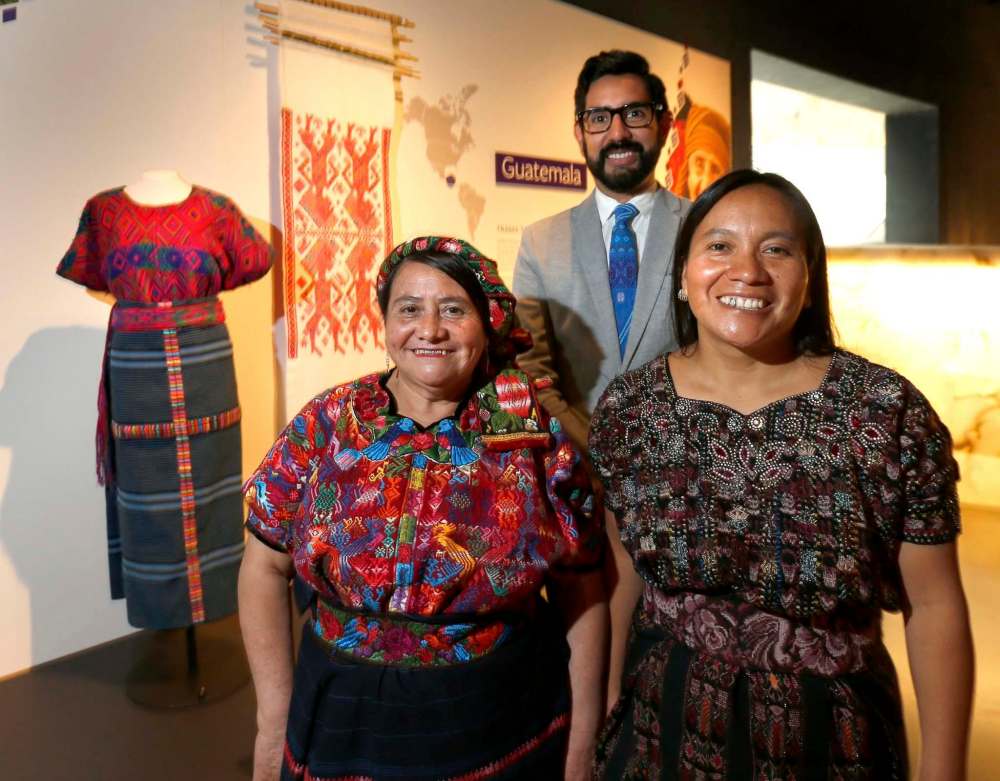
Sharing their stories with the rest of the world has been good for their spirits and the bottom line, said Chopen. With the help of volunteers, they’ve got their own website and are able to sell their woven goods online. The museum boutique is now selling the artisans’ wares. The income the women generate helps to put food on the table and to send their girls to school so they have more choices and control over their lives, Chopen said. “I’m very grateful.”
The exhibition, organized by the Museum of International Folk Art in Santa Fe, N.M., features embroidered story cloths, beaded neck collars and hand-dyed wool weavings from co-operatives generating change in Bolivia, India, Kenya, Laos, Morocco, Nepal, Peru, Rwanda, South Africa and Swaziland. In Bolivia, for example, women adapted their skills to cultivate garabatá plants, reclaiming their indigenous tradition of weaving bags from the plants’ fibres. In Rwanda, Hutu and Tutsi women work side by side, weaving peace baskets as they heal from the trauma of war. In India, a co-operative allows embroiderers to stop wandering in search of work and support children at home.
carol.sanders@freepress.mb.ca
Carol Sanders
Legislature reporter
Carol Sanders is a reporter at the Free Press legislature bureau. The former general assignment reporter and copy editor joined the paper in 1997. Read more about Carol.
Every piece of reporting Carol produces is reviewed by an editing team before it is posted online or published in print — part of the Free Press‘s tradition, since 1872, of producing reliable independent journalism. Read more about Free Press’s history and mandate, and learn how our newsroom operates.
Our newsroom depends on a growing audience of readers to power our journalism. If you are not a paid reader, please consider becoming a subscriber.
Our newsroom depends on its audience of readers to power our journalism. Thank you for your support.
Carol Sanders
Legislature reporter
Carol Sanders is a reporter at the Free Press legislature bureau. The former general assignment reporter and copy editor joined the paper in 1997. Read more about Carol.
Every piece of reporting Carol produces is reviewed by an editing team before it is posted online or published in print — part of the Free Press‘s tradition, since 1872, of producing reliable independent journalism. Read more about Free Press’s history and mandate, and learn how our newsroom operates.
Our newsroom depends on a growing audience of readers to power our journalism. If you are not a paid reader, please consider becoming a subscriber.
Our newsroom depends on its audience of readers to power our journalism. Thank you for your support.
Advertisement Advertise With Us
Advertisement Advertise With Us
History
Updated on Wednesday, July 20, 2016 7:57 AM CDT: Photos added.