

Mary Jane, meet John Law: How will we deal with stoned drivers in the era of legalization?

Advertisement
Read this article for free:
or
Already have an account? Log in here »
To continue reading, please subscribe:
Monthly Digital Subscription
$1 per week for 24 weeks*
- Enjoy unlimited reading on winnipegfreepress.com
- Read the E-Edition, our digital replica newspaper
- Access News Break, our award-winning app
- Play interactive puzzles
*Billed as $4.00 plus GST every four weeks. After 24 weeks, price increases to the regular rate of $19.95 plus GST every four weeks. Offer available to new and qualified returning subscribers only. Cancel any time.
Monthly Digital Subscription
$4.99/week*
- Enjoy unlimited reading on winnipegfreepress.com
- Read the E-Edition, our digital replica newspaper
- Access News Break, our award-winning app
- Play interactive puzzles
*Billed as $19.95 plus GST every four weeks. Cancel any time.
To continue reading, please subscribe:
Add Free Press access to your Brandon Sun subscription for only an additional
$1 for the first 4 weeks*
*Your next subscription payment will increase by $1.00 and you will be charged $16.99 plus GST for four weeks. After four weeks, your payment will increase to $23.99 plus GST every four weeks.
Read unlimited articles for free today:
or
Already have an account? Log in here »
Hey there, time traveller!
This article was published 20/08/2016 (3531 days ago), so information in it may no longer be current.
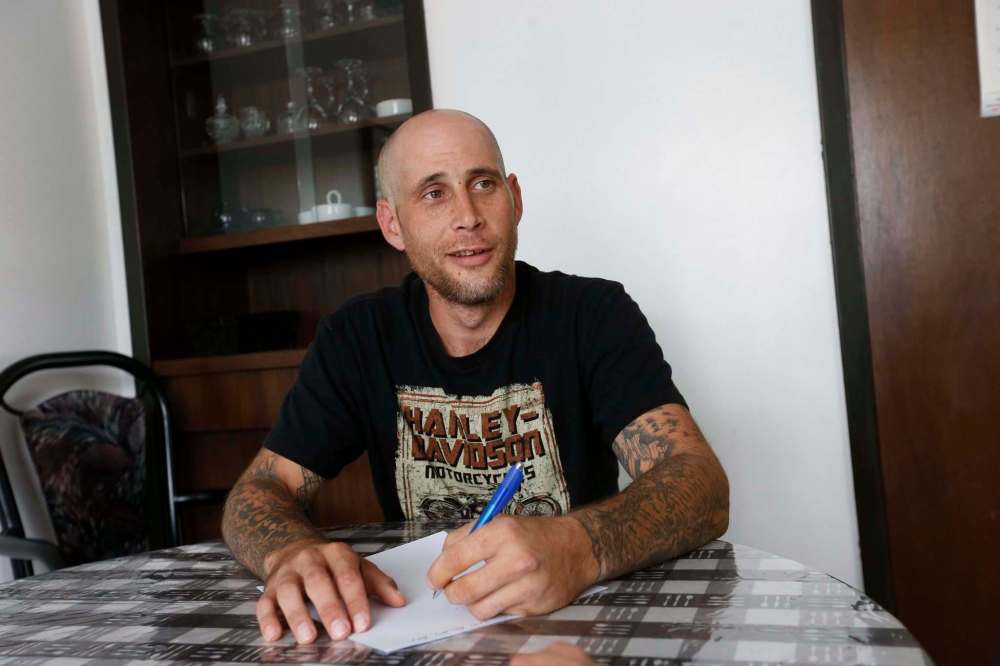
Joey Cowan’s life didn’t really begin until he died.
A history of drug and alcohol abuse, starting with his first six-pack at age 11, came crashing to a halt in 2008 when his opiate abuse led to the inevitable overdose.
“I was clinically dead for 9½ minutes,” he said. “Fortunately, the ambulance got to me in time.”
So when Cowan has strong opinions on the legalization of marijuana, he’s come to them the hard way, and not the least of his concerns is dealing with stoned drivers.
Growing up as a teenager in suburban Winnipeg, Cowan played hockey with the passion of a Jonathan Toews, at the rink at 6 a.m. every day.
But at 11, he found the bottle, and, as he says, downed a six-pack of Bud by himself, sleeping it off at a friend’s house overnight. The next morning, his dad — knowingly — had him mowing the lawn nursing a ripping hangover.
“You’d think that would have taught me,” he said. “But it didn’t. I had found something.”
By the time he moved into coaching, he was an alcoholic. And then to stay out of trouble with his ex-wife, he found cocaine. “I’d be drunk as a skunk and if I did just one line, I was as sober as a judge.”
Soon, he’d be flying so high on cocaine that to sleep, he turned to opiates. Heroin, in other words, often in such forms as Percocet or Oxycontin. Through it all, he never stopped driving, but can’t say what that was like. “I don’t remember any of it,” he said. “That’s what is so scary.”
No easy answer
The beginning of the end was Sept. 1, 2008. His opiate tolerance had reached a point he suffered the inevitable overdose and, technically, died.
Cowan’s experience as a hard-core drug user, and his ability at the time to evade detection by law enforcement, brings him to one critical question:
“How can we even think about legalizing something when we have no way to tell if someone is impaired, or haven’t decided on the concentrations that are too much or what the consequences are?”
Cowan has, perhaps inadvertently, articulated the problems discovered by any agency, government or advocacy group that has struggled with the question of legalized marijuana and driving while impaired: there’s no easy answer. The experience of two states, Colorado and Washington, which have seen a spike in marijuana-related statistics regarding driving, suggests an answer should be found.
“Marijuana is in its own special world,” Const. Stéphane Fontaine, the impaired-driving countermeasures director for the Winnipeg Police Service, said. “It’s unique: how it gets into your system, how long it stays there. Our focus is on the impairment we see on the roadside.”
Indeed, even an organization as powerful as the American Automobile Association disputes any suggestion of a scientific link between specific concentrations of THC — the active ingredient in marijuana — and impairment.
“No, not a single shred of evidence supports the claim a positive saliva test alone is a reliable indicator of impairment due to active THC,” said Jake Nelson, director of traffic safety advocacy and research for the AAA. “The same is true for a positive blood test.
“That said, if law enforcement has collected other evidence of impairment, a positive blood or saliva test can serve as another piece of evidence.”
The problems are tolerance and how short an amount of time THC remains in the blood: heavy users can consume large amounts with few signs of impairment while novice users can be heavily impaired at low concentrations, the association said in a study.
Tough to measure
A study by the Journal of Analytical Toxicology, an Oxford University publication, says blood concentrations — though not the effects — wear off so quickly, someone would practically have to be smoking a joint at the time of a blood test “to be able to measure meaningful concentrations” of the psychoactive agent.
In Australia, which has largely decriminalized pot, the cutoff is 25 nanograms per millilitre. For some users, depending on the potency of the weed, that can be as little as half a joint. But questions are arising Down Under with people testing positive for a week or more after using. Courts there are ruling it’s impairment, not past use, that should be the deciding factor in impaired-driving convictions.
In the United States, four states have legalized marijuana for recreational use. In Washington, a study by the American Automobile Association suggests incidents of pot use in fatal crashes has doubled, though the association also cautions it is not drawing a direct line between the use of pot and the cause of the crash.
The study showed the majority of those drivers mixed pot with booze, and at times, other drugs, further clouding the extent to which marijuana use contributed to crashes.
Another study found in Colorado, another state with legalized pot, evidence of the drug in impaired-driving cases rose 100 per cent between 2007 — when the state took its first steps towards legalization — and 2012, the year full legalization took effect.
“There is understandably a strong desire by both lawmakers and the public to create legal limits for marijuana impairment, in the same manner as we do with alcohol,” said Marshall Doney, AAA’s president and CEO. “In the case of marijuana, this approach is flawed and not supported by scientific research. It’s simply not possible today to determine whether a driver is impaired based solely on the amount of the drug in their body.”
Mounties test devices
The Royal Canadian Mounted Police is testing four devices that typically use saliva to detect THC, and say legislative changes, federally and provincially, will be required to institute such tests. One such device, the Alere DDS2, is calibrated to show current THC levels, with indications of past use non-existent after four to six hours.
Yet even Alere spokeswoman Jackie Lustig said there remains little consensus on what levels constitute impairment, especially considering the varied response to the drug based on the experience of the user. She did, however, say that with device calibrated to Australia’s standard, the DDS2 won’t detect use more than four to six hours old.
The AAA says what it means — for now — is law enforcement is left with standard roadside sobriety tests, with blood or saliva testing serving only as supplementary evidence.
Fontaine said the results of roadside tests are often the same regardless of intoxicant. “If you can’t do a simple co-ordination test, how can you be expected to do a complex, multi-function task such as driving?”
While Fontaine said trained police can spot users, and distinguish between the various intoxicants, Cowan isn’t convinced. “I’d be high as a kite and the officer didn’t suspect a thing.”
Cowan, who is now sober and running two businesses — one in construction and one in addictions counselling — has a loving partner and eight children between them.
Life is good, but the memory of what had been still haunts him, to the point he is now a staunch advocate against impaired driving, regardless of intoxicant. He said he does whatever it takes to stop anyone he can from driving impaired. “I’ve had too many calls where I’m the only number they can get from a cellphone and I have to go ID a body on a slab.
“It’s the worst call you can get.”
kelly.taylor@freepress.mb.ca
Kelly Taylor
Copy Editor, Autos Reporter
Kelly Taylor is a copy editor and award-winning automotive journalist, and he writes the Free Press‘s Business Weekly newsletter. Kelly got his start in journalism in 1988 at the Winnipeg Sun, straight out of the creative communications program at RRC Polytech (then Red River Community College). A detour to the Brandon Sun for eight months led to the Winnipeg Free Press in 1989. Read more about Kelly.
Every piece of reporting Kelly produces is reviewed by an editing team before it is posted online or published in print — part of the Free Press‘s tradition, since 1872, of producing reliable independent journalism. Read more about Free Press’s history and mandate, and learn how our newsroom operates.
Our newsroom depends on a growing audience of readers to power our journalism. If you are not a paid reader, please consider becoming a subscriber.
Our newsroom depends on its audience of readers to power our journalism. Thank you for your support.
Kelly Taylor
Copy Editor, Autos Reporter
Kelly Taylor is a copy editor and award-winning automotive journalist, and he writes the Free Press‘s Business Weekly newsletter. Kelly got his start in journalism in 1988 at the Winnipeg Sun, straight out of the creative communications program at RRC Polytech (then Red River Community College). A detour to the Brandon Sun for eight months led to the Winnipeg Free Press in 1989. Read more about Kelly.
Every piece of reporting Kelly produces is reviewed by an editing team before it is posted online or published in print — part of the Free Press‘s tradition, since 1872, of producing reliable independent journalism. Read more about Free Press’s history and mandate, and learn how our newsroom operates.
Our newsroom depends on a growing audience of readers to power our journalism. If you are not a paid reader, please consider becoming a subscriber.
Our newsroom depends on its audience of readers to power our journalism. Thank you for your support.
Related Articles
Driving while high not enough for conviction, judge rules
Advertisement Advertise With Us
Advertisement Advertise With Us