Walton’s Platonic sci-fi trilogy terrific

Advertisement

Advertise with us

It’s probably safe to say if Jo Walton hadn’t written Necessity and its two preceding volumes, nothing even remotely similar would exist. And that would be a terrible shame. The award-winning Welsh-Canadian writer is known for her refusal to write inside genre lines, and nowhere is that more evident than in her just-completed trilogy.

Read this article for free:


or

Already have an account? Log in here »

To continue reading, please subscribe:

Subscribe and receive a limited-edition Free Press branded hat or tote.

Digital Subscription

One year of digital access for only $205*

  • Enjoy unlimited reading on winnipegfreepress.com
  • Read the E-Edition, our digital replica newspaper
  • Access News Break, our award-winning app
  • Play interactive puzzles

*First annual payment billed as $205.00 + GST for one year. This annual subscription will automatically renew at $233.00 + GST every 52 weeks (10% off the regular annual price of $259.35). Offer available to new and qualified returning subscribers only. Cancel any time.

To continue reading, please subscribe:

Add Free Press access to your Brandon Sun subscription for only an additional

$1 for the first 4 weeks*

  • Enjoy unlimited reading on winnipegfreepress.com
  • Read the E-Edition, our digital replica newspaper
  • Access News Break, our award-winning app
  • Play interactive puzzles
Start now

*Your next Brandon Sun subscription payment will increase by $1.00 and you will be charged $17.95 plus GST for four weeks. After four weeks, your payment will increase to $24.95 plus GST every four weeks.

Hey there, time traveller!
This article was published 29/10/2016 (3607 days ago), so information in it may no longer be current.

It’s probably safe to say if Jo Walton hadn’t written Necessity and its two preceding volumes, nothing even remotely similar would exist. And that would be a terrible shame. The award-winning Welsh-Canadian writer is known for her refusal to write inside genre lines, and nowhere is that more evident than in her just-completed trilogy.

In the first book, The Just City, the Greek goddess of wisdom Athene plucked hundreds of classical scholars and philosophers from throughout history to set up a city modelled on Plato’s Republic. The seminal work of political philosophy imagined a perfect society wherein citizens would all strive to reach their greatest potential, the greatest among them to rule benevolently as philosopher kings. Plato sought an end to tyrants, sycophants and incompetents in civic life, and imagined a true meritocracy for the common good.

A philosophical thought experiment and an actual, functioning city are two different things. By the end of the second book, The Philosopher Kings, the original city had fragmented into dozens of competing versions before its denizens were divinely transported to an alien planet in the far future.
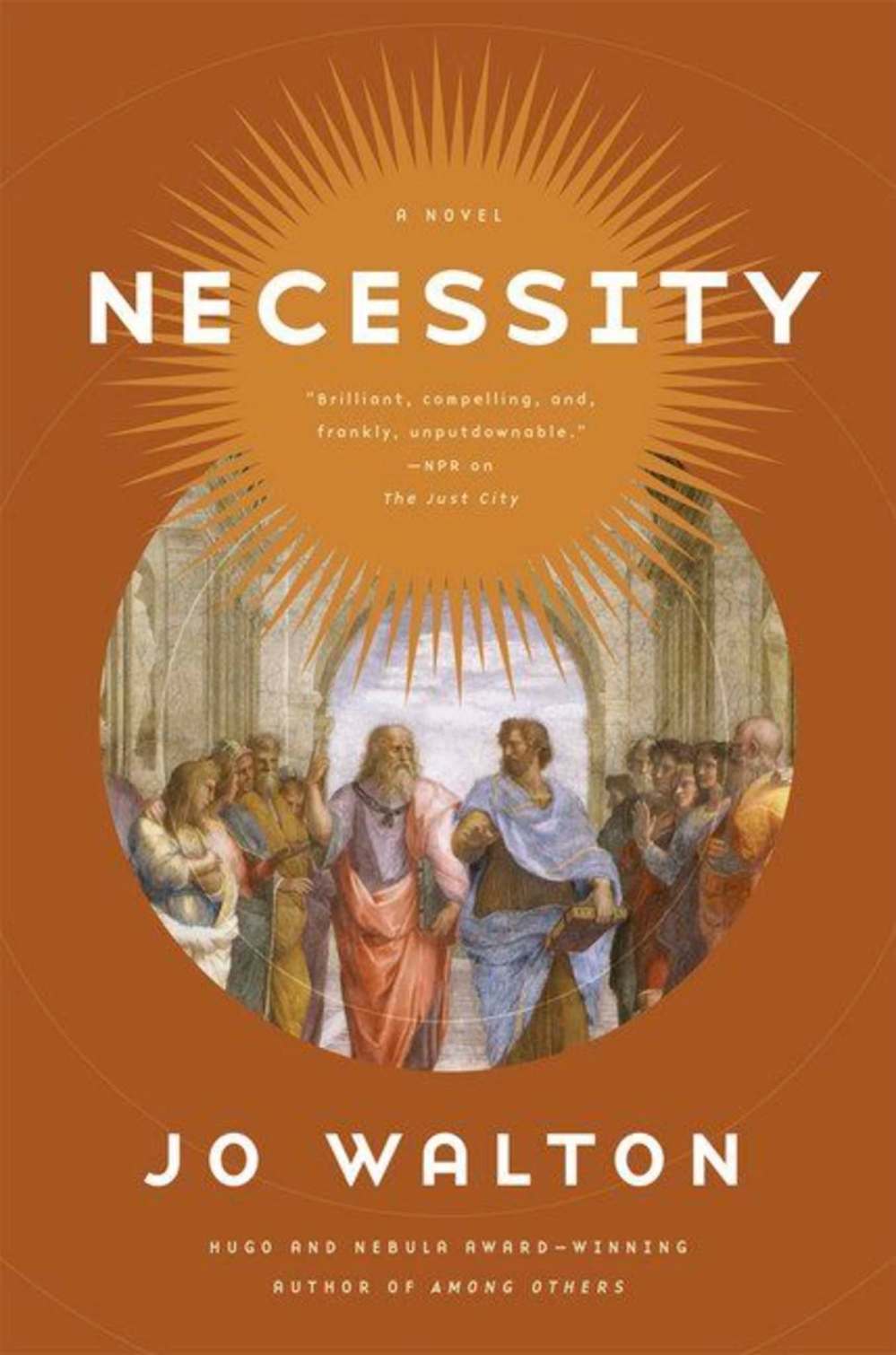
In Necessity, the cities now boast third and fourth generations of citizens who have never experienced life outside Plato, their world. They are used to the fact that aliens live among them, that the many robots originally transported from a future time to take the place of human slaves are in fact capable of sentience and therefore also entitled to opt for citizenship. And of course the existence of gods is also an irrefutable notion, given that Apollo himself is a citizen.

A common element of many of the great works of science fiction is the ability to grapple with big ideas. When this is done thoughtfully and deeply enough, a work might be described as philosophical science fiction. But this has never been so literally true as with Walton’s recent novels. Her memorable characters include famous Renaissance philosophers, newly sentient artificial intelligences, alien beings, and even alien gods, all seeking truth and meaning.

A robot wants to know: Does attaining consciousness also mean he has a soul? The god Apollo wants to know (because Zeus has not told him): What is the purpose of the universe? And everyone, human, alien and otherwise, wants to know the best way to live life, Platonically or otherwise — and, if the former, to know which interpretation of Plato is the correct one.

When people read Plato in English translation, they may not be aware that the translator is also making critical choices in word use and interpretation. One such example in Plato’s Republic revolves around a key concept described in Greek as arete, most often translated as virtue. This has a monastic tinge to it: Platonic life argued in terms of piety and scripture. But Walton favours the less popular but perhaps more appropriate translation of arete as excellence, and the connotations are entirely different.

This is important, as it shows Walton has done her homework — she hasn’t just read Plato, she’s read the commentary on Plato, the alternative translations of Plato, and the commentary on these translations of Plato. She knows the scholarship and has scholarly opinions, and that’s important because a book of ideas would fail if the author didn’t understand them.

It’s easy to name-drop Homer, Tacitus and Virgil, less so to synthesize history, mythology and philosophy into a fictional cross-genre narrative featuring many well-known historical figures without misrepresenting their work or personalities. If Walton had actually learned Latin and ancient Greek as part of her research for these novels, it would not be shocking.

Her readers have a less painful option: picking up these thoughtful, enjoyable and entirely original books, and maybe even getting a little bit smarter in the process.

Joel Boyce is a Winnipeg writer and educator.
Report Error Submit a Tip

More Stories

Treating the disease we simply won’t insure

Rafiq Andani 5 minute read 2:00 AM CDT

There is a condition affecting tens of thousands of Canadians. In 2024, one national measure estimated that almost 120,000 people had the condition. The estimate captures only part of the problem.

Walton’s Platonic sci-fi trilogy terrific

Reviewed by Joel Boyce 4 minute read Preview

Walton’s Platonic sci-fi trilogy terrific

Reviewed by Joel Boyce 4 minute read Saturday, Oct. 29, 2016

It’s probably safe to say if Jo Walton hadn’t written Necessity and its two preceding volumes, nothing even remotely similar would exist. And that would be a terrible shame. The award-winning Welsh-Canadian writer is known for her refusal to write inside genre lines, and nowhere is that more evident than in her just-completed trilogy.

In the first book, The Just City, the Greek goddess of wisdom Athene plucked hundreds of classical scholars and philosophers from throughout history to set up a city modelled on Plato’s Republic. The seminal work of political philosophy imagined a perfect society wherein citizens would all strive to reach their greatest potential, the greatest among them to rule benevolently as philosopher kings. Plato sought an end to tyrants, sycophants and incompetents in civic life, and imagined a true meritocracy for the common good.

A philosophical thought experiment and an actual, functioning city are two different things. By the end of the second book, The Philosopher Kings, the original city had fragmented into dozens of competing versions before its denizens were divinely transported to an alien planet in the far future.

In Necessity, the cities now boast third and fourth generations of citizens who have never experienced life outside Plato, their world. They are used to the fact that aliens live among them, that the many robots originally transported from a future time to take the place of human slaves are in fact capable of sentience and therefore also entitled to opt for citizenship. And of course the existence of gods is also an irrefutable notion, given that Apollo himself is a citizen.

Read
Saturday, Oct. 29, 2016

Defenceman Morrissey focused on season ahead

Ken Wiebe 8 minute read Preview

Defenceman Morrissey focused on season ahead

Ken Wiebe 8 minute read 12:08 PM CDT

Josh Morrissey insists that a trade request from the franchise goalie doesn’t change his desire to be a lifelong Winnipeg Jet.

The top-pairing defenceman and alternate captain reinforced that view on Monday morning when speaking to a group of reporters prior to the Winnipeg Jets Golf Classic at St. Charles Country Club.

“At the end of the day, I love being here and I love being a Jet. That’s how I’ve always felt,” said Morrissey, who spoke for just over nine minutes on a variety of topics. “That doesn’t change because of somebody else’s decision. Nothing is finalized, so who knows, he could be back. My position doesn’t change.”

Morrissey has two years left on a contract that pays him US$6.25 million and he’s only eligible to sign an extension on July 1, but the future of the franchise pillar will be a topic of discussion as the Jets work to sort through the situation with franchise goaltender Connor Hellebuyck, which remains unresolved.

Read
12:08 PM CDT

Finding fulfilment as canines’ companion

AV Kitching 9 minute read Preview

Finding fulfilment as canines’ companion

AV Kitching 9 minute read 6:00 AM CDT

Tim Campbell loves dogs. He loves them so much that as soon he retired from his job at Panasonic Canada in early 2024 he began volunteering in earnest at the Winnipeg Humane Society (WHS).

He’d started his voluntary career five years prior with another local dog rescue organization. The work was rewarding, he says but the call-outs were unpredictable.

He was looking for a voluntary role which had a bit more structure to it, something he could build a routine around, while spending time with the animals he truly adores.

“In the summer, I’m there two mornings a week, and when the weather turns a little colder, I’m there anywhere from three to four mornings, depending on what’s going on,” Campbell, 59, explains.

Read
6:00 AM CDT

Fathers united by loss share warning about dangers of fentanyl

Marsha McLeod 5 minute read Preview

Fathers united by loss share warning about dangers of fentanyl

Marsha McLeod 5 minute read Yesterday at 7:30 PM CDT

Harlan James Edward Fourre would have turned 35 on Sunday.

But instead of celebrating his birthday, Fourre’s father organized a sombre walk through downtown Winnipeg to commemorate his son and the many others who have died of fentanyl poisoning.

Three and a half years ago, Harlan Fourre took a recreational drug he believed was ecstasy but turned out to contain fentanyl, which killed him, said his father Joseph Fourre, a Red River Métis citizen, actor and filmmaker.

Fourre said his son was a master roofer, working on a job in The Pas around the time of his death. He wasn’t known to use drugs — in fact, his boss relayed that if someone pulled out an illicit substance at the end of a job, Harlan’s response would be: “no thanks, I’m good.”

Read
Yesterday at 7:30 PM CDT

Tory health critic ‘disappointed’ after being rebuffed by health officials

Carol Sanders 4 minute read Preview

Tory health critic ‘disappointed’ after being rebuffed by health officials

Carol Sanders 4 minute read Saturday, Sep. 12, 2026

The health critic for the Progressive Conservative party says her ability to get information about the accelerated reopening of Dauphin’s emergency department was stymied by Prairie Mountain Health officials because they refused to meet with her.

“I wanted to meet with PMH staff to discuss the status of the facility and the challenges they’re facing and getting services back online,” Kathleen Cook said Friday.

“I was very disappointed that Prairie Mountain Health declined me that opportunity.”

Cook said she asked for a meeting a few days after the Sept. 7 reopening of a temporary ER at the hospital, that was severely damaged by flooding.

Read
Saturday, Sep. 12, 2026