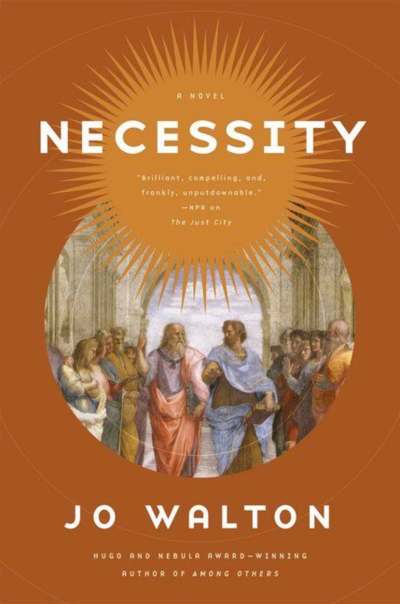
Walton’s Platonic sci-fi trilogy terrific

Advertisement

Advertise with us

It’s probably safe to say if Jo Walton hadn’t written Necessity and its two preceding volumes, nothing even remotely similar would exist. And that would be a terrible shame. The award-winning Welsh-Canadian writer is known for her refusal to write inside genre lines, and nowhere is that more evident than in her just-completed trilogy.

Read this article for free:


or

Already have an account? Log in here »

To continue reading, please subscribe:

Subscribe and receive a limited-edition Free Press branded hat or tote.

Digital Subscription

One year of digital access for only $205*

  • Enjoy unlimited reading on winnipegfreepress.com
  • Read the E-Edition, our digital replica newspaper
  • Access News Break, our award-winning app
  • Play interactive puzzles

*First annual payment billed as $205.00 + GST for one year. This annual subscription will automatically renew at $233.00 + GST every 52 weeks (10% off the regular annual price of $259.35). Offer available to new and qualified returning subscribers only. Cancel any time.

To continue reading, please subscribe:

Add Free Press access to your Brandon Sun subscription for only an additional

$1 for the first 4 weeks*

  • Enjoy unlimited reading on winnipegfreepress.com
  • Read the E-Edition, our digital replica newspaper
  • Access News Break, our award-winning app
  • Play interactive puzzles
Start now

*Your next Brandon Sun subscription payment will increase by $1.00 and you will be charged $17.95 plus GST for four weeks. After four weeks, your payment will increase to $24.95 plus GST every four weeks.

Hey there, time traveller!
This article was published 29/10/2016 (3578 days ago), so information in it may no longer be current.

It’s probably safe to say if Jo Walton hadn’t written Necessity and its two preceding volumes, nothing even remotely similar would exist. And that would be a terrible shame. The award-winning Welsh-Canadian writer is known for her refusal to write inside genre lines, and nowhere is that more evident than in her just-completed trilogy.

In the first book, The Just City, the Greek goddess of wisdom Athene plucked hundreds of classical scholars and philosophers from throughout history to set up a city modelled on Plato’s Republic. The seminal work of political philosophy imagined a perfect society wherein citizens would all strive to reach their greatest potential, the greatest among them to rule benevolently as philosopher kings. Plato sought an end to tyrants, sycophants and incompetents in civic life, and imagined a true meritocracy for the common good.

A philosophical thought experiment and an actual, functioning city are two different things. By the end of the second book, The Philosopher Kings, the original city had fragmented into dozens of competing versions before its denizens were divinely transported to an alien planet in the far future.
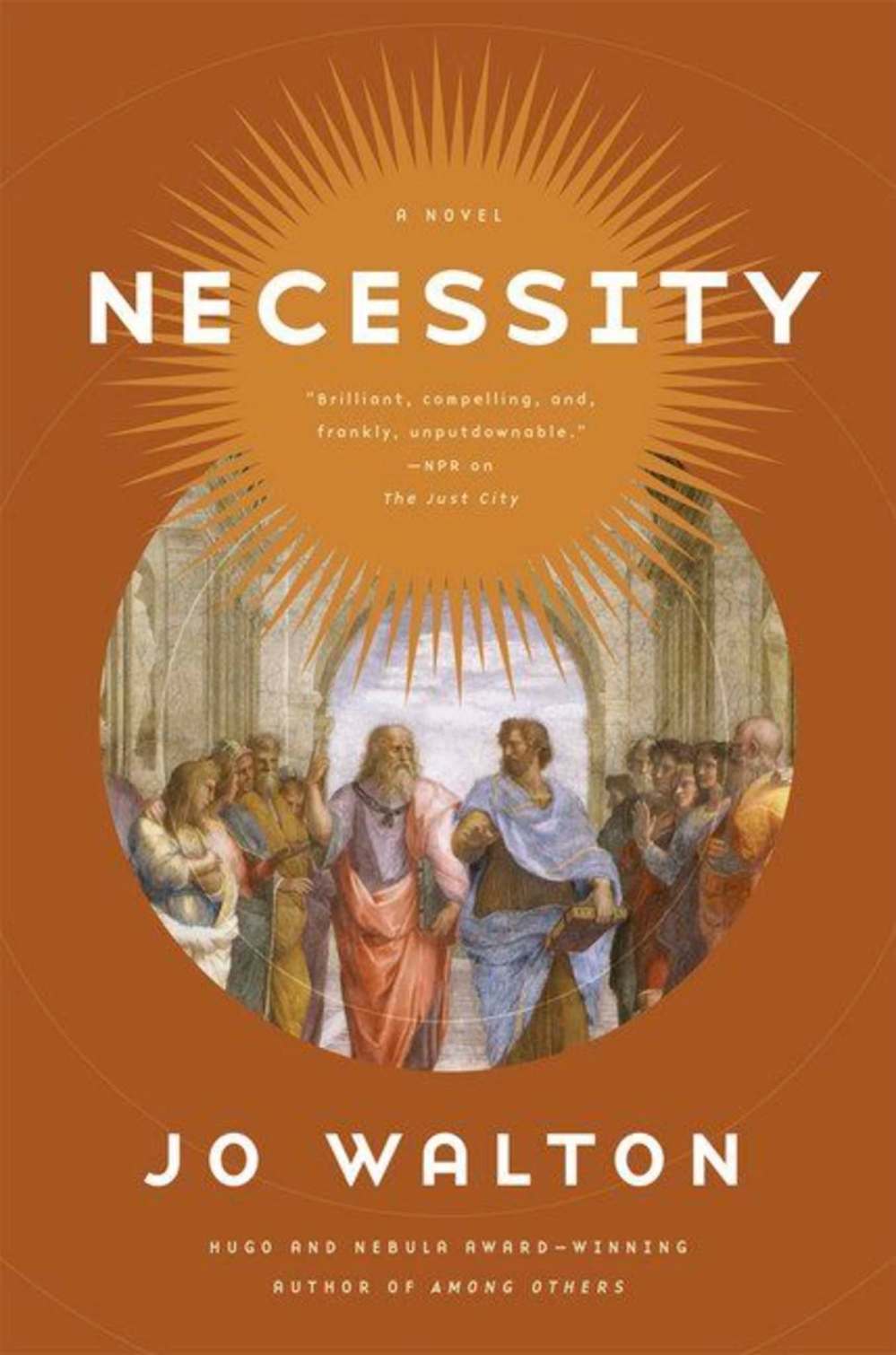
In Necessity, the cities now boast third and fourth generations of citizens who have never experienced life outside Plato, their world. They are used to the fact that aliens live among them, that the many robots originally transported from a future time to take the place of human slaves are in fact capable of sentience and therefore also entitled to opt for citizenship. And of course the existence of gods is also an irrefutable notion, given that Apollo himself is a citizen.

A common element of many of the great works of science fiction is the ability to grapple with big ideas. When this is done thoughtfully and deeply enough, a work might be described as philosophical science fiction. But this has never been so literally true as with Walton’s recent novels. Her memorable characters include famous Renaissance philosophers, newly sentient artificial intelligences, alien beings, and even alien gods, all seeking truth and meaning.

A robot wants to know: Does attaining consciousness also mean he has a soul? The god Apollo wants to know (because Zeus has not told him): What is the purpose of the universe? And everyone, human, alien and otherwise, wants to know the best way to live life, Platonically or otherwise — and, if the former, to know which interpretation of Plato is the correct one.

When people read Plato in English translation, they may not be aware that the translator is also making critical choices in word use and interpretation. One such example in Plato’s Republic revolves around a key concept described in Greek as arete, most often translated as virtue. This has a monastic tinge to it: Platonic life argued in terms of piety and scripture. But Walton favours the less popular but perhaps more appropriate translation of arete as excellence, and the connotations are entirely different.

This is important, as it shows Walton has done her homework — she hasn’t just read Plato, she’s read the commentary on Plato, the alternative translations of Plato, and the commentary on these translations of Plato. She knows the scholarship and has scholarly opinions, and that’s important because a book of ideas would fail if the author didn’t understand them.

It’s easy to name-drop Homer, Tacitus and Virgil, less so to synthesize history, mythology and philosophy into a fictional cross-genre narrative featuring many well-known historical figures without misrepresenting their work or personalities. If Walton had actually learned Latin and ancient Greek as part of her research for these novels, it would not be shocking.

Her readers have a less painful option: picking up these thoughtful, enjoyable and entirely original books, and maybe even getting a little bit smarter in the process.

Joel Boyce is a Winnipeg writer and educator.

Report Error Submit a Tip

More Stories

Rainbow Stage’s Legally Blonde a lovely legal musical

Holly Harris 5 minute read Preview

Rainbow Stage’s Legally Blonde a lovely legal musical

Holly Harris 5 minute read Friday, Aug. 14, 2026

Omigod, you guys! Rainbow Stage kicked off its penultimate summer production Thursday with a high-octane joy machine bathed in a sea of pink.

Inspired by the 2001 Hollywood film starring Reese Witherspoon, and Amanda Brown’s same-titled novel, the award-winning Legally Blonde: The Musical — featuring a book by Heather Hach, with music/lyrics by Laurence O’Keefe and Nell Benjamin — opened on Broadway in April 2007, followed by a subsequent West End run.

The tale — equal parts cheesy rom-com and potent siren call for female autonomy and empowerment — focuses on quintessential Cali-girl Elle Woods (a pitch-perfect Claire Mac Master). A proud daughter and president of Delta Nu sorority house, she enrols at Harvard Law School to win back her upwardly mobile ex-boyfriend, Warner Huntington III (Duncan Cox).

Laser-focused on marrying a “Jackie, not a Marilyn,” Warner dreams of becoming an American senator, latching onto uber-preppy fellow pupil Vivienne Kensington (Julie Davis), who becomes Elle’s arch nemesis.

Read
Friday, Aug. 14, 2026

Firefighter’s death fuels cancer fight

Zoe Pierce 5 minute read Preview

Firefighter’s death fuels cancer fight

Zoe Pierce 5 minute read Yesterday at 2:01 AM CDT

The United Fire Fighters of Winnipeg is mourning the loss of Winnipeg firefighter Darrel Maynard while continuing its work to raise awareness of occupational cancer and improve health protections for firefighters.

Maynard, a senior firefighter II and acting lieutenant with the Winnipeg Fire Paramedic Service, died Aug. 5 at age 41 after a three-year battle with occupational cancer.

He served Winnipeg for nearly two decades and leaves behind his wife Francine and sons Colin and Christian.

“Darrel was an incredible, incredible person, an incredible firefighter, and really, really special to all of us,” said Nick Kasper, president of UFFW.

Read
Yesterday at 2:01 AM CDT

HSC weapons scanners effective, needed at other hospitals: nurses union

Carol Sanders 5 minute read Preview

HSC weapons scanners effective, needed at other hospitals: nurses union

Carol Sanders 5 minute read Yesterday at 9:57 AM CDT

The AI weapons scanners at Health Sciences Centre have detected close to 2,000 items since they were installed at Manitoba’s largest hospital.

From March 6, 2025 to the beginning of this month, a total of 1,973 items had been flagged by the scanners and identified for further review, Shared Health said this week.

Knives, Swiss army knives and other multi-tools, drugs, alcohol, box cutters, syringes and other injection devices were detected, it said. The technology set up at entrances to the adult and children’s emergency rooms and the crisis response centre is designed to identify a wide range of objects that may require review under site safety protocols.

But Manitoba Nurses Union president Darlene Jackson said the technology isn’t available everywhere at HSC, and a sawed-off rifle was discovered in the adult ER earlier this month.

Read
Yesterday at 9:57 AM CDT

Could renewed interest in strategically critical rare earth elements finally make sub-sector profitable?

Joel Schlesinger 6 minute read Preview

Could renewed interest in strategically critical rare earth elements finally make sub-sector profitable?

Joel Schlesinger 6 minute read Yesterday at 3:00 AM CDT

Rare earth elements are among the most critical of mined resources for modern economies.

They’re essential in manufacturing specialized magnets used in a host of technologies from wind turbines and electric vehicles to hard drives, smartphones, television screens, and fibre optics. Most notably, however, rare earth minerals are increasingly vital to the defence industry.

These 17 elements — closely related chemically and usually found all together in mineral deposits — have indeed been growing in geopolitical importance as the United States, Canada and other Western nations recognize their dependence on production from China.

It is the world’s largest producer and processor of rare earths, including the most in-demand elements neodymium and praseodymium used to manufacture very light and powerful magnets for an array of technologies, including the most advanced weapons of modern warfare.

Read
Yesterday at 3:00 AM CDT

Walton’s Platonic sci-fi trilogy terrific

Reviewed by Joel Boyce 4 minute read Preview

Walton’s Platonic sci-fi trilogy terrific

Reviewed by Joel Boyce 4 minute read Saturday, Oct. 29, 2016

It’s probably safe to say if Jo Walton hadn’t written Necessity and its two preceding volumes, nothing even remotely similar would exist. And that would be a terrible shame. The award-winning Welsh-Canadian writer is known for her refusal to write inside genre lines, and nowhere is that more evident than in her just-completed trilogy.

In the first book, The Just City, the Greek goddess of wisdom Athene plucked hundreds of classical scholars and philosophers from throughout history to set up a city modelled on Plato’s Republic. The seminal work of political philosophy imagined a perfect society wherein citizens would all strive to reach their greatest potential, the greatest among them to rule benevolently as philosopher kings. Plato sought an end to tyrants, sycophants and incompetents in civic life, and imagined a true meritocracy for the common good.

A philosophical thought experiment and an actual, functioning city are two different things. By the end of the second book, The Philosopher Kings, the original city had fragmented into dozens of competing versions before its denizens were divinely transported to an alien planet in the far future.

In Necessity, the cities now boast third and fourth generations of citizens who have never experienced life outside Plato, their world. They are used to the fact that aliens live among them, that the many robots originally transported from a future time to take the place of human slaves are in fact capable of sentience and therefore also entitled to opt for citizenship. And of course the existence of gods is also an irrefutable notion, given that Apollo himself is a citizen.

Read
Saturday, Oct. 29, 2016

West Kildonan Industrial residents call for speed bumps after child hit by truck

Morgan Modjeski 3 minute read Preview

West Kildonan Industrial residents call for speed bumps after child hit by truck

Morgan Modjeski 3 minute read Updated: Yesterday at 3:09 PM CDT

Residents in the West Kildonan Industrial neighbourhood are calling on the city to install speed bumps in their area after a child was hit and dragged by a vehicle Thursday.

Katelyn Bemister lives near the area where the child — who was hospitalized as a result of the incident and has been upgraded to stable condition — was struck. She says people frequently speed in the area.

“They’re going really fast, and they’re not really paying attention at all to the pedestrians in the area,” says Bemister.

In video supplied to the Free Press by a resident, the child can be seen riding a bike down a sidewalk along the 500 block of North Point Boulevard.

Read
Updated: Yesterday at 3:09 PM CDT