In Conversation with Susan Holbrook
Advertisement
Read this article for free:
or
Already have an account? Log in here »
To continue reading, please subscribe:

Digital Subscription
One year of digital access for only $205*
- Enjoy unlimited reading on winnipegfreepress.com
- Read the E-Edition, our digital replica newspaper
- Access News Break, our award-winning app
- Play interactive puzzles
*First annual payment billed as $205.00 + GST for one year. This annual subscription will automatically renew at $233.00 + GST every 52 weeks (10% off the regular annual price of $259.35). Offer available to new and qualified returning subscribers only. Cancel any time.
To continue reading, please subscribe:
Add Free Press access to your Brandon Sun subscription for only an additional
$1 for the first 4 weeks*
- Enjoy unlimited reading on winnipegfreepress.com
- Read the E-Edition, our digital replica newspaper
- Access News Break, our award-winning app
- Play interactive puzzles
*Your next Brandon Sun subscription payment will increase by $1.00 and you will be charged $17.95 plus GST for four weeks. After four weeks, your payment will increase to $24.95 plus GST every four weeks.
Read unlimited articles for free today:
or
Already have an account? Log in here »
Hey there, time traveller!
This article was published 26/11/2016 (3563 days ago), so information in it may no longer be current.
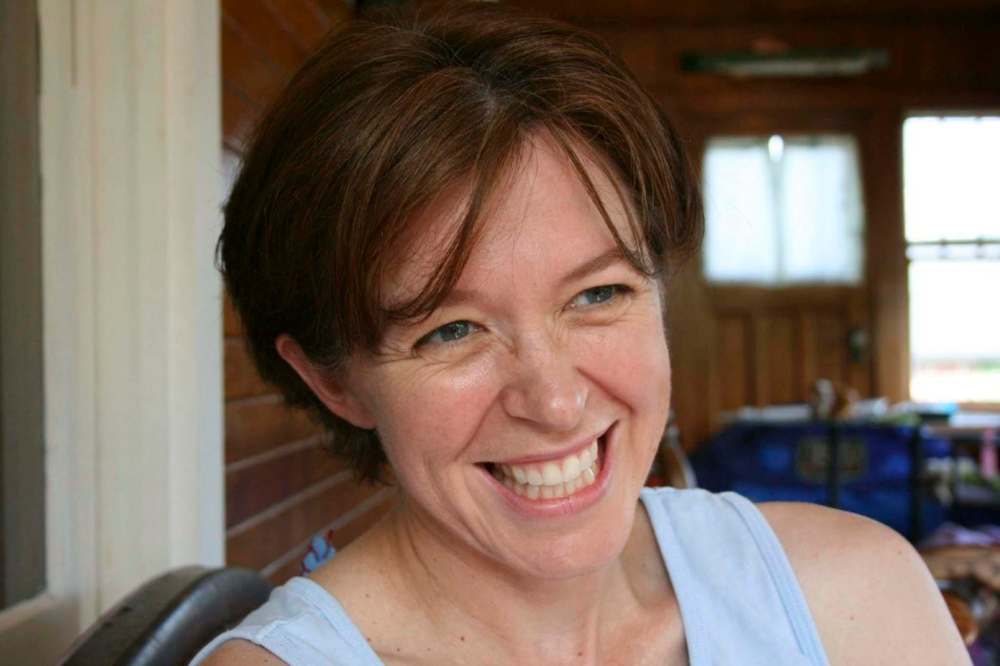
Susan Holbrook is a writer based in Leamington, Ont. She is the author of four books of poetry, including Joy is So Exhausting, which was nominated for a Trillium award. She also recently co-authored a poetry textbook, Reading (and Writing About) Poetry, with Broadview Press.
At the end of September, Holbrook launched her latest book, Throaty Wipes, at the Winnipeg International Writers Festival. A week later, she received the news that it was nominated for the Governor General’s Award for Poetry.
Winnipeg Free Press: What do you want people to know about Throaty Wipes?
Susan Holbrook: There’s a chicken on the cover! There are anagrams, a poem composed on a calculator, lyric poems, poems made of shredder bits, concrete poems, a revision of genesis, something for everybody…
FP: Speaking of which, the title for this collection is an anagram of “What is poetry?” Which comes from Gertrude Stein’s “What is poetry and if you know what poetry is what is prose.” It seems to me that you’re engaging in some pretty serious play here, but I could be wrong. What are you trying to do when writing a poem?
SH: I’m always trying to figure out how the world shapes us via language and how we might shape the world via language. It all happens in that wild, beautiful, dangerous, funny, wounded, hopeful stuff that we talk and write with. I just get in there and yes, play, but I’m always hoping that play will bring readers into more intimate relation with their words, more empowered relation with their environments.
FP: Tell me about the pleasures of working with form poetry and experimental techniques.
SH: Experimental writing offers an open process. It lets you, well, experiment. It’s research, exploratory rather than declarative. And working within a new form, like choosing an old form, offers the magic of constraint. When you have to stick to a certain number of syllables, as in a sonnet, or avoid the letter ‘u’, or whatever the rule, you are forced into finding language you never would have encountered otherwise. You have to kick your intentions and habits out of the way and you invariably discover something true.
FP: After four books, what have you learned about your own writing? Your process?
SH: That I’m slow, and that’s OK. Ideas pop through in the middle of the night or when I’m driving, rather than at a writing desk. I just have to remember to set aside a little time to follow through on them so they get written.
FP: Who are the writers you look to? Who are your influences?
SH: Harryette Mullen, Sina Queyras, Nourbese, Charles Bernstein, Lee Ann Brown, Robert Kroetsch. So many others… I love work that’s formally innovative and political and musical and funny.
FP: You teach creative writing and edit poetry manuscripts in addition to your own practice. How has this deeply engaged work with other people’s writing changed your work?
SH: That’s really mostly what I do in my life, edit. I tell my students that learning to edit each other will make them newly attentive to their own work and I think that’s so. Editing for Coach House means I get to work very closely with the most incredible writing. It’s very inspiring, seeing the poetic possibilities.
FP: As a writer (i.e. Someone whose artistic practice is predicated on time spent alone) how do you approach readings? What do you get out of them?
SH: Sometimes it feels like a fun little party. I love to know my work has made somebody laugh or touched them or inspired them — it’s part of what an artist wants to do.

FP: What are you reading right now? What are you writing right now?
SH: Reading Margaret Christakos’s Her Paraphernalia, which is amazing, and writing up the minutes from a committee meeting. No poems. But that gives me an idea…
Ariel Gordon is a Winnipeg writer.