

Monkey say, monkey do
Vowel sounds made by baboons show roots of human speech may go back 25 million years
Advertisement
Read this article for free:
or
Already have an account? Log in here »
To continue reading, please subscribe:
Monthly Digital Subscription
$1 per week for 24 weeks*
- Enjoy unlimited reading on winnipegfreepress.com
- Read the E-Edition, our digital replica newspaper
- Access News Break, our award-winning app
- Play interactive puzzles
*Billed as $4.00 plus GST every four weeks. After 24 weeks, price increases to the regular rate of $19.95 plus GST every four weeks. Offer available to new and qualified returning subscribers only. Cancel any time.
Monthly Digital Subscription
$4.99/week*
- Enjoy unlimited reading on winnipegfreepress.com
- Read the E-Edition, our digital replica newspaper
- Access News Break, our award-winning app
- Play interactive puzzles
*Billed as $19.95 plus GST every four weeks. Cancel any time.
To continue reading, please subscribe:
Add Free Press access to your Brandon Sun subscription for only an additional
$1 for the first 4 weeks*
*Your next subscription payment will increase by $1.00 and you will be charged $16.99 plus GST for four weeks. After four weeks, your payment will increase to $23.99 plus GST every four weeks.
Read unlimited articles for free today:
or
Already have an account? Log in here »
Hey there, time traveller!
This article was published 15/01/2017 (3292 days ago), so information in it may no longer be current.
Listen closely to those baboon calls — they may tell you a thing or two about human speech.
Scientists who studied baboons’ wahoos, yaks, barks and other vocalizations have found evidence of five vowel-like sounds — a sign the physical capacity for speech may have evolved over much longer time scales than previously thought.
The findings, described in the journal PLOS One, could have significant implications for our understanding of human speech’s development and the emergence of language.
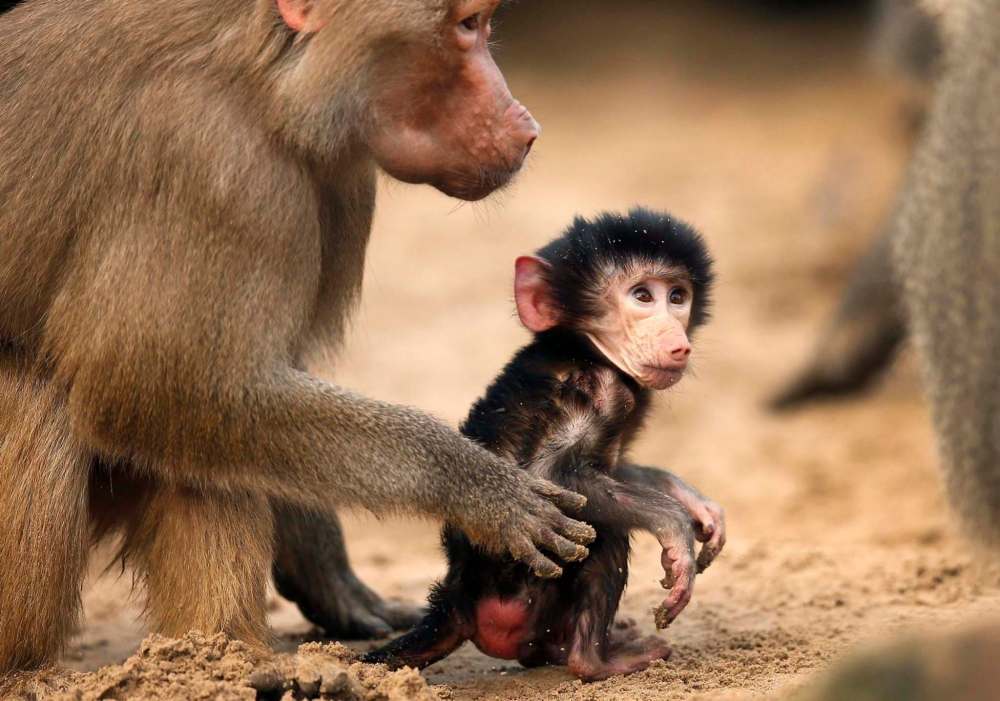
Scientists studying the evolution of speech are left in a tricky bind because, unlike bones or shells, spoken words leave no fossil imprints in the geological record. How do you study the development of something as insubstantial as a sound?
Luckily, there are physical structures we can study — the mouths that make those sounds. By comparing the mouths of humans and their close relatives, researchers get a sense of which particular traits were necessary for the emergence of speech in humans — or perhaps, which physical characteristics would have impeded it.
“While it shares neuro-cognitive mechanisms with language, speech also engages anatomical traits that might leave fossil clues, as well as overt anatomical, physiological and behavioural aspects for which parallels can be sought in living primates,” the study authors wrote.
Human speech is, in large part, based on using vowels as the kernel of a sound and placing consonants around those vowels. So the number of different vowels you can make is important, because it means you can make more potentially meaningful chunks of sound.
Think about “cat,” “kit,” “cut,” “coat,” “coot,” “keet” and “caught” — seven words with different meanings. Each has a “k” sound at the beginning and a “t” at the end and are essentially differentiated in sound only by their vowels. Without each of those subtly distinguishable vowels, we wouldn’t be able to tell those words apart.
Languages have different inventories and patterns of vowel and consonant usage, but they all rely on roughly the same vocal-tract shape. For a long time, many researchers assumed non-human primates couldn’t make vowel-like sounds because their larynxes (or voice boxes) sat much higher in the neck than human larynxes do. That assumption had major implications for theories on the emergence of language, which remains a uniquely human ability.
“This theory has often been used to buttress the theoretical claim of a recent date for language origin, e.g. 70,000-100,000 years ago,” the study authors explained.
“It also diverted scientists’ interests away from articulated sound in non-human primates as a potential homolog of human speech and thus lent support to less direct explanations of language evolution, involving communicative gestures, complex cognitive or neural functions or genetics.”
Recent research has begun to challenge that assumption about the larynx, the study’s authors wrote. First off, lowered larynxes have been found in other animals that have no ability to make vowels. And human babies, who have very high larynxes, can still generate the same vowel range as adults can. Scientists have begun to realize, through computer modelling work, the movement and control of the tongue’s position is actually much more important in making vowel sounds than the height of the larynx.
To test this idea, a French-led team of scientists studied vocalizations from 15 guinea baboons (12 female and three males) living in an outdoor enclosure at the National Center for Scientific Research’s primate centre in Rousset-sur-Arc, France.
They focused in particular on the half-hour before feeding, when the community of two dozen baboons was particularly vocal, and avoided recording during the dinner hour, when they were busy munching on their meals.
The scientists analyzed the recordings looking for “formants” — concentrations of acoustic energy around key frequencies in human speech, and whose distribution is defined by the shape of our vocal tract. The individual formants found in a vowel can tell you the configuration of the mouth that made it — for example, how high the tongue is, whether it’s pushed forward (closer to the teeth) or back in the mouth and whether the lips are rounded. In human speech, each vowel has a particular blend of formants that make it a unique, easily identifiable sound.
The scientists ended up analyzing five types of vocalizations that also appeared to feature formants — grunts, wahoos, barks, yaks and mating calls. After analyzing the 1,335 spontaneous vocalizations (and after splitting the wahoos into their wa- and -hoo subunits), the researchers concluded the recordings held 1,404 “vowel-like segments.”
The scientists also verified baboons are physically capable of making these sounds by dissecting and analyzing the tongues of two baboons (both of whom had already died of natural causes that were unrelated to the study). For the ability to make specific vowel-like sounds, it seemed tongue position really was more important than the larynx’s height.
Many scientists have thought human speech may have evolved recently — within the last 100,000 years or so — partly because they figured humans’ primate ancestors didn’t have vocal tracts that were physically capable of generating speech. But the new findings show this assumption is not true. The ability to articulate vowel-like sounds, necessary for the development of human speech, was probably shared by the last common ancestor of humans and baboons 25 million years ago.
“We believe that the currently dominant view, that vowel systems can only have emerged after the descent of the larynx in modern Homo sapiens, is falsified by our finding of five distinct vowel qualities in a two-dimensional system in an old-world monkey, the Guinea baboon,” the authors wrote.
The scientists suggest this ability to create distinct vowels using the vocal tract became more sophisticated over time in the ancestors of modern humans.
“Whatever the course of the emergence of language and speech, the evidence developed in this study does not support the hypothesis of the recent, sudden and simultaneous appearance of language and speech in modern Homo sapiens,” they wrote.
“Rather, our findings in a monkey species allow us to infer certain features of ancestral communication systems antedating our own species.”
— Los Angeles Times