Make room for mushrooms
Manitoba's newest foraging expert shares tips on growing edible and soil-nourishing fungi in your own backyard

Advertisement
Read this article for free:
or
Already have an account? Log in here »
To continue reading, please subscribe:

Digital Subscription
One year of digital access for only $205*
- Enjoy unlimited reading on winnipegfreepress.com
- Read the E-Edition, our digital replica newspaper
- Access News Break, our award-winning app
- Play interactive puzzles
*First annual payment billed as $205.00 + GST for one year. This annual subscription will automatically renew at $233.00 + GST every 52 weeks (10% off the regular annual price of $259.35). Offer available to new and qualified returning subscribers only. Cancel any time.
To continue reading, please subscribe:
Add Free Press access to your Brandon Sun subscription for only an additional
$1 for the first 4 weeks*
- Enjoy unlimited reading on winnipegfreepress.com
- Read the E-Edition, our digital replica newspaper
- Access News Break, our award-winning app
- Play interactive puzzles
*Your next Brandon Sun subscription payment will increase by $1.00 and you will be charged $17.95 plus GST for four weeks. After four weeks, your payment will increase to $24.95 plus GST every four weeks.
Read unlimited articles for free today:
or
Already have an account? Log in here »
Hey there, time traveller!
This article was published 04/02/2017 (3514 days ago), so information in it may no longer be current.
Tom Nagy is on a mission. Passionate about the study of the relationship between people and plants, he finds the integration between himself and the natural world to be liberating. Nagy’s curious palate leads him to fearlessly forage and to teach himself and others traditional methods of food production, including how to grow fungi.
A graduate of Sir Sandford Fleming College in Peterborough, Ont., where he studied ecosystem management and ecology, Nagy recently moved to Winnipeg. A rabid mushroom enthusiast, he has wasted little time in exploring the wild fungi that grow in Manitoba.
Isn’t it one thing to forage for edible mushrooms and another to cultivate a mushroom patch in your own backyard? It’s elementary, says Nagy, who likes to focus on growing two edible mushrooms in particular — oyster mushroom (Pleurotus ostreatus) and wine cap mushroom (Stropharia rugosoannulata).
The oyster mushroom has a white-to-grey or tan, shell-like appearance. The wine cap mushroom, also known as king stropharia or garden giant, has a burgundy purple-red cap with charcoal-grey gills and a white stalk.
Both the oyster and wine cap mushrooms are North American native species. They differ, however, in the type of substrate material in which they prefer to grow.
Oyster mushrooms are saprophytic, which means they are able to obtain nourishment from dead organisms or decaying organic material. They grow on rotting wood, Nagy says, but are so versatile they will also grow on any sort of wood by-product or fibrous, carbon-rich plant material.
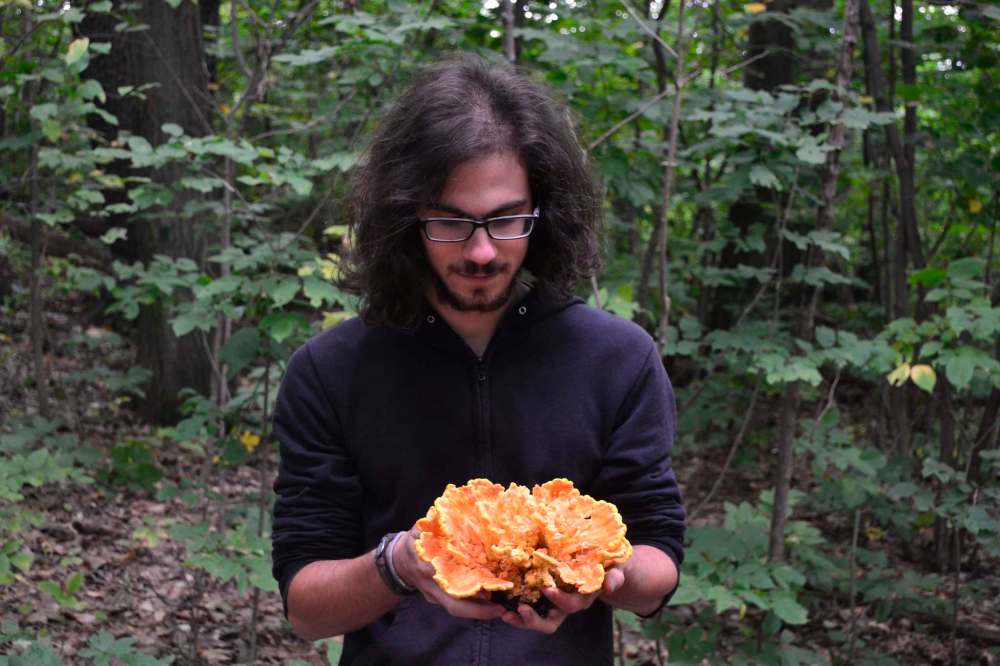
Indeed, Nagy says, you can grow oyster mushrooms on shredded newspaper, cardboard, toilet paper or paper towel rolls. Yields, however, won’t be optimum.
Interestingly, coffee grounds are also a viable medium in which to grow oyster mushrooms. Rich in carbon and nitrogen, coffee grounds are a hospitable environment for the mushroom mycelium, facilitating digestion and extraction of nutrients. Straw, too, is a common substrate material in which to grow oyster mushrooms.
In order for the oyster mushroom mycelium to colonize and fruit successfully, pasteurization of the substrate is a necessary first step, Nagy says. Methods include heat or steam pasteurization or a lime bath.
Purchase hydrated lime (calcium hydroxide) at a local garden supply or hardware store. Mix the lime with water according to directions, then soak the straw substrate. Remove and allow the straw to drain. Begin by mixing the oyster mushroom spawn into the pasteurized straw. Once completed, pack the mixture firmly into sealed bags or plastic containers that have been evenly perforated to allow for an adequate amount of air exchange.
You can start your oyster mushrooms indoors in early April. Nagy recommends placing the bag or basket on a metal rack in a well-ventilated room and covering it loosely with a layer of plastic to promote a humid environment.
In May, move the mushrooms outdoors, hanging the bag or basket from a low-lying tree branch where it is protected from any direct sunlight. Oyster mushrooms colonize very quickly and fruit in cooler temperatures, Nagy says. “You could have your first flush in a matter of weeks.”
“The nature of oyster mushrooms,” Nagy says, “is to fruit in beautiful, tight clusters. Masses of mushrooms fruit from perhaps only two or three of the perforated holes. For whatever reason, they don’t use every single hole that you create in the sides of the bag or pail. It’s fascinating to watch.”
Take care to monitor the fruiting process. From the time that fruiting begins, there will be only five to six days before the mushrooms are ready to harvest, Nagy says. Indeed, the mushrooms can nearly double in size in a 24-hour period. When you notice that the margins of the cap are slightly inrolled and then begin to flatten out, your mushrooms are ready to harvest. The spores are rich in flavour until they start to release.
“Harvest the oyster mushrooms the same way you would pick an apple,” Nagy says, “gripping them at the base, then gently twist and pull.” Don’t worry if a small amount of substrate comes off with the mushroom. What’s important is that you not cut them, as the stub left behind can become infected and lead to contamination, Nagy says. Picking the mushrooms is enough of a gentle disturbance to encourage the mycelium to fruit again from that same location.
Unlike oyster mushrooms, wine-cap mushrooms are terrestrial, so they grow in the ground. No pasteurization of the substrate is required, Nagy says, as wine caps require soil bacteria and micro-organisms in order to thrive. Notoriously aggressive, they are better suited than oyster mushrooms at out-competing any moulds or weed fungi that may be present in the growing environment, Nagy says. This type of edible fungi can be grown easily in a hardwood woodchip and hardwood sawdust substrate in your backyard.
Early spring is an ideal time to create your outdoor mushroom patch. Begin by layering five to seven centimetres of hardwood woodchips. On top of that, Nagy recommends adding three to five centimetres of hardwood sawdust. Water the area to moisten (mycelium needs a moist environment to thrive). Before openly broadcasting the spawn onto the prepared surface, squeeze the contents of the bag in which the spawn is contained, massaging it gently into smaller pieces until the contents have a crumbly texture.
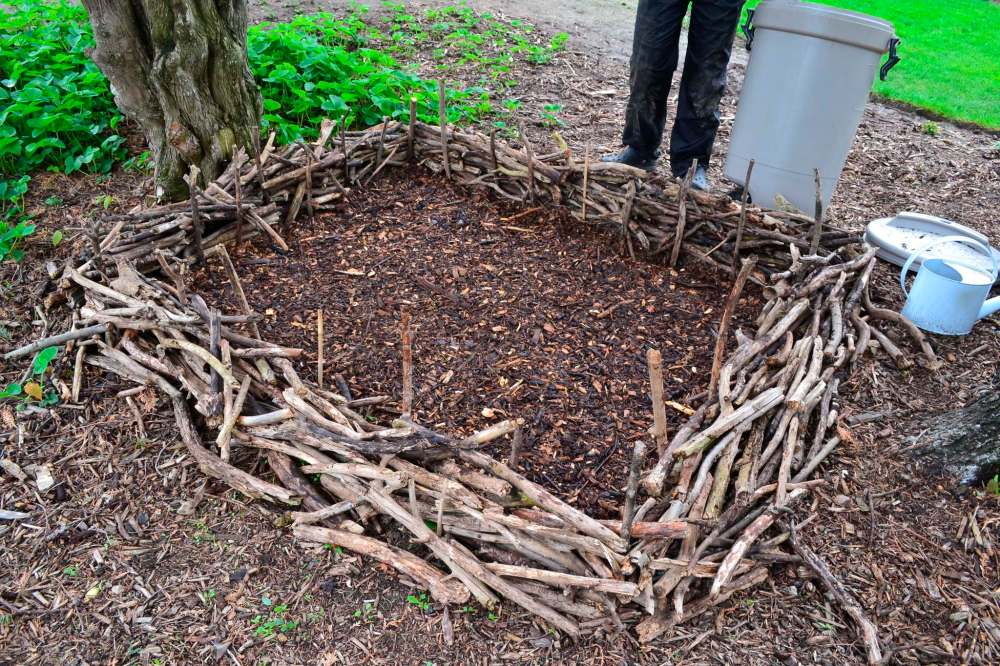
Next, Nagy says, add another layer of moistened sawdust topped with an additional seven to 10 cm layer of woodchips. The depth of the layers, combined, should be approximately 30 cm in total. Adding a shallow trench or creating a border of twigs around the perimeter of the patch helps to prevent water run-off. It takes two to three months to establish your mushroom patch — by the end of August or early September, you could see a flush of mushrooms.
The following year, expect to see one or two flushes over the course of the summer and each year afterward, provided you are feeding the patch with small yearly applications of hardwood mulch to supplement the existing material. In addition to harvesting tasty wine-cap mushrooms, Nagy says, the mycelium from the mushrooms is consuming and deriving energy from the woodchips, gradually breaking them down and converting them into rich, friable soil.
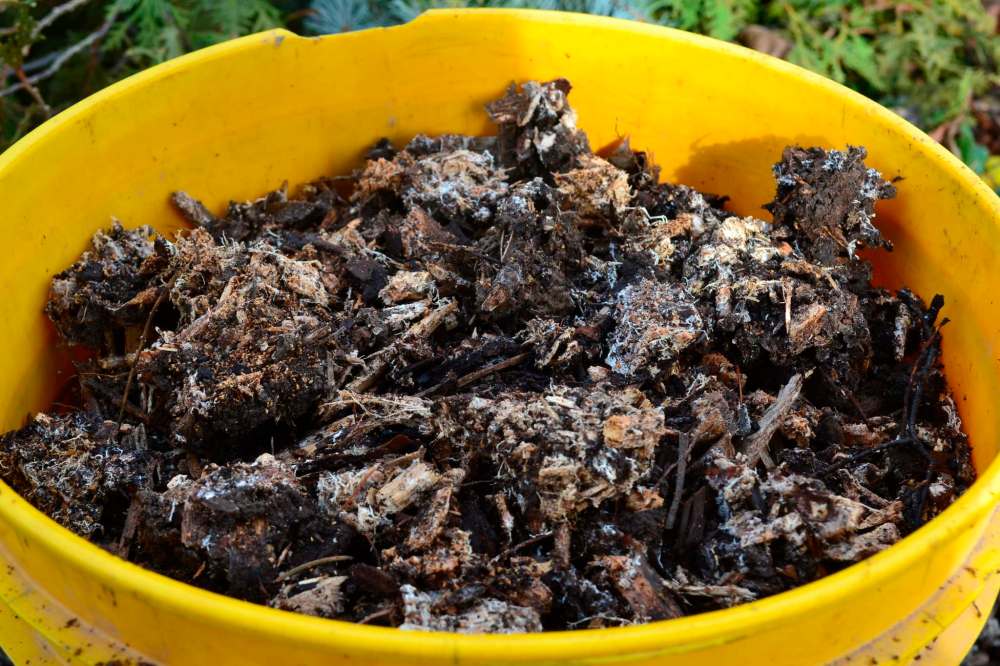
Mushrooms, as the spore-bearing structures of fungi, are primary decomposers. They have the amazing potential to remediate and improve soil that can then be used for growing plants such as vegetables, fruit trees or ornamentals.
If you would like to try growing oyster or wine cap mushrooms, you will need to first source mushroom spawn that has been inoculated with mycelium.
In Canada, two sources are Mycosource (Toronto) and MycoBoutique (Montreal). The standard size for a bag of spawn, is approximately 2.5 kilograms, Nagy says. A sterile product, the mushroom mycelium has been created under laboratory conditions and contains no mold spores or other fungi. The amount supplied is enough to inoculate an outdoor bed of hardwood woodchips that is approximately 4.5 square metres.
To learn more, visit Nagy’s website at outsidethehops.com.
colleenizacharias@gmail.com

Colleen Zacharias
Gardening columnist
Colleen Zacharias writes about many aspects of gardening including trends, plant recommendations, and how-to information that is uniquely relevant to Prairie gardeners. She has written a column for the Free Press since 2010 and pens the monthly newsletter Winnipeg Gardener. Read more about Colleen.
Every piece of reporting Colleen produces is reviewed by an editing team before it is posted online or published in print — part of the Free Press‘s tradition, since 1872, of producing reliable independent journalism. Read more about Free Press’s history and mandate, and learn how our newsroom operates.
Our newsroom depends on a growing audience of readers to power our journalism. If you are not a paid reader, please consider becoming a subscriber.
Our newsroom depends on its audience of readers to power our journalism. Thank you for your support.
Event
Plan to attend Seedy on Saturday, Feb. 11, at Canadian Mennonite University, for a gathering of gardeners and foodies celebrating local seeds. Bring your seeds to swap with others. 10 a.m. to 3 p.m., 500 Shaftesbury Blvd.
Colleen Zacharias
Gardening columnist
Colleen Zacharias writes about many aspects of gardening including trends, plant recommendations, and how-to information that is uniquely relevant to Prairie gardeners. She has written a column for the Free Press since 2010 and pens the monthly newsletter Winnipeg Gardener. Read more about Colleen.
Every piece of reporting Colleen produces is reviewed by an editing team before it is posted online or published in print — part of the Free Press‘s tradition, since 1872, of producing reliable independent journalism. Read more about Free Press’s history and mandate, and learn how our newsroom operates.
Our newsroom depends on a growing audience of readers to power our journalism. If you are not a paid reader, please consider becoming a subscriber.
Our newsroom depends on its audience of readers to power our journalism. Thank you for your support.
Advertisement Advertise With Us
Advertisement Advertise With Us