

Removing Baltimore’s blight, brick by brick
City, like others in U.S., hopes demolishing abandoned housing will allow neighbourhoods to thrive
Advertisement
Read this article for free:
or
Already have an account? Log in here »
To continue reading, please subscribe:
Monthly Digital Subscription
$1 per week for 24 weeks*
- Enjoy unlimited reading on winnipegfreepress.com
- Read the E-Edition, our digital replica newspaper
- Access News Break, our award-winning app
- Play interactive puzzles
*Billed as $4.00 plus GST every four weeks. After 24 weeks, price increases to the regular rate of $19.95 plus GST every four weeks. Offer available to new and qualified returning subscribers only. Cancel any time.
Monthly Digital Subscription
$4.99/week*
- Enjoy unlimited reading on winnipegfreepress.com
- Read the E-Edition, our digital replica newspaper
- Access News Break, our award-winning app
- Play interactive puzzles
*Billed as $19.95 plus GST every four weeks. Cancel any time.
To continue reading, please subscribe:
Add Free Press access to your Brandon Sun subscription for only an additional
$1 for the first 4 weeks*
*Your next subscription payment will increase by $1.00 and you will be charged $16.99 plus GST for four weeks. After four weeks, your payment will increase to $23.99 plus GST every four weeks.
Read unlimited articles for free today:
or
Already have an account? Log in here »
Hey there, time traveller!
This article was published 05/02/2017 (3299 days ago), so information in it may no longer be current.
BALTIMORE — The nine row houses a few blocks from Johns Hopkins Hospital stood for more than a century, through waves of immigration, two world wars, the upending of the city’s economy and a shift in its racial makeup.
The arched windows along the 900 block of North Bradford Street reflected both the boom and the decline of a great American city: the prosperous mid-century, when all nine households could afford the Formstone that covered their brick fronts; the tumult of 1968, when residents could smell the smoke from nearby riots; the white flight that would open the street to African Americans and the drug wars that would drive many of them away.
Since it was built on an old brickyard in 1905 by the “two-storey king of East Baltimore,” hundreds of people have called the block home.
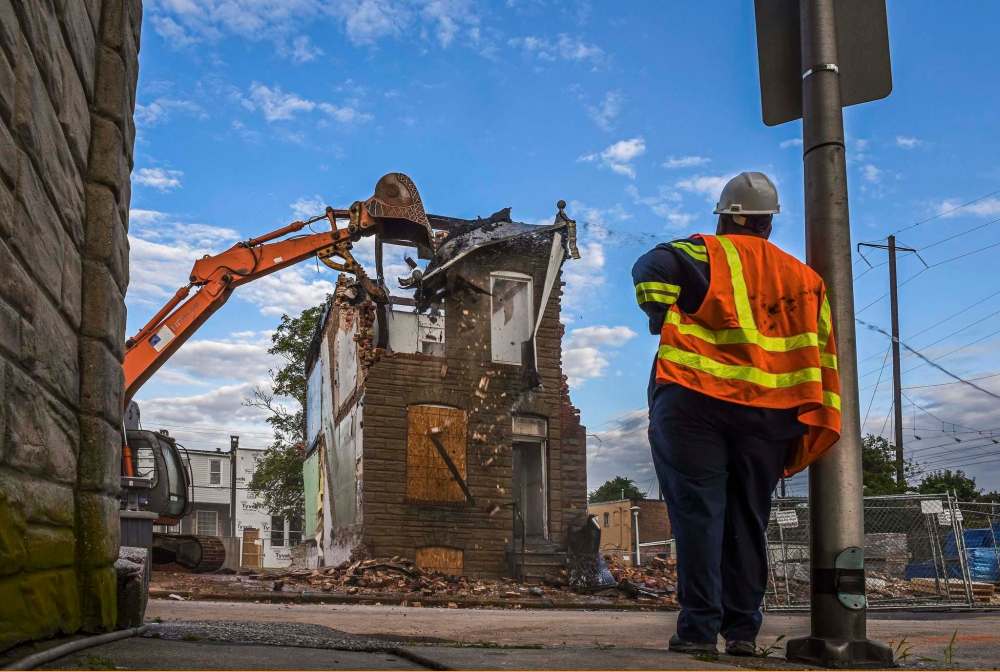
Only one of them was there to see that history end.
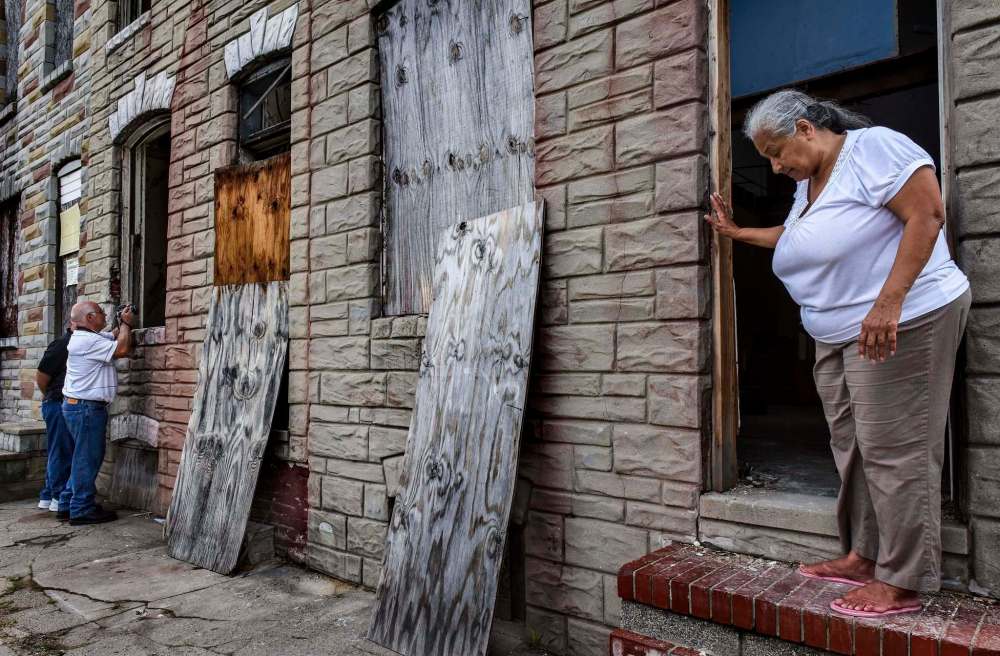
Mable Olds, 69, the last resident of 936 North Bradford, was on hand to see the government-paid excavator roll up to the house where she — and many mothers before her — had raised her family.
“I don’t know,” Olds said on a sunny summer morning, standing by the manhole cover that had been home plate when her son played baseball on the narrow street. “I just don’t know about tearing down good houses.”
She was not the only one uncertain about the intentional destruction she was about to witness. Baltimore, like Detroit and other aging American cities plagued by abandoned housing, is spending millions of dollars tearing out blighted pieces of itself in the hope that, like a pruned tree, the rest of the city will bloom.
As Maryland’s largest city has dwindled to about 620,000 today from a peak population of 950,000 in 1950, the receding tide has left behind 17,000 boarded-up houses and buildings, unoccupied, unwanted and unstable. They are scattered throughout the city, with major concentrations on the east side, as well as in battered West Baltimore, where 25-year-old Freddie Gray’s death from an injury suffered in police custody triggered riots in 2015.
Some of the vacant houses are brick hulks, roofless and irreparable, in such danger of collapse the city keeps a demolition crew on standby 24 hours a day. But many are structurally sound, artifacts of Baltimore’s rich history and the craftsmanship of its earlier days.
City planners hope the demolitions will give a boost to its struggling, often crime-plagued communities. Others are skeptical or downright suspicious.
“I hope it’s not just to move black people out,” Olds said.
That’s a common fear in a neighbourhood where Johns Hopkins, a world-renowned and ever-expanding hospital, has just built a public charter school a block away and where millennials moving into rehabbed row houses play with their pets on a grassy, demolition-created field.
“People need houses, not dog parks,” declared Olds’s son, Barak Olds, who said the hospital has long been open about its desire to remake the area.
“When I was a kid, they used to have a model of the whole neighbourhood at Hopkins, how they wanted it to look,” he said. “This is the fruition of that plan.”
● ● ●
Mable Olds raised her 44-year-old son and two daughters at 936 North Bradford St. while working shifts at a laundry plant. She moved into the 760-square-foot row house in 1974, bought it in 1978 for US$4,000 and lived in it until there were only three other homes still occupied on the block.
Olds was the last owner. The first was Lewis Crossont, a German American glass factory worker who paid about US$800 for the house in 1906 and moved in with his wife and sister. In the decades between, a factory foreman, barrelmaker and house painter made No. 936 home.
“So many families here,” Olds said quietly. The glittered and glued letters C-H-L-O-E-E were still stuck on her granddaughter’s bedroom wall.
A workman took up a fire hose, ready to spray down the demo dust. He grew up four blocks away from Bradford. Another worker, ready to stack salvaged bricks on a pallet, had an aunt who lived across the street. These were not strangers taking down the neighbourhood.
“Oh, I knew Miss Emma very well before she went to the nursing home,” said Jerome (Reds) Banks, pointing at one of the houses as he got ready to climb into the cab of his Hitachi excavator and knock it down. “She was a good friend of my mother’s.”
Across the street, as he waited in the shade to load his dump truck with the tonnes of debris each house would produce, “Big Mike” Saunders, 59, remembered his own mother. She cleaned stoops on these streets for seven hours a day, going door to door with a bucket and a can of Ajax.
He described the end of the milkman era and the bags of furnace coal you had to shove through basement windows. He learned to make sausage from the Polish butchers in the market, hunkered down during the riots and saw his black neighbours begin to move out when drugs came and crime soared in the 1990s.
“I seen this whole neighbourhood change, man,” Saunders said.
A diesel engine revved to life across the street. Saunders leaned back on a stoop. He was going to watch it change some more.
● ● ●
When the 900 block of North Bradford Street was built in 1905, Baltimore was growing. It was the sixth-biggest city in America, and the great wave of European immigration was still depositing Poles, Germans, Italians and others in ethnic enclaves all over the city.
A good many Czechs — then described as Austro-Bohemians on census documents — gathered in “Little Bohemia” north of Patterson Park, where a young builder named Frank Novak was putting up row houses fast enough to earn the “two-storey king” moniker. He built the homes on North Bradford for about US$700 each, with bricks produced around the corner on Eager Street and lumber brought up by ship from Georgia and North Carolina.
They were “alley houses,” just three metres wide, with shallow window arches and wooden stoops, and their three tiny bedrooms were crammed with big families such as the Mifkovics.
Peter Mifkovic, a young labourer who came over from a village just north of Bratislava in what is now Slovakia in 1905, and his new wife, Agnes, moved into 930 N. Bradford, where all six of their children grew up. The house was a boisterous gathering place for the next half-century as the Mifkovic children married into German, Italian and Irish families.
‘I just don’t know about tearing down good houses… I hope it’s not just to move black people out’– Mable Olds, the last resident of 936 North Bradford St.
“It was a league of nations around that dining-room table,” remembered Mary Mifkovic, 91, who lives in a suburban retirement community. She was married for 62 years to Ed, the youngest Mifkovic boy, who was born in 1923 in one of the upstairs bedrooms.
The two met at Martin Aviation, the airplane manufacturer where both worked just after the Second World War. Ed’s mother, who never learned much English, worked at a tomato cannery. One sister worked in a textile plant, two others for McCormick, all downtown factories.
After the war, Ed and Mary Mifkovic joined the growing migration to the suburbs.
“Everybody was sold on the idea that you wanted to live in an environment with grass and trees and new schools,” said Francis O’Neill, a Baltimore historian at the Maryland Historical Society.
“They built new roads making it feasible to commute back to the factories, but then the factories began to move out, too.”
● ● ●
In a growing city, a vacant house is an asset. In a shrinking one, it is a menace. The empty yard becomes a dump; plywood sheets do little to keep out squatters, drug dealers, sex-trade workers and arsonists. Fires started in abandoned buildings cause US$900 billion in property damage and kill 45 people a year, the U.S. Fire Administration says.
Worse, blight is contagious. An abandoned house saps the property value of its neighbours and can trigger more decay.
“People start to lose faith in the block,” said Alan Mallach, an economist at the Center for Community Progress and the former housing director of Trenton, N.J. “People begin to care less. Those who can think about moving.”
The inventory of abandoned homes in the United States grew by more than 4.5 million between 2000 and 2010, fuelled by the foreclosure crisis. Rust Belt mayors, confronted with neighbourhoods that looked like deserted movie sets, started talking less about growth and more about “right-sizing.”
Akron and Toledo, Ohio; Flint, Mich.; Buffalo and other cities began demolishing vacant structures as an alternative to managing them. Detroit has torn down almost 11,000 using more than US$580 million from the federal government’s Hardest Hit Fund, a program targeting the states most stricken by foreclosures.
The promise of demolition is twofold. It eliminates the hazards associated with abandoned buildings and boosts the values of the houses that are left. It also creates green space — sometimes urban gardens, sometimes weedy lots.
Mallach has been bullish on demolition, touting its potential in an influential 2012 Brookings Institution report. He cites two recent studies that show healthy effects in Detroit and Cleveland. In Detroit, researchers found each house that was knocked down boosted the value of nearby properties by more than four per cent.
But as more cities tear down more houses, he has become less certain. Neighbourhoods that are largely intact can clearly benefit from having the vacant structures pruned out, Mallach said. But sometimes, the bulldozers leave too many holes in the community fabric.
“In some cases, demolishing a lot of houses might be removing that neighbourhood’s chance to revive in the future,” Mallach said.
“There’s still a lot of ambivalence about it.”
Baltimore, still struggling to recover from the chaos and soaring crime that followed Gray’s death, has spent about US$40 million laying siege to blighted neighbourhoods since 2012. Approximately 500 rowhouses were knocked down in 2016, about the same pace as the previous year. Maryland Gov. Larry Hogan, a Republican, has pledged US$74 million in state money. It would take about US$500 million to clear away all of the boarded-up properties.
City officials said residents of the affected neighbourhoods have been overwhelmingly supportive, including those who have to be relocated.
“We have people saying, ‘When are you going to get around to our block?’” said Baltimore acting housing commissioner Michael Braverman.
Bradford, after requests from neighbourhood leaders, made it onto the list in 2013.
● ● ●
The block began to shift from white to black during the postwar migration to the suburbs. David Bell, 64, an African American who has lived on the opposite side of the block at 909 N. Bradford for most of his life, can remember when black families and aging white immigrants lived side by side. The newcomers called the immigrants “Germans,” no matter where they were born.
“We had an old German man next to us for a long time, used to give us candy,” Bell said. “All the white folks went to St. Wenceslaus (Catholic Church), and the black folks went to Israel Baptist.”
On a hot afternoon the week before the demolition was scheduled, Bell was sitting on a Bradford stoop with another longtime neighbourhood resident, Alvin Gentry, 64. A commuter train roared by, close enough to make the pavement quiver.
“We used to walk those tracks before Amtrak came,” Gentry said. “Remember those smoky trains?”
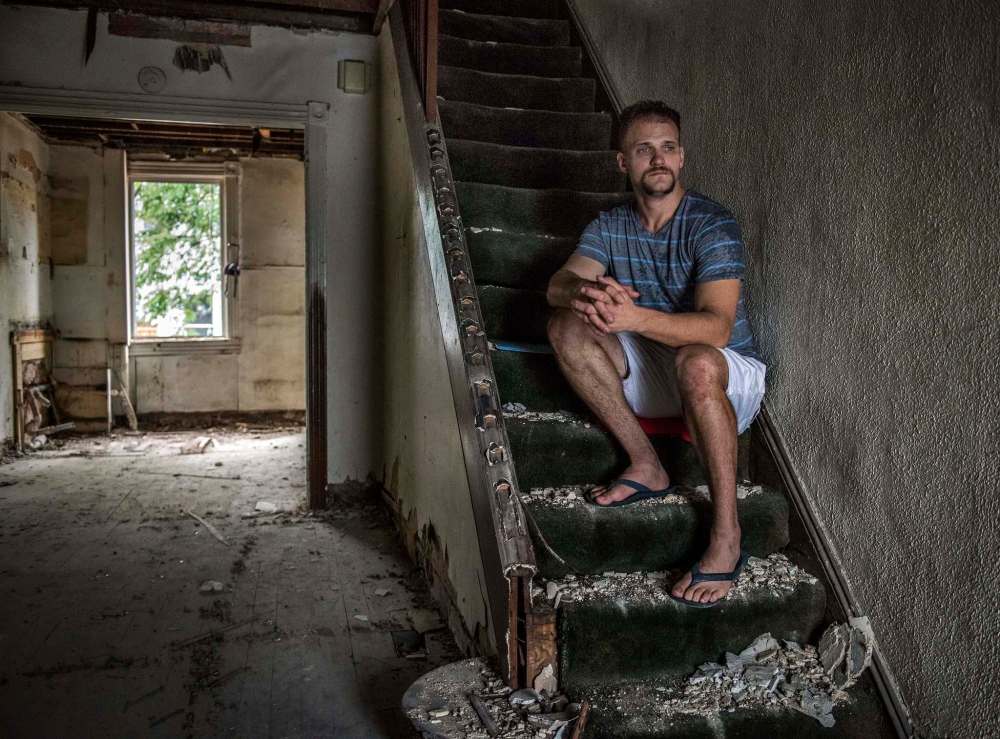
“Yes, I do,” Bell replied.
“My grandmother would beat me for coming out of that tunnel all covered in soot,” Gentry said.
The Bradford of their boyhoods had clean sidewalks and flowers in the alley. Miss Ethel sold candy apples from her dining room and frozen ice pops from her kitchen. Mothers swept their stoops first thing every morning.
Agnes Mifkovic, long widowed and still living at 930 N. Bradford, died in 1968 at 83. She lived to see the riots that year, with the National Guard there telling residents to stay indoors.
Bell spent three years in prison for armed robbery in the 1970s. “When I came out,” he said, “all the white folks were gone.”
***
Back then, Mable Olds knew everybody on the block and was known by all as “Miss Beekee,” a childhood nickname. Her three children rode bicycles on the street, went barefoot in the alleys and roamed freely.
But by the mid-1980s, drug dealing was growing more common and more blatant.
“You’d hear gunshots all the time,” Barak Olds said. “All. The. Time. Every night.”
One night in the mid-1990s, his family was in the living room when the pop-pop-pops seemed closer than usual. They went out to find a woman lying dead at the end of the block. “She stayed there for a couple hours,” he recalled.
The groups of men on the corners became more menacing. When a renter moved out, it took longer for a new tenant to move in. By the end of the 1980s, several houses on the block were empty. By the end of the ‘90s, some were uninhabitable. When the city listed Mable Olds’s house for demolition in 2013, it was one of only three on the block that was not boarded up.
They offered Olds a renovated rowhouse just around the corner on North Montford Avenue, a key-for-key swap. Financially, she traded a house with a resale value near zero to one on a block where rehabbed houses like hers have sold for US$200,000.
“It’s fine,” she said of her new house, shrugging. She hasn’t put up any of the photographs from No. 936. She’s worried about water stains on the living room ceiling. “There are pigeons in the eaves.”
The city and state contract with multiple firms to demolish houses. But only one does more than knock them down and dump the remains. Details, a branch of the Baltimore not-for-profit Humanim, deconstructs them and salvages the material for resale. To do the work, they hire ex-offenders, former addicts and other hard-to-employ residents. Many are from the neighbourhood.
“Watch yourself!” cried Ronald Fonce, 45, whose aunt lived a few yards away on Eager Street, as he dropped a window sash from what used to be Olds’s upstairs window. Down came the mattress a squatter had moved in after Olds had moved out in 2014. On the floor was a can of mixed vegetables, pried opened with a knife.
● ● ●
Bernadette Buckson, 53, was tearing down the plasterboard in the tiny bathroom. Once, pulling down the ceiling in another teardown, US$200 in cash floated past her head.
“Somebody hid that a long time ago,” Buckson said.
A recovering addict with an arrest record, Buckson had been turned down for jobs 32 times before being hired by Details. Even if she weren’t grateful for the work, she thinks it’s good to clear away the empty houses.
“I got clean and turned my life around,” Buckson said. “I think change is good.”
Later that morning, a voice called out from No. 920, where the crew was pulling out the heart pine flooring that would soon line the walls of a trendy new Baltimore restaurant called Gnocco. The thick joists were bound for the Exelon headquarters being built at Harbor Point. The bricks would be sent to downtown Washington, D.C., for the restoration of the historic Carter G. Woodson house.
“Max,” the voice called. “Come see this.”
Max Pollock, the Details supervisor and an architectural history buff, came in to find his team looking up at an exposed joist with the words “Rose Bessie” and “Hannamans” painted on the side. The Rose was the coastal ship that delivered milled lumber more than a century ago, Pollock said. Hannamans was a local lumber yard.
A former University of Michigan linebacker with a master’s degree in city design from the London School of Economics, Pollock tears down houses with love. He tracks as much of the history of their builders and residents as he can and blogs about them at BaltimoreBrickByBrick.com.
“He’s got me walking down the street looking at bricks,” Buckson said.
● ● ●
Later that day, Jonathan Todd, a carpenter from the Baltimore suburbs, pulled up. He had never seen the house where his grandfather, Ed Mifkovic, was born. But he’d heard the stories, and curiosity finally led him to Google the address.
“This is where they ate dinner,” he marvelled, standing for the first and only time in the kitchen of 930 N. Bradford. Some of its floorboards were already gone; the ground was littered with old-fashioned cut nails. “I have a picture of them sitting around the table right here.”
He walked about in silence, amazed to discover his ancestral seat only days before it was to be demolished.
“God brought me here,” he said. “He knows I’m sentimental.”
Lewis Crossont, the first resident of Mable Olds’s house at No. 936, also has descendants in the area. His grandson Chester Crossont owns a racing garage in Baltimore County with his two sons.
Reached by phone, Crossont, 70, said his knowledge of his family history is sketchy. His grandfather started as a furnace tender and worked his whole career in the Carr-Lowrey glass bottle factory. His dad, Ernest Lewis, was born in the house and grew up to be a steelworker at Bethlehem Steel.
Crossont had never heard of North Bradford Street but knew his father had grown up in East Baltimore. Told the block was going to be demolished, he said, “I’d like to see it.” His family avoids the city, he said, usually passing through only on the way to Ravens games. “Is it safe?”
A few days later, he, his wife and two sons walked into the living room of No. 936. Mable Olds walked in shortly after.
It took a few minutes for the white descendants of the rowhouse’s first owner and its black final owner to feel at ease with one another. But they formed a connection from their common experience raising children, knowing Baltimore and, mostly, sharing the heritage of the petite front room, the cramped kitchen, the narrow stairs.
They talked amid the exposed plaster lathing for nearly an hour, then for half an hour more in the street out front. They hugged each other goodbye, families linked by an address. An address about to disappear.
● ● ●
On demolition day, after the Bradford houses had been gutted of their valuable wood, Saunders waited for rubble piles to be loaded. He, too, was ready to believe those houses were going down to benefit the behemoth hospital down the road.
“You know who’s going to buy these houses now? Hopkins people,” Saunders said. That might be a good thing, he said; doctors and nurses make good neighbours. But still, it’s the hospital getting its way.
The tensions between Hopkins and longtime African American residents is personal for Saunders. He said he is a cousin of Henrietta Lacks, the Baltimorean whose biopsied ovarian cells were cultured by a Hopkins researcher without her consent, forming a line of living cells still used by medical researchers. A best-selling book about Lacks is being turned into a movie by Oprah Winfrey.
“They robbed my family,” Saunders said.
“They just do to African Americans in East Baltimore whatever they want to, always have.”
Across the street, the Bradford houses basked in their final morning sun. It wouldn’t take long now. Banks, who can demolish more than 100 houses in a busy month — and they are all busy now — worked the long arm of his excavator like a prize fighter. The hose played on the bricks, ready to wet the dust.
The rowhouses that sheltered 111 years of Crossonts, Mifkovics and Oldses shook at the first touch of the machine’s metal teeth. The bricks, last handled in 1905 by the masons who were building a booming city, shifted at the hydraulic bite.
Banks pulled a lever, the bucket clawed at the wall, and, in a cloud of dust and history, they fell, done at last with their century of service to a city and its people.
— Washington Post