Workplace pooches aren’t for everyone
The dogs in the newsroom experience includes plenty of slobber
Advertisement
Read this article for free:
or
Already have an account? Log in here »
To continue reading, please subscribe:
Digital Subscription
One year of digital access for only $1.44 a week*
- Enjoy unlimited reading on winnipegfreepress.com
- Read the E-Edition, our digital replica newspaper
- Access News Break, our award-winning app
- Play interactive puzzles
*Billed as $5.77 plus GST every four weeks. After 52 weeks, price increases to the regular rate of $19.95 plus GST every four weeks. Offer available to new and qualified returning subscribers only. Cancel any time.
To continue reading, please subscribe:
Add Free Press access to your Brandon Sun subscription for only an additional
$1 for the first 4 weeks*
- Enjoy unlimited reading on winnipegfreepress.com
- Read the E-Edition, our digital replica newspaper
- Access News Break, our award-winning app
- Play interactive puzzles
*Your next Brandon Sun subscription payment will increase by $1.00 and you will be charged $17.95 plus GST for four weeks. After four weeks, your payment will increase to $24.95 plus GST every four weeks.
Read unlimited articles for free today:
or
Already have an account? Log in here »
Hey there, time traveller!
This article was published 04/04/2017 (3492 days ago), so information in it may no longer be current.
It may come as a surprise to animal lovers, but welcoming dogs into the workplace isn’t everyone’s cup of tea.
That’s just one of the facts that hounded its way to the surface at the end of Week 2 of our month-long Newsroom Dogs project, wherein editorial department employees are being allowed to bring their canine companions to the office.
It’s not that some of my colleagues hate the idea of our office going to the dogs; it’s more they feel dogs have their place and that place is not necessarily the newsroom of a major provincial newspaper.
“I haven’t had a problem with the dogs and I don’t expect to, but I choose not to own a dog,” a long-time editor confided after I sent out an email to everyone in our department seeking “dissenting voices.”
“When I come to work and dogs are suddenly allowed, that choice is taken away from me,” the editor notes. “If I made a strenuous objection to dogs in the office, I fear I would be perceived as ‘not a team player,’ so I’ve mostly kept my misgivings to myself.”
As we start Week 3 of the project, it appears the introduction of dogs in the newsroom — we have a schedule to ensure there is only one, possibly two dogs, on any given day — has gone more smoothly than might be expected.
Free Press editor Paul Samyn gave the project the green light to see whether recent scientific studies are correct when they state that allowing dogs in a workplace can reduce stress and boost productivity.
As an editor, of course, he was also hoping the dogs would provide some interesting storylines for Free Press readers.
From purely casual observation, the dogs seem to be doing their job. If you were to visit the newsroom on any given day, you’d see battle-hardened journalists crawling under a colleague’s desk to spend a few minutes cuddling with their new best friend.
Or you’d see reporters taking a break from a story to enjoy a rousing game of fetch with whatever dog is visiting that day. Not to mention the never-ending stream of baby talk — “Who’s a good boy? Are you a good boy? Yes you are!” — as colleagues strive to bond with our newest, and furriest, employees.
But the point is, dogs will be dogs and they have a natural ability to bark at the wrong moment or disturb someone in the middle of a tense interview.
“I love dogs!” sports editor Steve Lyons explains to me as a rambunctious canine rambled around his desk. “I just don’t think we need any more distractions in the newsroom. What’s really distracting is the people making a fuss over the dogs.”
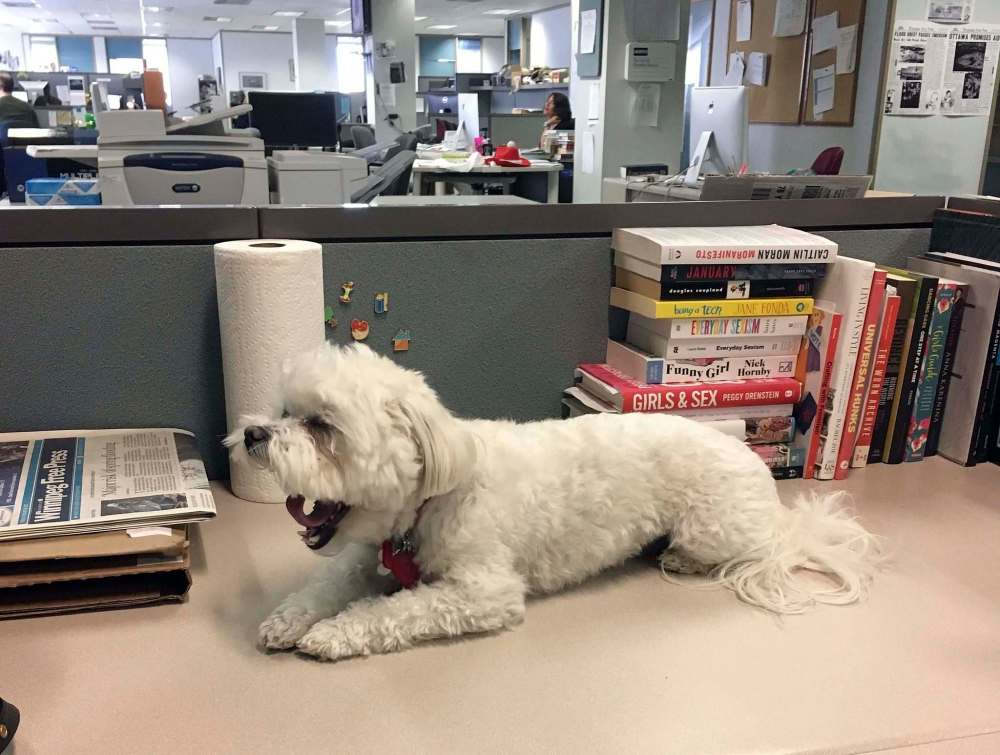
I have to confess, the thing I enjoyed the most when I brought my little white dog, Bogey — whom I frequently identify in my columns as “Mr. X” — in for Week 1 was watching many of my normally laid-back colleagues fussing over my little buddy.
The thing we dog owners need to remember, however, is that not everyone in the office environment finds our pets as adorable as we do.
“Not to rain on the puppy parade, but I’m neither super happy nor particularly put out about the dogs in the newsroom,” Uptown editor Jill Wilson says. “I’m a total cat lady and you could, at best, call me ‘dognostic,’ so having a dog around isn’t likely to improve my mood or lower my stress.
“I’m not keen on dogs jumping up on me and I find (historically, not based on my co-workers’ behaviour) that dog owners tend to be so absorbed in their pets’ cuteness that they forget not everyone is a fan. That said, so far I’ve found our canine visitors to be pretty adorable and if they make other people happy, that makes the office a nicer place to be.”
There is no shortage of anecdotal evidence supporting the idea that animals improve morale, but clearly there are downsides to going to the dogs.
In a recent article on the topic, Britain’s Guardian newspaper noted some dog-friendly companies have reported problems with dogs stealing food out of office bins, barking at motorcycle couriers and behaving aggressively towards other dogs in the office.
There have also been concerns in Britain that workplace dogs might invalidate a company’s liability insurance and compromise its fire-safety certificate unless a proper risk assessment is carried out.
At the outset of Week 3 of Newsroom Dogs, a spokesman for the Free Press’s human resources department says they have not fielded any formal complaints about our canine colleagues.
“There haven’t been any complaints at all, but people are only beginning to notice them now,” the spokesman says. “It’s been low-key.”
But, she says, there are obvious concerns for any company going to the dogs, including sanitation issues (“Who cleans up after them?”), safety issues (“What if a dog bites someone? It’s just a question.”), and the fact some people are afraid of dogs or have allergies.
“It can have a positive effect and boost morale and give people a bit of a break,” she says. “But you have to be respectful of the rights of people who may not be dog lovers or have health issues with animals… We take the responsibility, as an employer, to provide a safe work environment.”
So far, dog owners in only one other department, circulation, have inquired about bringing their pets to work. They’ll be allowed to do so, provided their co-workers and supervisors are onside with the experiment.
Our publisher, Bob Cox, who also happens to be my closest buddy, says it’s difficult to gauge the extent of any opposition to our office-canines experiment.
“I wouldn’t expect people to complain too openly,” Cox suggests. “You don’t want to anger your co-workers who love their dogs, so you just stay silent. Once dogs are in the workplace, they’re in your face. People aren’t used to it and neither are the dogs.”
With his office cubicle parked near the entrance to our newsroom, literary editor and drinks writer Ben MacPhee-Sigurdson has had the perfect perch from which to view the progress of our pooch project.
“I’m pretty indifferent to the dogs being around,” he told me via email. “When I heard about the project, I was neither excited or miffed, and since the pooches have started sniffing around the newsroom that feeling hasn’t changed.
“I haven’t been peed on (yet), which is good, and the dogs certainly don’t bother me, but I can’t say I’ve felt any sweeping positive effects either. I’m sure I’d feel different if I had a dog, or if dogs had ever been a big part of my life.”
In a second email, MacPhee-Sigurdson added: “Ha ha! You can also add that two minutes after I hit send and left my desk for a moment, I came back and sat down in a small puddle of dog drool.”
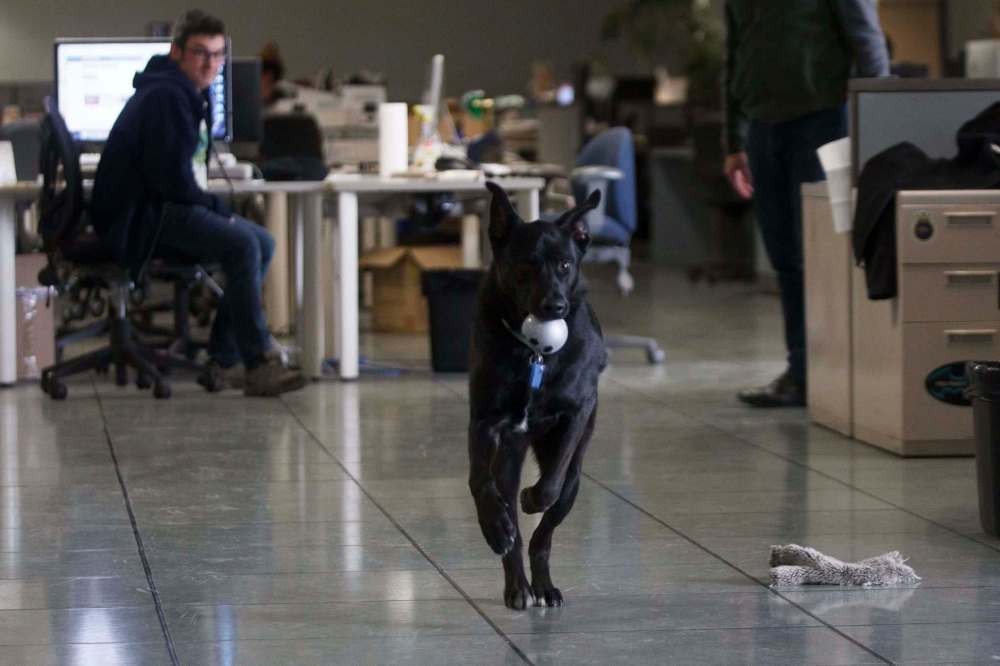
In the Case of the Mysterious Dog Drool, the culprit was Dash, a 16-month-old Lab cross owned by copy editor David Fuller. While most of our newsroom dogs have spent their day snoozing under their owners’ desks, Dash has bravely sniffed out every corner and employee, in the newsroom.
Just before noon one day, Dash’s sensitive nose informed him that I had obtained a cheeseburger from our cafeteria and he raced over to investigate, staring at me with the sort of laser-like intensity only a hungry dog can muster.
After I gave him a few Milk-Bone treats, he returned to my desk every few minutes as if I were reeling him in with a fishing rod. When I returned to my desk after dumping my burger wrapper in the garbage, there was Dash, licking my desk clean and leaving behind a healthy trail of drool.
For me, this was like a tiptoe through the tulips. But moments later I could hear our sports editor bellowing: “Someone come and get their dog! Doug, come and get him!” The problem was Dash had developed a sudden interest in the workings of the sports department.
An incredibly charming and gregarious dog, Dash also hoisted his leg and fired a steady stream near the cubicle of our movie writer, Randall King, a mess I quickly cleaned up with paper towels and wet wipes because, well, I am unofficial pack leader.
Later, Dash’s owner, Fuller, expressed gratitude and surprise at how much fun it was to have his best buddy in the office.
“What surprised me was how productive I managed to be with him here,” he says as Dash darted around the office. “Having to get up every 10 minutes to see what the heck he was getting into forced me to work in short bursts. When it got to be noon, I was actually ahead, even though I’d played fetch and taken him for two walks. He forced me to get ahead.”
The truth is, Dash made a lot of new friends and his proud master says he wasn’t overly stressed, even though it’s not easy keeping an eye on the whereabouts of a dog with wanderlust.
“I look forward to seeing the dogs every day,” Fuller says, beaming. “We’re getting used to it. It seems like an odd idea bringing dogs to work, but it takes hold very quickly if you love dogs.”
doug.speirs@freepress.mb.ca
It’s your turn to howl
Ever taken your best friend to work? How did that work out? Was it a canine calamity, or hound heaven?
If you’ve taken your dog to the office, email the tale to Doug Speirs at doug.speirs@freepress.mb.ca.
Doug and his canine colleague, Bogey, will pick a couple of their favourite stories about canines at work and share them with readers of our Newsroom Dogs project. Twitter users can follow along by using the hashtag #wfpdogs.
The winners will get whatever prize Doug and Bogey can dig up, such as copies of his book, Bite-Sized Doug, and tickets to some upcoming event.
It’s your chance to unleash the truth. Don’t forget to include your contact information.
Doggie Do’s and Don’ts
Before you put a tie around his neck and print out an employee badge for Fido, here are some common-sense steps from Dogtime.com to help the workday go smoothly for all involved:
Do’s:
1. Make sure co-workers are on board with the idea.
Even if Fido will be staying in your office or cubicle, his presence might give pause to people who are allergic to or afraid of dogs.
2. Pack Fido’s “briefcase.”
Participating employees are expected to provide for all their dogs’ needs: food and water dishes, toys, treats, a bed, poop bags or anything else the dog might need during the day.
3. Groom Fido as if he were going in for a job interview.
Give him a bath, brush his coat until it gleams and brush his teeth so he has nice breath when he meets the boss.
4. Dogproof your workspace.
To prevent Fido from chewing on cords, tipping over the trash, or swallowing that thumb drive with the report that’s due tomorrow, prepare your area.
5. Do a good deed for dogs.
Have a raffle to benefit your local shelter or bring in animal health and adoption groups to provide information about pets and services.
Don’ts:
1. Don’t bring Fido in if you can’t rely on his good manners and housetraining.
A dog who jumps up on clients, howls in the middle of a meeting or takes a dump in the conference room won’t be an incentive for your employer to participate in future events.
2. Don’t bring Fido if he’s sick.
If he has a contagious illness, other employees could unknowingly carry it home to their dogs. And a digestive disturbance could cause him to upchuck or have diarrhea. If he’ll be bow-wowing with other dogs, his vaccinations or titers should be up to date.
3. Don’t let Fido wander around off leash.
You should know where he is at all times — and where he should be is under your control. Use a baby gate or other barrier to keep him confined.
Source: Dogtime.com
Related Articles
Barking up the same tree


Advertisement Advertise With Us
Advertisement Advertise With Us
History
Updated on Tuesday, April 4, 2017 6:20 AM CDT: Adds photos