Refugee crisis A Passover lesson

Advertisement

Advertise with us

AT the start of Passover, which begins this year on Monday evening, Jewish people customarily sit down at their seder tables to discuss themes of slavery and liberation, while celebrating the Hebrew exodus from Egypt circa 1446 BC.

Read this article for free:


By clicking the button above, an account will be created and you will begin to receive some of our recommended newsletters. You may opt out of any newsletter by visiting your Email and Communication Preferences page or by clicking "unsubscribe" at the bottom of any email.

or

Already have an account? Log in here »

To continue reading, please subscribe:

Digital Subscription

One year of digital access for only $1.44 a week*

  • Enjoy unlimited reading on winnipegfreepress.com
  • Read the E-Edition, our digital replica newspaper
  • Access News Break, our award-winning app
  • Play interactive puzzles

*Billed as $5.77 plus GST every four weeks. After 52 weeks, price increases to the regular rate of $19.95 plus GST every four weeks. Offer available to new and qualified returning subscribers only. Cancel any time.

To continue reading, please subscribe:

Add Free Press access to your Brandon Sun subscription for only an additional

$1 for the first 4 weeks*

  • Enjoy unlimited reading on winnipegfreepress.com
  • Read the E-Edition, our digital replica newspaper
  • Access News Break, our award-winning app
  • Play interactive puzzles
Start now

*Your next Brandon Sun subscription payment will increase by $1.00 and you will be charged $17.95 plus GST for four weeks. After four weeks, your payment will increase to $24.95 plus GST every four weeks.

Hey there, time traveller!
This article was published 08/04/2017 (3487 days ago), so information in it may no longer be current.

AT the start of Passover, which begins this year on Monday evening, Jewish people customarily sit down at their seder tables to discuss themes of slavery and liberation, while celebrating the Hebrew exodus from Egypt circa 1446 BC.

In 2017, however, it would seem both out of touch and indifferent to speak about that event without also talking about current events and recognizing the millions worldwide who are enslaved, homeless and seeking refuge.

The Jewish people, who share a collective genetic memory of persecution and exile stretching from biblical times to the 20th century, have a particular obligation to recognize the suffering of others. The Torah instructs its followers 36 different times to help the stranger living among them, simply because, as Jews, they know what it is like to feel unwanted and unwelcome.
John Woods / The Canadian Press Files
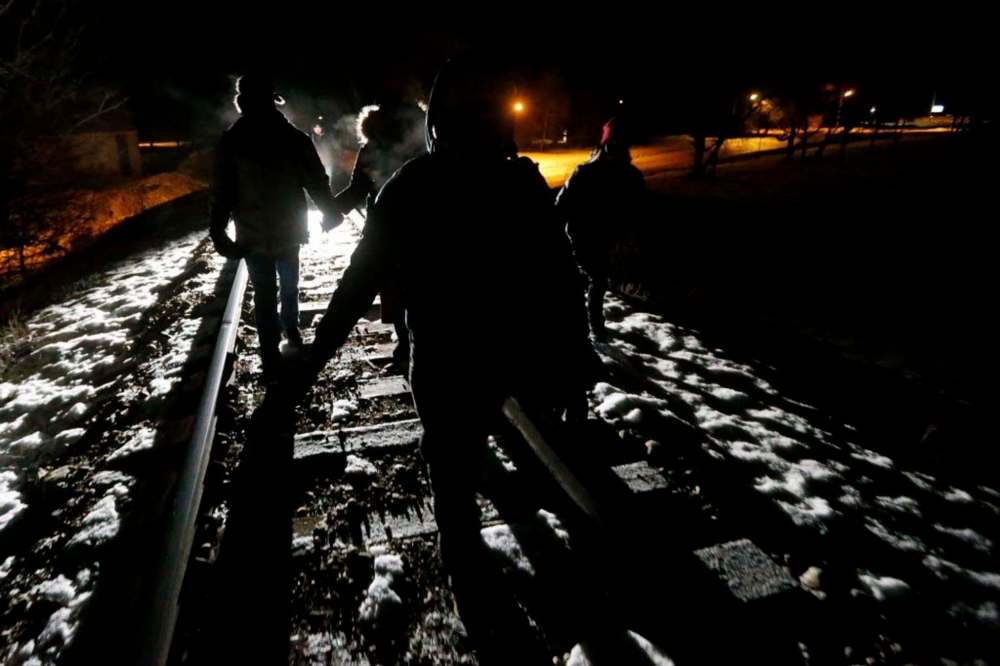
Migrants from Somalia cross into Canada from the United States at Emerson. Jewish organizations are hosting Refugee Seders during Passover to bring awareness to the world’s refugee crisis.
John Woods / The Canadian Press Files Migrants from Somalia cross into Canada from the United States at Emerson. Jewish organizations are hosting Refugee Seders during Passover to bring awareness to the world’s refugee crisis.

The Passover Haggadah, which is the holiday’s instructional text for the festive seder meal, reinforces this idea with the directive that every Jew should “see himself or herself as though he or she personally came forth from Egypt.”

“Passover is an important time in the Jewish calendar and plays a strong role in Jewish culture and psyche,” says Morgan Buras Finlay, a spokeswoman for Right Now: Advocates for Asylum Seekers in Israel, a human rights organization.

“At Passover, we identify strongly with being strangers in a strange land and our story of exodus, journey and refuge.”

That self-identification, in turn, is meant to generate greater empathy for the pain and suffering of other strangers in strange lands.

In recent years, that pain and suffering has been indelibly etched onto the faces of myriad people around the world, including those who risk their lives on leaky boats to cross the Mediterranean and those who risk their lives on desolate snow-covered fields to cross into Manitoba.

Many Jewish community organizations, congregations and individuals, including here in Winnipeg, have taken up the cause of refugees and have done notable work to help support, sponsor and resettle them, whether they are from Syria, Iraq or Sudan. In Israel, where the Hebrew people were delivered upon their exodus from slavery, grassroots organizations are even helping Syrian refugees, although their countries are avowed enemies.

Other grassroots agencies, such as Buras Finlay’s Right Now, have focused their attention on raising awareness about and showing support to thousands of Eritrean and Sudanese asylum seekers in Israel. After fleeing persecution in their homelands, these asylum seekers have largely been disparaged, ignored and, in some cases, deported by the Israeli government.

Every spring, Right Now connects the refugee crisis to the Passover holiday by sponsoring two refugee seders, one in Tel Aviv where the majority of the African asylum seekers live, and the other in Holot, where many of the African asylum seekers are detained.

This year, the organization also is partnering with the century-old international resettlement agency HIAS in order to encourage Diaspora Jewish communities to organize their own Refugee Seders as a means of drawing attention to the crisis.

HIAS’s motto — Welcome the Stranger. Protect the Refugee — perfectly describes what the organization has been doing for decades and what it believes everyone, Jew and non-Jew alike, should be doing, not just on Passover, but throughout the year.

swchisvin@gmail.com

The Free Press is committed to covering faith in Manitoba through our Religion in the News project. This reporting continues because readers like you step forward to fund it.

Donate now to support our reporting on religion.

Your donation is eligible for a charitable tax receipt. BECOME A FAITH JOURNALISM SUPPORTER

Report Error Submit a Tip

The Free Press acknowledges the financial support it receives from members of the city’s faith community, which makes our coverage of religion possible.

More Stories

Today’s horoscope

Georgia Nicols 4 minute read 2:00 AM CDT

MOON ALERT: Avoid shopping or making important decisions from 5:30 p.m. until 7 p.m. today.

ARIES (March 21-April 19)

Opportunities to socialize with others as well as to enjoy sporting events and fun activities with kids are abundant. Nevertheless, the full moon could create financial angst or disputes with someone, especially about money owed.

TAURUS (April 20-May 20)

Security under magnifying glass after suspicious death on Mountain Avenue

Morgan Modjeski 5 minute read Preview

Security under magnifying glass after suspicious death on Mountain Avenue

Morgan Modjeski 5 minute read Yesterday at 8:15 AM CDT

Homicide detectives are investigating the suspicious death of a 70-year-old man at a seniors high-rise on Mountain Avenue.

Forensic investigators and detectives have been at the building, at 595 Mountain Ave., and questioning residents about the death of Richard Boychuk, whose body was found in his second-storey suite Tuesday morning.

The 70-year-old, who used a wheelchair, had lived in the Winnipeg Housing Rehabilitation Corp. apartment for several years, said close friend Angela Abdilla.

She would clean, shop and take care of Boychuk, a former Elvis impersonator.

Read
Yesterday at 8:15 AM CDT

New Jet looking forward to ‘special’ debut

Ken Wiebe 7 minute read Preview

New Jet looking forward to ‘special’ debut

Ken Wiebe 7 minute read Yesterday at 10:38 PM CDT

Dawson Mercer is doing his best to get acclimated as quickly as possible.

After spending his first five NHL seasons and change with the New Jersey Devils, Mercer was informed on Friday morning that he was on his way to the Winnipeg Jets as part of a blockbuster deal for goalie Connor Hellebuyck.

That led to a mad scramble, as Mercer loaded up a suitcase with his belongings, jumped on a private jet with goalie Nico Daws and landed in the Manitoba capital on Friday night.

“Pretty busy and hectic. Pretty much, I was at the rink in Jersey, and then got the news,” said Mercer, who was the 18th overall pick in the 2020 NHL Draft. “Then, you go home, pack everything up, get on the jet, and then come here and come into a big game here at this classic. It’s pretty special, though. I’d rather do it this way than any other.”

Read
Yesterday at 10:38 PM CDT

Opening of Portage and Main shows even seemingly insurmountable impasses can be overcome

Jason Syvixay 10 minute read Preview

Opening of Portage and Main shows even seemingly insurmountable impasses can be overcome

Jason Syvixay 10 minute read Yesterday at 2:00 AM CDT

There are places in a city that become more than places. Portage and Main is one of them. For generations of Winnipeggers, the intersection has represented downtown, traffic, development and civic identity. Its reopening to pedestrians in 2025, after 46 years of closure, was about more than crossing a street. It was a reminder that decisions made by one generation can shape the choices available to another — and that even seemingly permanent decisions can be reconsidered.

I have spent much of my professional life thinking about Winnipeg as a planner, working in public, private and non-profit settings. My PhD research gave me an opportunity to examine Portage and Main differently: not simply as a debate about cars and pedestrians, but as a window into how power operates in a city. I reviewed 569 archival documents spanning the 1960s to the present, interviewed 48 planners with experience in Winnipeg, and mapped the relationships between planners, politicians, developers, engineers, residents, businesses and advocacy groups.

What emerged was a story about how planning decisions become embedded in a city’s institutions, agreements, infrastructure, professional practices and political expectations — shaping not only what gets built, but who gets to influence what gets built.

The closure of Portage and Main in 1979 did not remain a decision confined to a particular political moment. Over time, it was reinforced by development agreements, physical infrastructure, property relationships, traffic-engineering practices, administrative routines, and public narratives about mobility and downtown revitalization. The people who made many of those original decisions eventually left office. The arrangements they created remained. Later planners inherited them.

Read
Yesterday at 2:00 AM CDT

Winnipeg pharmacist fined for dispensing incorrect dosage of anti-psychotic medication

Erik Pindera 4 minute read Preview

Winnipeg pharmacist fined for dispensing incorrect dosage of anti-psychotic medication

Erik Pindera 4 minute read 11:31 AM CDT

A Winnipeg pharmacist has been fined for misconduct after dispensing a mistakenly high dose of an anti-psychotic, harming her patient.

Rumina Ishani was fined $3,500 and ordered to pay $5,000 in costs by the College of Pharmacists of Manitoba earlier this month, after pleading guilty to professional misconduct.

The college, in a written disciplinary decision, said the incident occurred on Aug. 12, 2025, at the Marion Street Shoppers Drug Mart where Ishani worked at the time.

She filled an aripiprazole prescription for a patient that day. The patient had first been given the anti-psychotic at that pharmacy in November 2023 at two milligrams a day for 30 days, and was again prescribed the drug in February 2025 at one mg/day, which was increased to two mg/day in March.

Read
11:31 AM CDT

First Crumbl cookie shop opens in Winnipeg

Gabrielle Piché 3 minute read Preview

First Crumbl cookie shop opens in Winnipeg

Gabrielle Piché 3 minute read Friday, Oct. 23, 2026

The early birds got their cookies.

Klaudia and Jayson Ballantyne were the first in line for the grand opening of Winnipeg’s first Crumbl location at 1570 Regent Ave. West, arriving at 2 a.m. Friday — six hours before the cookie chain was set to open.

The brother and sister brought their lawn chairs and blankets and hunkered down.

Roughly 90 minutes later, by their count, the next customers arrived.

Read
Friday, Oct. 23, 2026