Virtues and values

Pollster weighs probability of political sea change in Canada

Advertisement

Advertise with us

Following Donald Trump’s election in November 2016, major book retailers were reportedly overwhelmed by demand for Sinclair Lewis’s 1935 novel It Can’t Happen Here. Lewis’s novel details the rise of populist demagogue Berzelius (Buzz) Windrip, who wins the American presidency with nativist attacks on people of colour, immigrants and the media before turning openly to fascism. To many readers, the comparisons were obvious.

Read this article for free:


or

Already have an account? Log in here »

To continue reading, please subscribe:

Subscribe and receive a limited-edition Free Press branded hat or tote.

Digital Subscription

One year of digital access for only $205*

  • Enjoy unlimited reading on winnipegfreepress.com
  • Read the E-Edition, our digital replica newspaper
  • Access News Break, our award-winning app
  • Play interactive puzzles

*First annual payment billed as $205.00 + GST for one year. This annual subscription will automatically renew at $233.00 + GST every 52 weeks (10% off the regular annual price of $259.35). Offer available to new and qualified returning subscribers only. Cancel any time.

To continue reading, please subscribe:

Add Free Press access to your Brandon Sun subscription for only an additional

$1 for the first 4 weeks*

  • Enjoy unlimited reading on winnipegfreepress.com
  • Read the E-Edition, our digital replica newspaper
  • Access News Break, our award-winning app
  • Play interactive puzzles
Start now

*Your next Brandon Sun subscription payment will increase by $1.00 and you will be charged $17.95 plus GST for four weeks. After four weeks, your payment will increase to $24.95 plus GST every four weeks.

Hey there, time traveller!
This article was published 21/10/2017 (3219 days ago), so information in it may no longer be current.

Following Donald Trump’s election in November 2016, major book retailers were reportedly overwhelmed by demand for Sinclair Lewis’s 1935 novel It Can’t Happen Here. Lewis’s novel details the rise of populist demagogue Berzelius (Buzz) Windrip, who wins the American presidency with nativist attacks on people of colour, immigrants and the media before turning openly to fascism. To many readers, the comparisons were obvious.

With his new book Could It Happen Here?, Canadian social scientist Michael Adams evokes Lewis’s novel in an effort to determine the potential for Canadians to be drawn in significant numbers to the sort of nativist, xenophobic authoritarianism that seems to be spreading around the world, fuelling Trumpism and Britons’ rejection of the European Union.

Weighing in at a slim 192 pages — and pointedly bound in the same shade of red as the ubiquitous Trump campaign hat featured on its cover — Could It Happen Here? is not only another of Adams’ cogent investigations into Canada’s national mood, but an excellent primer on recent turmoil around the world, including the Syrian refugee crisis and the resurgence of far-right populism in Europe.

Mindy Schauer / The Associated Press files
In his new book, Michael Adams explores the potential for Canadians to get caught up in xenophobic and nativist politics.
Mindy Schauer / The Associated Press files In his new book, Michael Adams explores the potential for Canadians to get caught up in xenophobic and nativist politics.

The award-winning author of six previous books on the respective social characters of Canadians and Americans — including Sex in the Snow: The Surprising Revolution in Canadian Values (1997) and Fire and Ice: The United States, Canada and the Myth of Converging Values (2003), Adams is also the president of the Environics Institute for Survey Research and earlier this year became a recipient of the Order of Canada.

Adams’ particular gift is his ability to translate otherwise opaque and dry survey and polling data into an eminently readable argument. This latest analysis, however, also has a palpable sense of urgency: he claims to have “rushed into the office” to begin work on it the morning after Trump’s win to compare recent survey results of 8,000 Americans and 4,000 Canadians.

The results are fascinating and — for the moment, at least — reassuring. On every measure, he finds that Canadians appear to be embracing racial, ethnic, religious, gender and sexual diversity more successfully than most of the rest of the world. Canada’s political and social cultures offer poor soil for reactionary, xenophobic nationalism.

Not that some of our politicians haven’t tried: Adams recalls the Harper government’s efforts to ban the niqab in citizenship ceremonies and institute a “barbaric cultural practices” tip line, both of which proved disastrous for its fortunes in the 2015 election, while Kellie Leitch’s obsession with testing for vaguely defined “Canadian values” similarly doomed her Tory leadership campaign. Torontonians, for their part, had a brief fling with the populism of Rob Ford before electing the more level-headed John Tory to replace him as mayor.

Mary Altaffer / The Associated Press files
A police officer separates a pro Trump supporter, right, who was taunting one of the organizers of the “100 Days of Failure” protest and march, Saturday, April 29, 2017, in New York.
Mary Altaffer / The Associated Press files A police officer separates a pro Trump supporter, right, who was taunting one of the organizers of the “100 Days of Failure” protest and march, Saturday, April 29, 2017, in New York.

Adams draws on the work of an American pollster and political science scholar, Matthew MacWilliams, who uncovered a surprising predictor of political support for Trump: patriarchy. When asked if the “father of the family must be master of his own house,” those in the Deep South — a region that voted heavily for Trump — answered overwhelmingly in the affirmative (69 per cent), suggesting a strong preference for authoritarian leaders. While Albertans scored the highest among Canadians on this question, it was still at a significantly lower percentage (26 per cent) than the most progressive U.S. region, New England (42 per cent). Even here we stand apart: this sort of regional polarization is also absent north of the 49th parallel.

At the same time, however, Adams eschews a sense of Canadian exceptionalism. He points to such injustices as the persistent poverty experienced by so many Indigenous people as well as stressing that our country’s ability to avoid electing right-wing and racist leaders is not owed to some innate quality in our collective character, but rather to a combination of policy decisions, parliamentary institutions and democratic practices that, so far, favour negotiation and compromise rather than hyper-partisanship.

All these qualities must be continually nurtured rather than taken for granted. Could it Happen Here? is an essential guide not so much to who we are now as Canadians, but instead to what the rest of world will need us to be in an increasingly fractured and intolerant future.

Michael Dudley is a librarian at the University of Winnipeg.

Report Error Submit a Tip

More Stories

Nola chef earns national award

Eva Wasney 2 minute read Preview

Nola chef earns national award

Eva Wasney 2 minute read 2:01 AM CDT

Celebrated Winnipeg chef Emily Butcher has another feather to add to her toque. The executive chef and owner of Nola and Bar Accanto in St. Boniface has received the Culinary Award of Excellence from Restaurants Canada, a national foodservice advocacy organization.

Read
2:01 AM CDT

PCs say Hutterite colonies singled out by Bill 21

Alex Lambert 4 minute read Preview

PCs say Hutterite colonies singled out by Bill 21

Alex Lambert 4 minute read 2:01 AM CDT

SOURIS — Members of Hutterite colonies in the province took aim at the NDP government’s proposed changes to drinking water legislation during a public meeting Thursday in Souris.

The meeting was hosted by Progressive Conservative MLA Colleen Robbins (Spruce Woods) to hear from rural residents about their concerns over Bill 21, which the government says will improve oversight on wells and other water systems in the province.

“There’s not enough clarity, but I feel that the overreach that this bill will bring is not clearly defined, and it could have a lot of negative consequences,” attendee Gilbert Hofer, a member of Green Acres colony near Wawanesa, said after the meeting, which drew about 20 people.

The legislation would allow public health officers to designate the type of water source based on its intended use, water quality and use duration rather than solely the number of connections it has.

Read
2:01 AM CDT

Revered Broadway rail anchors Winnipeg’s resilient skateboarding scene

Benjamin Waldman 11 minute read Preview

Revered Broadway rail anchors Winnipeg’s resilient skateboarding scene

Benjamin Waldman 11 minute read 11:13 AM CDT

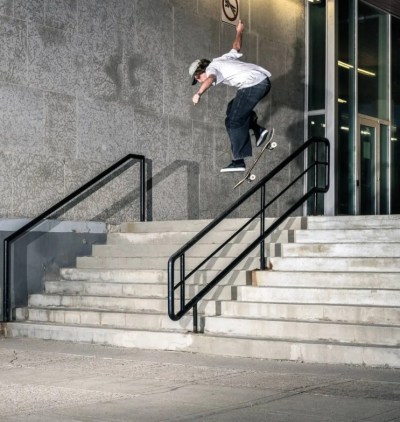
The Woodsworth Building at the corner of Broadway and Kennedy Street is an accidental, unofficial mecca of Winnipeg skateboarding.

Read
11:13 AM CDT

Development turning long-vacant gas station in Selkirk into commercial hub

By Tiago Resko 2 minute read Preview

Development turning long-vacant gas station in Selkirk into commercial hub

By Tiago Resko 2 minute read Yesterday at 3:59 PM CDT

A plot of land that has sat vacant in Selkirk for 30 years is being redeveloped to host new businesses in the heart of the city.

The former gas station site on Main Street — between Rosser and Pacific avenues — will be turned into a commercial hub that will be home to six local businesses, and will be a big stepping stone for economic growth in Selkirk, Mayor Larry Johannson said Thursday.

“For decades this site has been a reminder of what once was. Today, it represents what is possible when investors see the potential of our community and choose to be a part of its future,” he said in a news release announcing the project and Thursday’s groundbreaking.

“This development reflects confidence in Selkirk, our economy and the direction we are heading.”

Read
Yesterday at 3:59 PM CDT

Trailblazing Western Scrap Metals heavy-equipment operator relishes role at massive crane’s control

David Sanderson 7 minute read Preview

Trailblazing Western Scrap Metals heavy-equipment operator relishes role at massive crane’s control

David Sanderson 7 minute read 10:15 AM CDT

Less than five per cent of heavy-equipment operators in the country are women but that number is trending upward, according to a study conducted by trade magazine Crane & Hoist Canada.

It was reported that in Ontario roughly eight per cent of jobs in the transport and heavy-equipment field are currently held by women. Furthermore, in 2024 almost 20 per cent of graduates at an Edmonton-based heavy-equipment operator training school were female, the article stated.

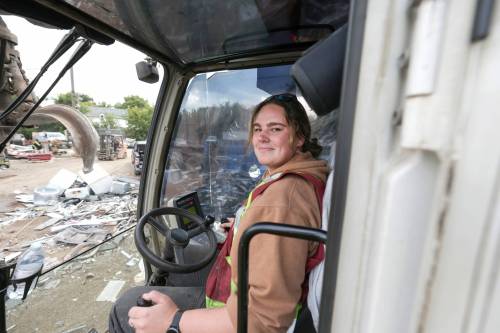
That brings us to Harmony Guspodarchuk, the first female crane operator in the 70-year history of Western Scrap Metals, a family-owned business at 18 Sutherland Ave.

Three years ago, Guspodarchuk literally stepped into the driver’s seat of a 27,500-kilogram, Liebherr C 924 Heavy Lift Litronic crane. The 29-year-old hasn’t looked back much since.

Read
10:15 AM CDT

Moving rail lines outside city would make Winnipeg ‘major transportation hub’

Carol Sanders 6 minute read Preview

Moving rail lines outside city would make Winnipeg ‘major transportation hub’

Carol Sanders 6 minute read Wednesday, Aug. 12, 2026

After decades of calls to move rail traffic to the outskirts of Winnipeg, a plan that would benefit residents, railways and taxpayers is now on track, says the former Winnipegger leading the way.

A rail line bypass south of the city, using Crown-owned land and the Manitoba Hydro corridor, would take 20 years to complete, remove 120 railway crossings that are a safety risk and free up about 250 acres of Winnipeg land over time for development, Lloyd Axworthy said Wednesday.

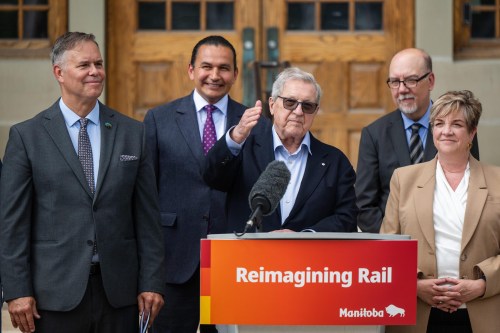
“The visions that we have have to be implemented,” Axworthy said at a news conference announcing the launch of a 90-day feasibility study to move freight rail traffic out of Winnipeg’s urban core along Manitoba Hydro’s southern transmission corridor, connecting east to west along the Perimeter Highway.

The former federal transport minister and Manitoba MP was tasked by Premier Wab Kinew in October 2024 to lead a two-year rail relocation feasibility study.

Read
Wednesday, Aug. 12, 2026