Plant the right greenery in your office space
Advertisement
Read this article for free:
or
Already have an account? Log in here »
To continue reading, please subscribe:

Digital Subscription
One year of digital access for only $205*
- Enjoy unlimited reading on winnipegfreepress.com
- Read the E-Edition, our digital replica newspaper
- Access News Break, our award-winning app
- Play interactive puzzles
*First annual payment billed as $205.00 + GST for one year. This annual subscription will automatically renew at $233.00 + GST every 52 weeks (10% off the regular annual price of $259.35). Offer available to new and qualified returning subscribers only. Cancel any time.
To continue reading, please subscribe:
Add Free Press access to your Brandon Sun subscription for only an additional
$1 for the first 4 weeks*
- Enjoy unlimited reading on winnipegfreepress.com
- Read the E-Edition, our digital replica newspaper
- Access News Break, our award-winning app
- Play interactive puzzles
*Your next Brandon Sun subscription payment will increase by $1.00 and you will be charged $17.95 plus GST for four weeks. After four weeks, your payment will increase to $24.95 plus GST every four weeks.
Read unlimited articles for free today:
or
Already have an account? Log in here »
Hey there, time traveller!
This article was published 06/11/2017 (3176 days ago), so information in it may no longer be current.
Many of us work in open-plan offices where our allotted cubicles are small but our own, so to speak. We personalize them with baubles that mean little to others, but a lot to us. A colleague, for instance, has a little blue glass dolphin that reminds her of a sun-drenched vacation on the Greek island of Paros. Another has a snow globe of San Francisco, a city where he used to work. There are pictures of his kids, then small, now grown.
Nothing quite marks one’s space like a plant, however. Territory, after all, is a word rooted in the soil. I was asked recently to talk to colleagues about caring for their cubicle flora. Although you can find whole volumes on how to cultivate houseplants, success can be distilled into a single sentence: pick the right plant, pay attention to the soil, and water as needed.
Just to state the obvious: most offices and many homes are awful places to grow plants. That is why people invented greenhouses as environments where the tropical-plant devotee could control temperatures, humidity and light levels. As for the office, the dimmer an environment and the more antiquated its heating and cooling systems, the tougher it is on the plants. Even in nice, bright and well-ventilated offices, you have to worry about plants being too close to heat registers and windows that are too hot in summer and too cold in winter.
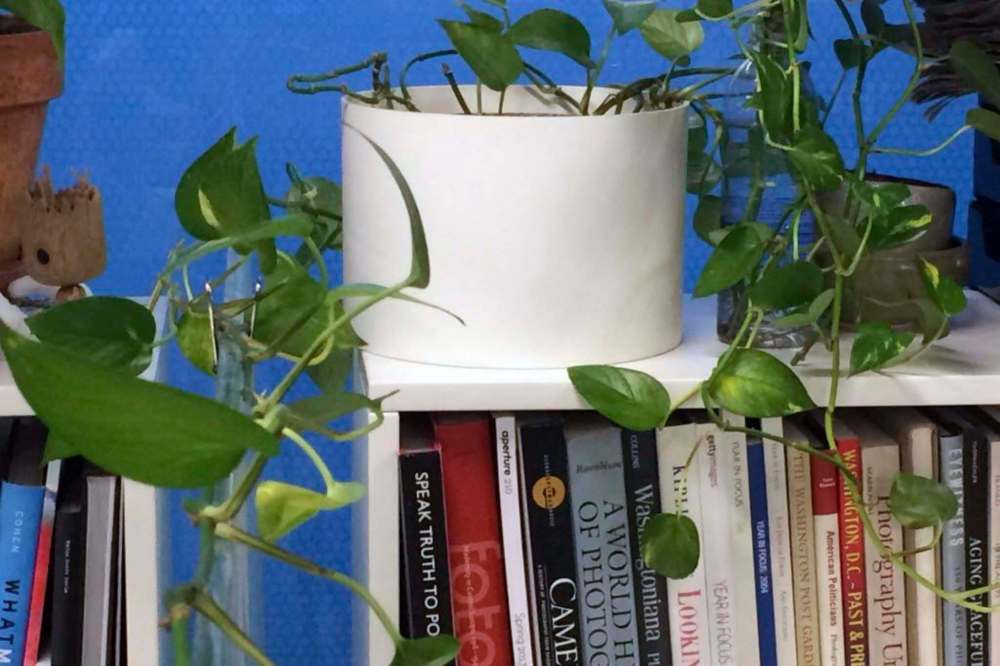
The quickest way to kill a plant is to overwater it. Soil that is constantly wet will lead to root rot. The slowest way to kill a plant is to water it just enough to keep it alive, but infrequently enough that it is in a constant state of stress. This is the more common condition I see in the office environment. This is connected to the type of container you’re using. If your plant is in a pot that doesn’t drain, you might understandably be sparing with the water you apply. The best setup is to have the plant growing in a free-draining pot that is then set in a slightly larger one that doesn’t drain, a cachepot. The outer pot can be glazed and handsome.
The infrequent watering condition is worsened by soil that is old, tired and depleted. If it has lightened in colour and is sunken, dense and crusted, it’s time to repot your old darling.
Early spring is the optimum time for this, to coincide with the plant’s natural regenerative growth cycle. But if your situation is dire, any time is a good time.
The standard advice is to put the plant in a slightly larger pot, teasing out the congested and overgrown roots while you’re at it. Use fresh potting soil beneath and around the root ball, water it well, watch the soil sink, and backfill it some more before giving it a final watering.
Plants differ in their moisture requirements, but if you have fresh, free-draining soil, it is hard to overwater — as long as you lift the inner pot out and take it to a sink to let the water soak through. Your finger is an excellent tool for measuring watering needs; the surface should be dry between waterings, and if you’re unsure, just set aside a time once a week to show your plant the sink.
I have a small list of plants that I recommend for office environments. It’s a group that may not win prizes for novelty, but the varieties are all survivors.
It’s a jungle in there
Pothos is not one of the three musketeers, but a familiar leafy vine from the South Pacific that benefits from an annual trim to keep the plant bushy and the vining stems in check. Varieties tend to be lime green, dark green or variegated. Satin pothos belongs to a related genus, but is just as easy to grow.
The Chinese evergreen is another stalwart houseplant, valued for its large, pointed leaves, sometimes narrow and all marked with interesting variegation that in some varieties recalls the prayer plant. Some books, noting its like of humid environments, suggest it is difficult. But if it is regularly watered as described, it will flourish.

Dracaenas come in many forms, depending on the species. But the fine-bladed, red-edged Dracaena marginata tricolour is as fine an architectural plant as you will find. It’s common, but in no way vulgar. I have had success with philodendrons and clivias, though they may be too big for most cubicles.
The spider plant is pretty foolproof, and it’s fun to root and then detach the pups after they develop.
Some of my colleagues thought this the most popular of houseplants.
But that title these days goes to phalaenopsis, the moth orchid, fluttering in every supermarket florists’ and big-box aisle. This would work in a cubicle on the brighter end of the room, though you might be telegraphing the wrong message. In spite of its ubiquity, the orchid remains glam, if not flamboyant. This is the office, after all. No one said anything about paradise.
— Washington Post
History
Updated on Monday, November 6, 2017 8:19 AM CST: Photo added