

Vikings may have settled in Nunavut, says archeologist
Advertisement
Read this article for free:
or
Already have an account? Log in here »
To continue reading, please subscribe:
Digital Subscription
One year of digital access for only $75*
- Enjoy unlimited reading on winnipegfreepress.com
- Read the E-Edition, our digital replica newspaper
- Access News Break, our award-winning app
- Play interactive puzzles
*Billed as $5.77 plus GST every four weeks. After 52 weeks, price increases to the regular rate of $19.95 plus GST every four weeks. Offer available to new and qualified returning subscribers only. Cancel any time.
Monthly Digital Subscription
$4.99/week*
- Enjoy unlimited reading on winnipegfreepress.com
- Read the E-Edition, our digital replica newspaper
- Access News Break, our award-winning app
- Play interactive puzzles
*Billed as $19.95 plus GST every four weeks. Cancel any time.
To continue reading, please subscribe:
Add Free Press access to your Brandon Sun subscription for only an additional
$1 for the first 4 weeks*
- Enjoy unlimited reading on winnipegfreepress.com
- Read the E-Edition, our digital replica newspaper
- Access News Break, our award-winning app
- Play interactive puzzles
*Your next Brandon Sun subscription payment will increase by $1.00 and you will be charged $17.95 plus GST for four weeks. After four weeks, your payment will increase to $24.95 plus GST every four weeks.
Read unlimited articles for free today:
or
Already have an account? Log in here »
Hey there, time traveller!
This article was published 27/05/2009 (6207 days ago), so information in it may no longer be current.
One of Canada’s top Arctic archeologists says the remnants of a stone-and-sod wall unearthed on southern Baffin Island may be traces of a shelter built more than 700 years ago by Norse seafarers — a stunning find that would be just the second location in the New World with evidence of a Viking-built structure.
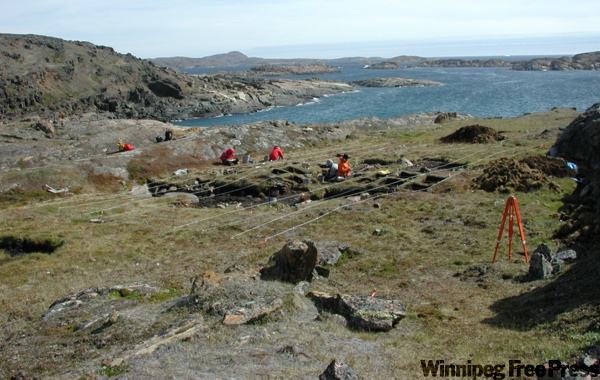
The tantalizing signs of a possible medieval Norse presence in Nunavut were found at the previously examined Nanook archeological site, about 200 km southwest of Iqaluit, where people of the now-extinct Dorset culture once occupied a stretch of Hudson Strait shoreline.
A UNESCO World Heritage site at northern Newfoundland’s L’Anse aux Meadows — about 1,500 km southeast of the Nanook dig — is the only confirmed location of a Viking settlement in North America. There, about 1,000 years ago, it’s believed a party of Norse voyagers from Greenland led by Leif Eiriksson built several sod-and-wood dwellings before abandoning their colonization attempt under threat from hostile natives they called "Skraelings."
But over the past 10 years, research teams led by the Canadian Museum of Civilization’s chief of Arctic archeology, Pat Sutherland, have compiled evidence from field studies and archived collections that strongly suggests the Norse presence in northern Canada didn’t end with Eiriksson’s retreat from Newfoundland.
At three sites on Baffin Island, which the Norse called "Helluland" or "land of stone slabs," and at another in northern Labrador, the researchers have documented dozens of suspected Norse artifacts such as Scandinavian-style spun yarn, distinctively notched and decorated wood objects and whetstones for sharpening knives and axes.
A single human tooth from one of the sites was tested a few years ago for possible European DNA, but the results were inconclusive.
There is also evidence at Nanook of what appears to be a rock-lined drainage system comparable to ones found at proven Viking sites.
The apparent "architectural elements" found at the site "still have to be confirmed," Sutherland told Canwest News Service. "They’re definitely anomalous for Dorset culture. And when you see these things in connection with Norse artifacts, it suggests that there may have been some kind of a shore station."
Sutherland’s theory is that Norse sailors continued to travel between Greenland and Arctic Canada for generations after the failed colony in Newfoundland. She believes they encountered and possibly traded with the Dorset, ancient aboriginals who were later overrun by the eastward-migrating Thule ancestors of modern Inuit.
The theory is a controversial one.
University of Waterloo archeologist Robert Park recently challenged the dating of artifacts and Sutherland’s interpretations of evidence in a paper published by the journal Antiquity.
He suggests such items may have been developed without any Norse influence by the ancient indigenous inhabitants of northern Canada.
Sutherland insists that while proof of Norse-Dorset interaction isn’t overwhelming, there are now "several lines of evidence" pointing to sustained contact.
— Canwest News Service