

On school patrol
There are 17 police officers whose beat is the academic hallways of five Winnipeg divisions where they build relationships and de-escalate problems

Advertisement
Read this article for free:
or
Already have an account? Log in here »
To continue reading, please subscribe:
Monthly Digital Subscription
$1 per week for 24 weeks*
- Enjoy unlimited reading on winnipegfreepress.com
- Read the E-Edition, our digital replica newspaper
- Access News Break, our award-winning app
- Play interactive puzzles
*Billed as $4.00 plus GST every four weeks. After 24 weeks, price increases to the regular rate of $19.95 plus GST every four weeks. Offer available to new and qualified returning subscribers only. Cancel any time.
Monthly Digital Subscription
$4.99/week*
- Enjoy unlimited reading on winnipegfreepress.com
- Read the E-Edition, our digital replica newspaper
- Access News Break, our award-winning app
- Play interactive puzzles
*Billed as $19.95 plus GST every four weeks. Cancel any time.
To continue reading, please subscribe:
Add Free Press access to your Brandon Sun subscription for only an additional
$1 for the first 4 weeks*
*Your next subscription payment will increase by $1.00 and you will be charged $16.99 plus GST for four weeks. After four weeks, your payment will increase to $23.99 plus GST every four weeks.
Read unlimited articles for free today:
or
Already have an account? Log in here »
Hey there, time traveller!
This article was published 30/12/2017 (2957 days ago), so information in it may no longer be current.
It’s like a warm and fuzzy Disney movie when Const. Garnie McIntyre walks the halls of inner-city school Hugh John Macdonald.
Grinning Syrian junior high boys talk animatedly to the man they know as Constable Mac, a white guy in a police uniform with a big gun on his hip,
Girls and a resource teacher wearing hijabs look relaxed as they stop to tell him what they’ve been doing.
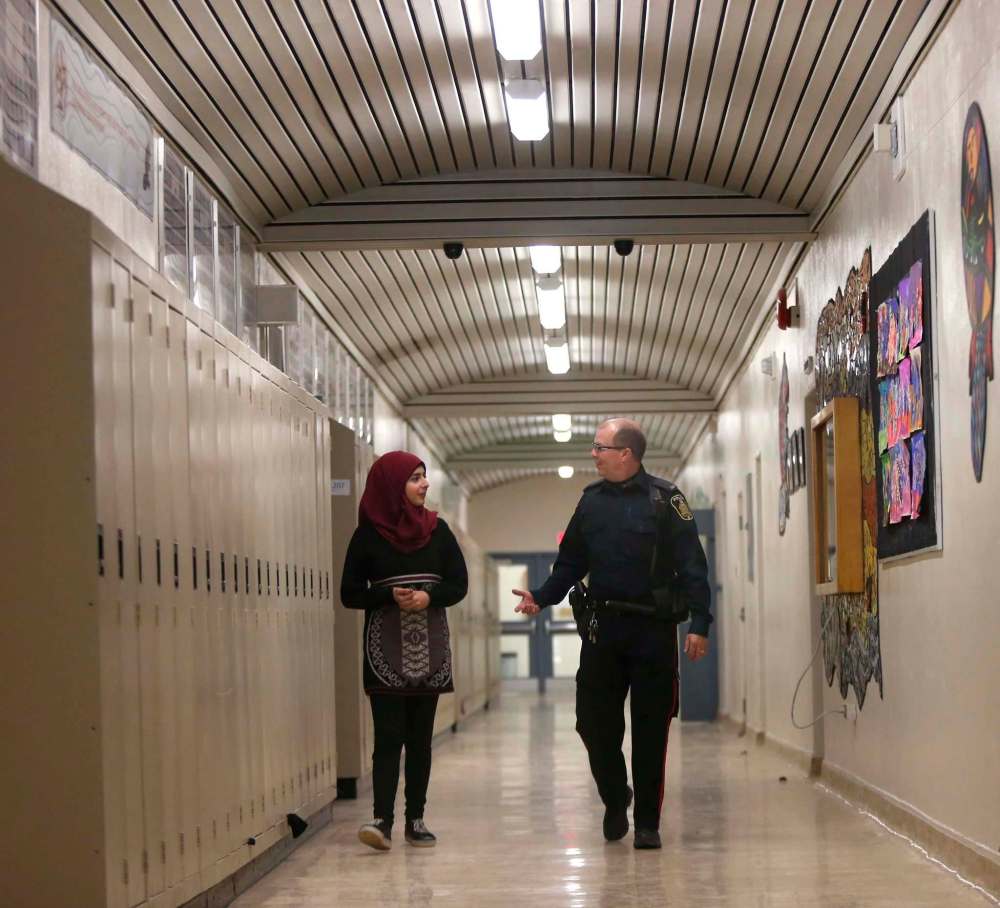
Kids from Africa talk with Garnie as though they’re as comfortable with the uniform as they are with the guy whose wearing it.
A Métis educational assistant sits in the cafeteria for a cheerful chat before rousting some kids for leaving garbage behind — her authority seems far more feared than his.
The respectful, cheerful interaction between youth and a cop seems too good to be true, but it’s real. Some kids even hug him.
At a time when Toronto educators consider pulling police out of high schools amid public complaints they are an occupying force in schools to keep the lid on certain minorities, the program in Winnipeg has grown since it started in 2002, now with 17 police officers in clusters of schools in five city divisions.
Constable Mac’s been doing it for almost six years, working in Tec Voc High School and its elementary and junior high feeder schools.
“It started with three officers in the North End,” recalled police Chief Danny Smyth. “Primarily, there’s a relationship-building component with the schools, the children, the parents. It’s always been more a preventative relationship.”
In the beginning, the principals all had different ideas about how the program would work, Smyth said. “There were times that the principals wanted them for law enforcement. They were expecting an investigative role — it was never intended that way. “
The chief pointed out that many school officers coach school teams and get invited to graduation ceremonies. “It’s done wonders,” Smyth said. “Once they establish themselves, the schools don’t want to let them go.”
The minimum qualifications to apply is to be a first-class constable, a rank which usually takes five years to achieve.
Nahanni Fontaine, the NDP MLA for St. Johns, knew school officers when she was director of justice with the Southern Chiefs Organization: “I had the benefit of working with several over the years in restorative justice. I’ve seen phenomenal work done by phenomenal officers.”
She once received a call from a school officer at Children of the Earth High School. “There’d been a couple of incidents between two boys there,” Fontaine recalled.
The school and police officer held a circle with the boys and their parents and worked things out. “It turned out to be a really powerful transformative moment. This is the best of what’s possible with school resource officers — their effect spills out into the families, the communities,” Fontaine said. “There is often a distrust with Indigenous people towards police. We have to ensure they’re a fit, that they understand the school and the community.”
Fontaine said there is still concern that officers only get assigned to problem schools. “There was a lot more vocal concern at the start of this program. (Now), it’s almost a given, it’s a normalized activity,” she said.
“Any notion it was for the inner city should have been dispelled when Pembina Trails came on,” Smyth said.
Aboriginal Council of Winnipeg president Damon Johnston has Indigenous people walk into his office on Higgins Avenue to complain about their experiences with governments and police officers they encounter on the street: “I’ve had not one complaint about police being in school.
“You can’t get to know people until you interact” away from the street and police cruisers, Johnston said.
University of Manitoba sociology Prof. Frank Cormier has supervised two sets of student researchers who examined the school-officer program extensively.
“They improve the relationship between students and the police,” Cormier said his students concluded. “They want to be someone the students can go to and confide in.”
The research found that the school staff wanted the police in high schools primarily, while the police wanted to be in feeder schools. “The younger a person is, the less likely they’ll have developed a hardened attitude towards the police,” he said.
However, his students found that in the earlier years of the program, the presence of police made some students feel as though their school must be unsafe, Cormier said. “Some took it as almost an insult,” he said.
Winnipeg School Division board chair Sherri Rollins is a huge fan.
“The men and women spend their time building the relationships in the community to do prevention work,” Rollins said. “Talk to any principal and they will say they are important members of our school community.”
But, Rollins said, “While the program and the men and women who serve our communities are wonderful, the school division shouldn’t be paying for it. In other provinces, community policing is paid for by the provincial government. It’s a community policing line in a provincial budget,” Rollins said. “The Winnipeg School Division has under-resourced and undeserved communities and neighbourhoods. It continues to make our board deeply uncomfortable that community policing is on our bill.”
Justice Minister Heather Stefanson was not made available for an interview.
Manitoba Teachers’ Society president Norm Gould said the program doesn’t get raised as a union issue. “Now that’s not to say individual principals don’t want increased police presence, but it’s not a hot stove item with principals right now.”
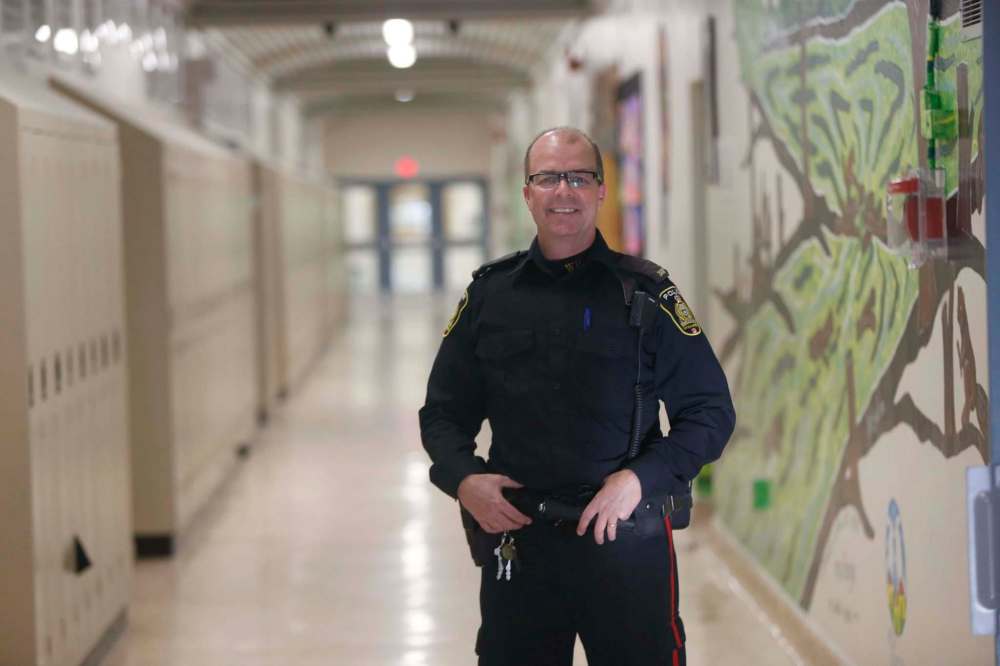
Back on the beat at Hugh John, Constable Mac talked about his job.
“I do a lot of restorative stuff — it’s putting out little fires before they become big fires,” he said. “All the little stuff I get told… notes put under my door, (such as) you might want to be in Roosevelt Park at noon.”
If a kid comes into a school wearing gang colours, McIntyre quietly takes him aside, and sends the lad home to change.
“Don’t get me wrong, we’re not doing this as a popularity contest. I tell the appropriate people. The caution level goes up,” he said.
He’ll talk to siblings of gang members, especially if a teacher has spotted red flags. If he knows a kid has an outstanding warrant, he’ll advise the student to go to the station so police don’t have to bust him in school.
“I genuinely believe in my heart that we’re making a big difference,” said Constable Mac.
Hugh John Macdonald principal Vinh Huynh was among many who lobbied to have the police stint extended. “We do it from a relational context: we care for you. There’s a lot of broken relationships we want to fix — we don’t want it to fester.”
At Pinkham School, principal Val Mowez has seen her kids go on to Hugh John for junior high, having known Constable Mac for most of their lives. “We’re seeing a shift in attitude towards the Winnipeg Police Service. They come up hugging him,” Mowez said. “Some of our children, their first experience with the police is they come to the house and take mom or dad away.”
Speaking to a Grade 2 class at Pinkham, Constable Mac singled out kids he’s heard have helped out other children or gone out of their way to include them.
“One of the reasons I became a policeman is, I don’t like bullies,” he told the kids. If there’s bullying, “You tell a trusted adult. There’s a difference between tattling and telling someone — tattling is because you want to get someone in trouble.”

Constable Mac explained the 11 kilograms of equipment he wears on the job, the radio, the baton, the handcuffs, the protective vest, and, of course, the fascinating gun, which he rarely draws and which he’s shot only on the practice range.
“Who’s the biggest gang in Winnipeg? The police,” he declares. “I don’t know a lot of bad guys who have a helicopter. We have snowmobiles, we have boats, we have dogs.”
And an insider’s tip, learned at the cost of a ruined shirt. When on a coffee break, it’s critical to know where the hole is in a jelly doughnut, Constable Mac told the kids.
“Find out where the hole is, turn it away from you, that’s called doughnut safety.”
nick.martin@freepress.mb.ca
Nick Martin
Former Free Press reporter Nick Martin, who wrote the monthly suspense column in the books section and was prolific in his standalone reviews of mystery/thriller novels, died Oct. 15 at age 77 while on holiday in Edinburgh, Scotland.
Our newsroom depends on a growing audience of readers to power our journalism. If you are not a paid reader, please consider becoming a subscriber.
Our newsroom depends on its audience of readers to power our journalism. Thank you for your support.
Pinkham School on Pacific Avenue describes the role of the school resource officer as:
Participating in hold and secure and lock-down rehearsals
Participating in school events
Engaging in class visits and informal lectures
Supporting school patrol programs
Being available for students, parents, and caregivers to answer questions/give advice
Investigate minor incidents
Assisting and following up on major incidents
Keeping schools informed of community/police matters
Contacting the school to activate lock-out based on nearby threats
Participating in resolving school and community issues
Province, divisions
share policing cost
The province provides $554,000 to fund the school resource officer program this year, through Manitoba Justice, splitting the cost with school divisions.
That funds 16 officers in five school divisions, and Seven Oaks fully funds a 17th officer.
There are nine in Winnipeg, three in Seven Oaks, two apiece in Pembina Trails and St. James-Assiniboia, and one in Louis Riel.
The funding covers a less-experienced officer level, but only first-class constables work as SROs, none with less than 13 years of experience; the Winnipeg Police Service covers the difference in wages and benefits.
In addition, school divisions provide $15,000 in kind support, such as office space and phones.
WPS provides $30,000 in kind support, such as training, overtime, uniforms and vehicles.
WSD says trustees raised school property taxes this year to maintain the program — it has requested a meeting with the justice and education ministers to argue its case that the province should pay all costs.
Nick Martin
Former Free Press reporter Nick Martin, who wrote the monthly suspense column in the books section and was prolific in his standalone reviews of mystery/thriller novels, died Oct. 15 at age 77 while on holiday in Edinburgh, Scotland.
Our newsroom depends on a growing audience of readers to power our journalism. If you are not a paid reader, please consider becoming a subscriber.
Our newsroom depends on its audience of readers to power our journalism. Thank you for your support.

Advertisement Advertise With Us
Advertisement Advertise With Us
History
Updated on Saturday, December 30, 2017 8:07 AM CST: Photo added.
Updated on Saturday, December 30, 2017 8:19 AM CST: Headline shortened