

Memories of Ronaldinho belong to me
Advertisement
Read this article for free:
or
Already have an account? Log in here »
To continue reading, please subscribe:

Digital Subscription
One year of digital access for only $205*
- Enjoy unlimited reading on winnipegfreepress.com
- Read the E-Edition, our digital replica newspaper
- Access News Break, our award-winning app
- Play interactive puzzles
*First annual payment billed as $205.00 + GST for one year. This annual subscription will automatically renew at $233.00 + GST every 52 weeks (10% off the regular annual price of $259.35). Offer available to new and qualified returning subscribers only. Cancel any time.
To continue reading, please subscribe:
Add Free Press access to your Brandon Sun subscription for only an additional
$1 for the first 4 weeks*
- Enjoy unlimited reading on winnipegfreepress.com
- Read the E-Edition, our digital replica newspaper
- Access News Break, our award-winning app
- Play interactive puzzles
*Your next Brandon Sun subscription payment will increase by $1.00 and you will be charged $17.95 plus GST for four weeks. After four weeks, your payment will increase to $24.95 plus GST every four weeks.
Read unlimited articles for free today:
or
Already have an account? Log in here »
Hey there, time traveller!
This article was published 20/01/2018 (3146 days ago), so information in it may no longer be current.
I remember Ronaldinho. I remember ponytails and high-rise apartments, chipped goals and hotdogs, elasticos and magazine articles. “I” remember Ronaldinho.
Following the announcement of his retirement this week, I tried — I really did — to compose something about Ronaldinho, and Ronaldinho alone. Goodness knows he left enough material. But, as Marcel Proust writes about memories, “we have put something of ourselves everywhere, everything is fertile.” And when I think back on Ronaldinho, my recollections of his career are inevitably attached to myself, to my own experience.
When The Tragically Hip evokes Paul Henderson’s Summit Series goal, Gord Downie sings, “all I remember was sitting beside you.” Countless things happen without us, but what makes them “our” memories is that they fasten themselves to us — like a lover to a song, a golaço to a place. The past few days I’ve kept returning to three words: I remember Ronaldinho.
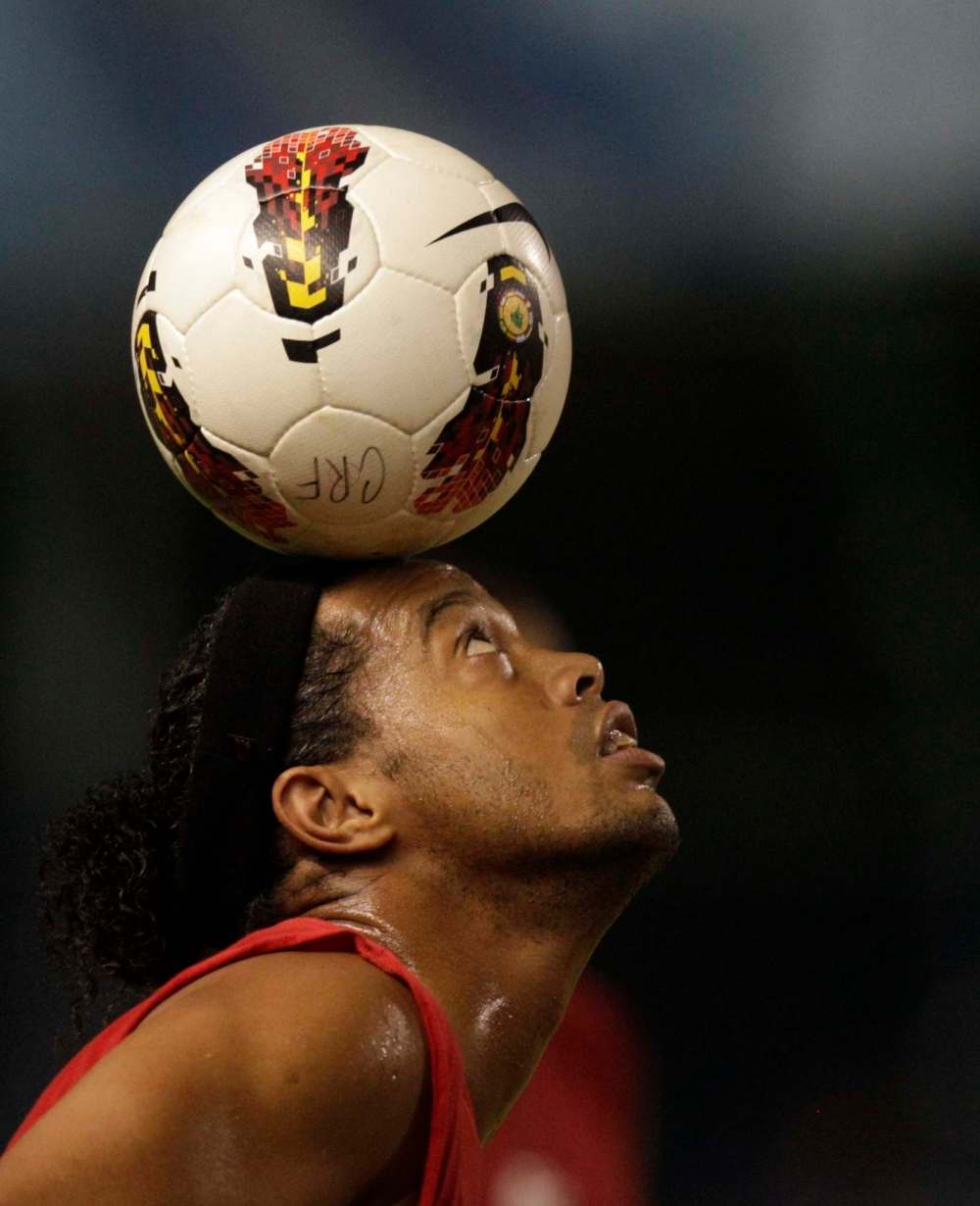
I remember Ronaldinho being not only the best player in football, but also the greatest showman in sports. Having introduced himself to the world with an audacious free-kick against England at the 2002 World Cup, he had moved from Paris Saint-Germain to Barcelona in 2003 (“consolation” for the Catalans having failed to sign David Beckham) and been named FIFA world player of the year in 2004.
The 2005-06 season, which was his best, saw him demolish Real Madrid in November, win the Ballon d’Or in January and lift the European Cup in May.
Back then, I was living in a downtown Winnipeg highrise, despairing and unpredictable and in a life-and-death struggle with clinical depression. Unmedicated, I survived off walking, reading and regular doses of “Ronaldinho treatment.” Here was the original YouTube footballer — a superstar who would provide a giggle and a smile as you followed him down the rabbit hole.
He would look one way and pass the other, or scamper downfield almost in a crouch to lower his centre of gravity. As a figure with the ball at his feet, he was a marvel. His ponytail bounced to the rhythm of jogo bonito.
Giggles and smiles — rare and unexpected reactions in those difficult days. That Bernabéu performance provided plenty of both.
I remember Ronaldinho swerving in from the left, as he often did, this time jinking past Iván Helguera and Sergio Ramos before beating Iker Casillas to complete his mazy run. He scored twice in Barcelona’s 3-0 win, and even earned an ovation from the astonished Madrid supporters. But my favourite memory of the encounter is his cheeky chip of the ball overtop a dead-in-his-tracks Zinedine Zidane.
It was a match that also included Beckham, Raúl, Ronaldo, Roberto Carlos, Xavi, Puyol, Deco, Eto’o, Iniesta and Messi. In the history of club football, there may not have been two teams as star-studded on the pitch at one time, and Ronaldinho shone brighter than them all.
He gave the game joy.
He always loved taking on the best in the world, and in one-on-one situations — or even one-on-two or one-on-three — he would usually come out on top. On one occasion against AC Milan, he played keepy-uppy with himself as he passed first Gattuso, then Pirlo and then Nesta. Oh, how the ponytail bounced — a physical representation of pure pleasure.
I remember Ronaldinho and Barcelona winning the Champions League that spring.
I had bailed on plans to watch the final with some friends — the volatility, in hindsight, by then an already well-established pattern and symptom of mental illness — and had instead done what I had done throughout the latter stages of the tournament: bought a couple hotdogs from a nearby vendor and taken them up to my apartment in time for kickoff. I even saw my friends out of the corner of my eye and snuck out of their line of vision as they made their way to the pub. I never told them that.
It was a match the Blaugrana nearly didn’t win, and one Ronaldinho had difficulty asserting himself into. But on Eto’o’s equalizer, his presence away from the build-up was enough to draw four Arsenal players away from the Cameroonian, who finally broke through a stubborn, 10-man opponent.

By then, even though he was just 26 years old, the maestro who had tricked Seaman and toe-poked Chelsea, had hit what would prove to be the height of his career. Sure, there would be further magic at Milan, Flamengo, Atlético Mineiro and even Querétaro, with which he earned another ovation from the away fans, this time at Estadio Azteca following a highlight-reel brace in 2015. But those moments would be more and more occasional, the best of his repertoire catalogued into memory.
I remember Ronaldinho joining Milan, because it provided the subject for one of my first articles in a football magazine. In the piece, I likened him to Leonardo da Vinci, who had moved to the same city near the end of his career, working as a sort knowledge repository for his patron, Charles d’Amboise. That’s the first of my articles in which I tied football and the arts. They’ve seemed intertwined to me ever since. Like football and my past, my memories.
We have indeed put something of ourselves everywhere. How else would we remember anything? How would we know who we were, and are? I remember certain things, particular times, because football was happening around them.
I remember Ronaldinho.
jerradpeters@gmail.comTwitter @JerradPeters
History
Updated on Saturday, January 20, 2018 8:25 AM CST: Photo added.