Replica of Franklin’s doomed ship sails into museum
Advertisement
Read this article for free:
or
Already have an account? Log in here »
To continue reading, please subscribe:

Digital Subscription
One year of digital access for only $205*
- Enjoy unlimited reading on winnipegfreepress.com
- Read the E-Edition, our digital replica newspaper
- Access News Break, our award-winning app
- Play interactive puzzles
*First annual payment billed as $205.00 + GST for one year. This annual subscription will automatically renew at $233.00 + GST every 52 weeks (10% off the regular annual price of $259.35). Offer available to new and qualified returning subscribers only. Cancel any time.
To continue reading, please subscribe:
Add Free Press access to your Brandon Sun subscription for only an additional
$1 for the first 4 weeks*
- Enjoy unlimited reading on winnipegfreepress.com
- Read the E-Edition, our digital replica newspaper
- Access News Break, our award-winning app
- Play interactive puzzles
*Your next Brandon Sun subscription payment will increase by $1.00 and you will be charged $17.95 plus GST for four weeks. After four weeks, your payment will increase to $24.95 plus GST every four weeks.
Read unlimited articles for free today:
or
Already have an account? Log in here »
Hey there, time traveller!
This article was published 23/01/2018 (3157 days ago), so information in it may no longer be current.
He was famous in Britain as “the man who ate his boots,” after he and crew members boiled their belts and footwear to make soup and survive an earlier expedition to find the Northwest Passage.
Undaunted, Sir John Franklin set sail again in 1845 at age 59, with a crew of 129 men — and this time became famous for another reason: vanishing in the Canadian Arctic. His disappearance triggered one of the largest search efforts in history.
The British Admiralty offered a reward of 20,000 pounds — equivalent to $2.5 million today — for information leading to the crew’s whereabouts, and 39 ships went searching. The first set sail in 1848 (it was not unusual for Arctic expeditions such as Franklin’s not to be heard from for one or two years) and the last in 1859, when enough evidence was found to reconstruct the grisly events that left no survivors.
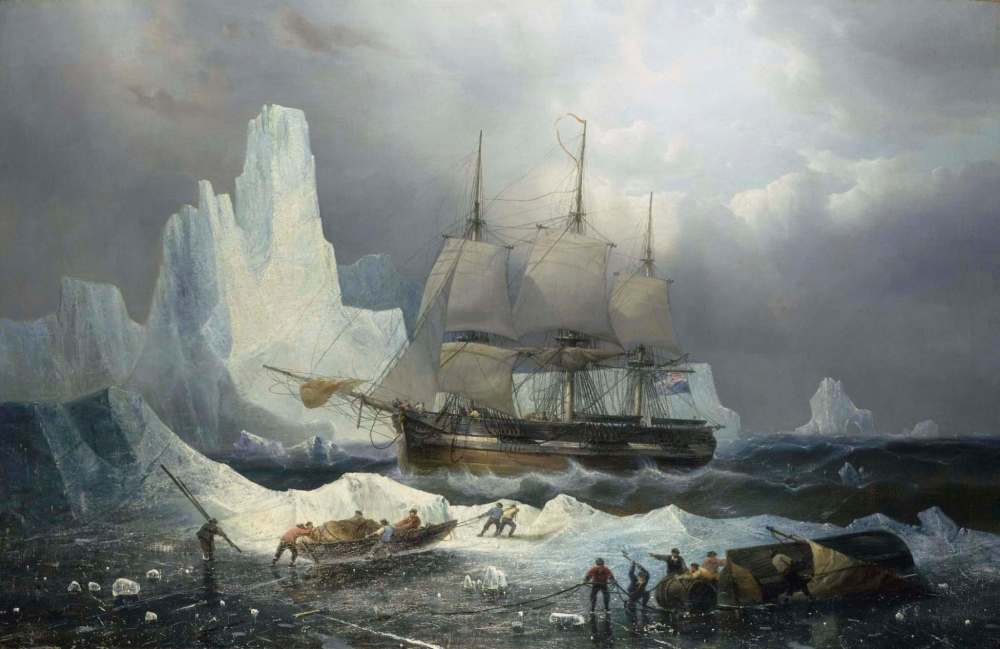
Franklin’s ships, however, were only found recently by the Parks Canada underwater archeology team: the HMS Erebus (darkness personified, as the name is derived from a chamber in Hades of Greek myth) in 2014, and the HMS Terror in 2016.
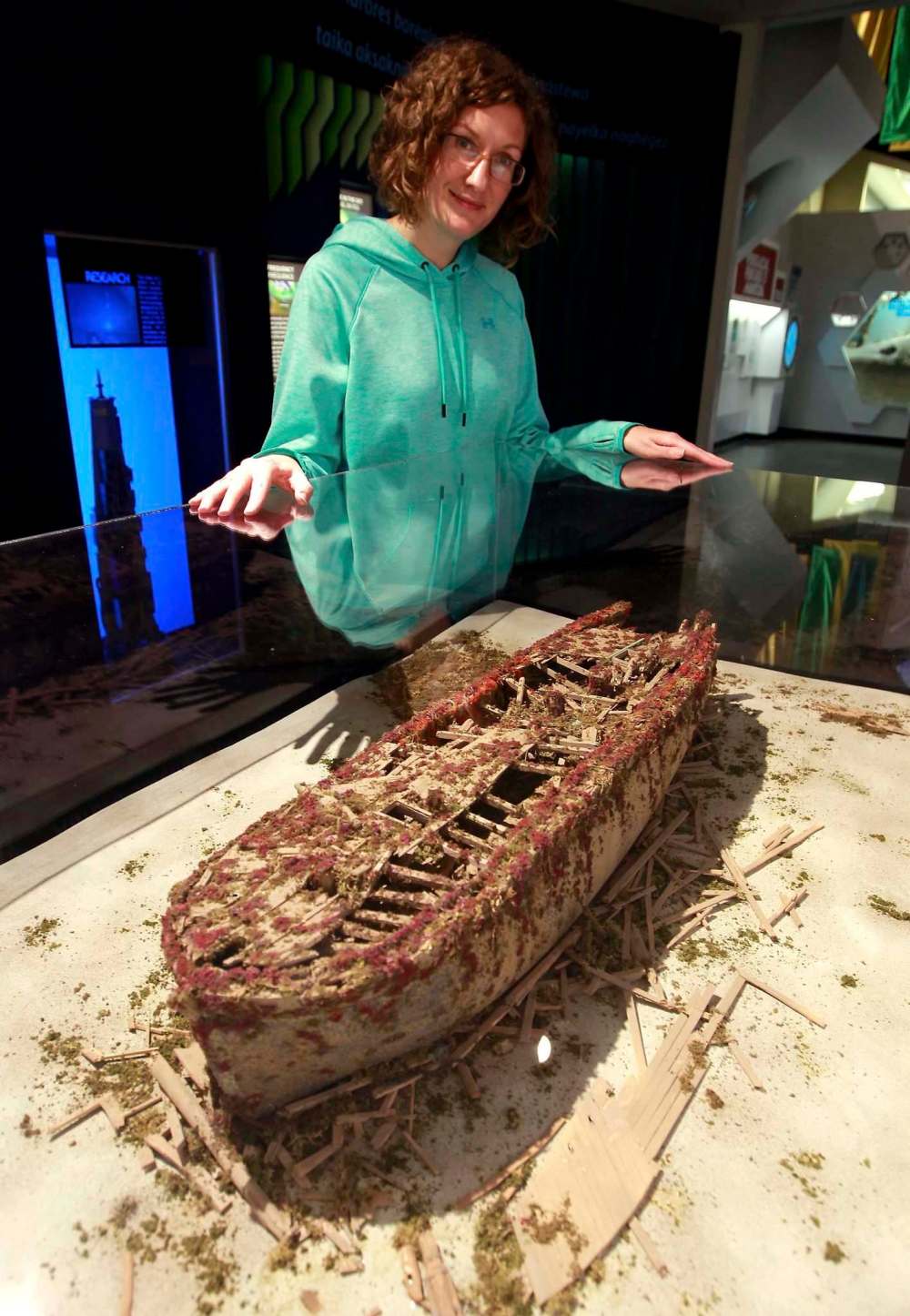
The Manitoba Museum is exhibiting a miniature replica of the HMS Erebus from Jan. 26 to March 21, courtesy of Parks Canada, to go with its Franklin Exploration pop-up display — an electronic information board and interactive touch screen — which has been up since September 2016.
Both are relatively modest exhibits, but anything pertaining to Franklin attracts eyeballs.
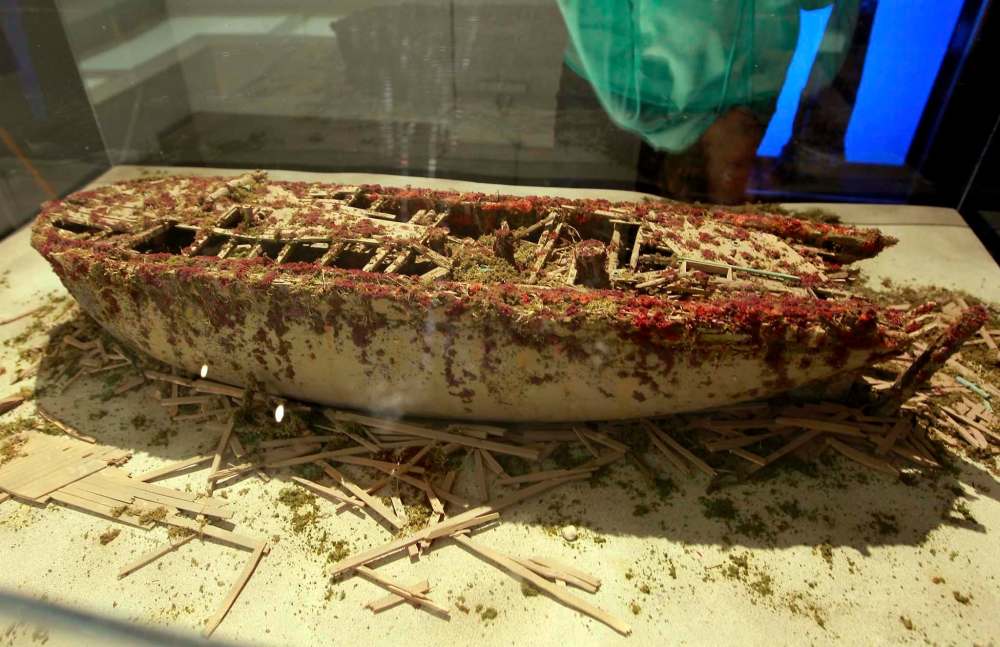
The replica is of what the divers found of the Erebus in 2014, with its stern smashed in, its rudder detached and planted in the seabed like a staff, and deck planks shattered and scattered around the ship’s hull. Copper items such as cannons and a bilge pump have turned verdigris (a soft green patina).
Every ship of the day would have had cannons in case of piracy or just to announce arrivals, said Amelia Fay, Manitoba Museum curator of the Hudson Bay Company museum collection, who is overseeing the Franklin display.
The ship is quite well preserved, and deck planking may have been sheared off by ice moving over top, she said. It was found only 10 metres deep and you can see it in satellite photos, if you know where to look, museum staff said.
The ship’s deck and sides are encrusted with brightly coloured coral of scarlet, orange, and light and dark green.
“The Arctic seabed is really beautiful. It’s bright colours of different coral and anemone,” Fay said.
The ships became locked in by ice in 1847 in the Victoria Strait to the north of King William Island, and Franklin died shortly after, possibly from a stroke. The ships were abandoned in 1848, and the sea current moved them into their present positions.
The Terror was found just off the south shore of King William Island, and the Erebus farther south, both in eastern Queen Maud Gulf in Nunavut.
The men did not survive after they abandoned ship and trekked across the ice.
“They were very well equipped for marine venture, but not for terrestrial adventure,” Fay said. The expedition left Britain with a two- to three-year supply of food, including loads of chocolate, as well as liquor for special occasions.
A few of the bodies found buried on a nearby island are remarkably well preserved, flesh and all, thanks to the permafrost.
The ships have not been thoroughly explored because of their fragile states and the dangers involved, but Fay said it’s possible Franklin’s remains are on one of them. Franklin, who was overweight and out of shape when the ship embarked, died when the ships were trapped, and there would have been nowhere to bury him, she said.
Fay suspects researchers will probably use robot divers to search the ship more thoroughly in the future. Ownership of the ships has yet to be settled.
Another debate is whether to bring one of the ships to the surface. Fay believes it would take decades and a huge expense to do so.

Some artifacts, including the bell from the Erebus, are currently on display at the National Maritime Museum in London. The artifacts are scheduled to move to the Canadian Museum of History in Gatineau, Que., later this year.
The replica Erebus is on a 1:40 scale. Another way to put it: the Erebus is about twice the size of the Nonsuch at the Manitoba Museum. (The Nonsuch Gallery is being renewed and is expected to reopen this summer.)
“Most of us are not divers. This is a neat way to see the (Erebus). It must have been incredible to dive around it,” Fay said.
The information signage for the Erebus replica wasn’t up yet at Monday’s sneak preview, and Fay wasn’t sure it would be ready by the opening on Jan. 26. She is also hoping to have the replica moved next to the Franklin Expedition pop-up display for a more cohesive experience.
bill.redekop@freepress.mb.ca