For evangelist Billy Graham, the world was his mission
Advertisement
Read this article for free:
or
Already have an account? Log in here »
To continue reading, please subscribe:

Digital Subscription
One year of digital access for only $205*
- Enjoy unlimited reading on winnipegfreepress.com
- Read the E-Edition, our digital replica newspaper
- Access News Break, our award-winning app
- Play interactive puzzles
*First annual payment billed as $205.00 + GST for one year. This annual subscription will automatically renew at $233.00 + GST every 52 weeks (10% off the regular annual price of $259.35). Offer available to new and qualified returning subscribers only. Cancel any time.
To continue reading, please subscribe:
Add Free Press access to your Brandon Sun subscription for only an additional
$1 for the first 4 weeks*
- Enjoy unlimited reading on winnipegfreepress.com
- Read the E-Edition, our digital replica newspaper
- Access News Break, our award-winning app
- Play interactive puzzles
*Your next Brandon Sun subscription payment will increase by $1.00 and you will be charged $17.95 plus GST for four weeks. After four weeks, your payment will increase to $24.95 plus GST every four weeks.
Read unlimited articles for free today:
or
Already have an account? Log in here »
Hey there, time traveller!
This article was published 21/02/2018 (3155 days ago), so information in it may no longer be current.
The man who has been called America’s pastor and the world’s best-known evangelist, Billy Graham, died Wednesday morning at his home in the hill country of North Carolina. He was 99. Graham had retired from active evangelism in 2005 after a crusade in New York, but his influence continued through the ministries he established or energized and the millions of lives he touched during over 60 years of public activity.
Over the years Graham conducted crusades around the world and in the early years he would extend them if people kept responding. That happened in London in 1954 where Harringay arena had been secured for three months, though a series of meetings were planned for six weeks. At the end of that time the team decided to go the full three months. And when that time ended, Wembley Stadium, seating 100,000 was secured, and a second, White City Stadium, seating 65,000 as well, for a grand final service. Both were filled, and at the last moment, Wembley was opened to another 22,000 people who sat on the turf.
During his months in England, he prepared 50 sermons on the days he preached and lost 30 pounds. He also appeared to win over a largely cynical press. After a face to face meeting with Graham, one who had earlier written a very clever denunciation, commented, “I never thought that simplicity could cudgel us sinners so damned hard.”
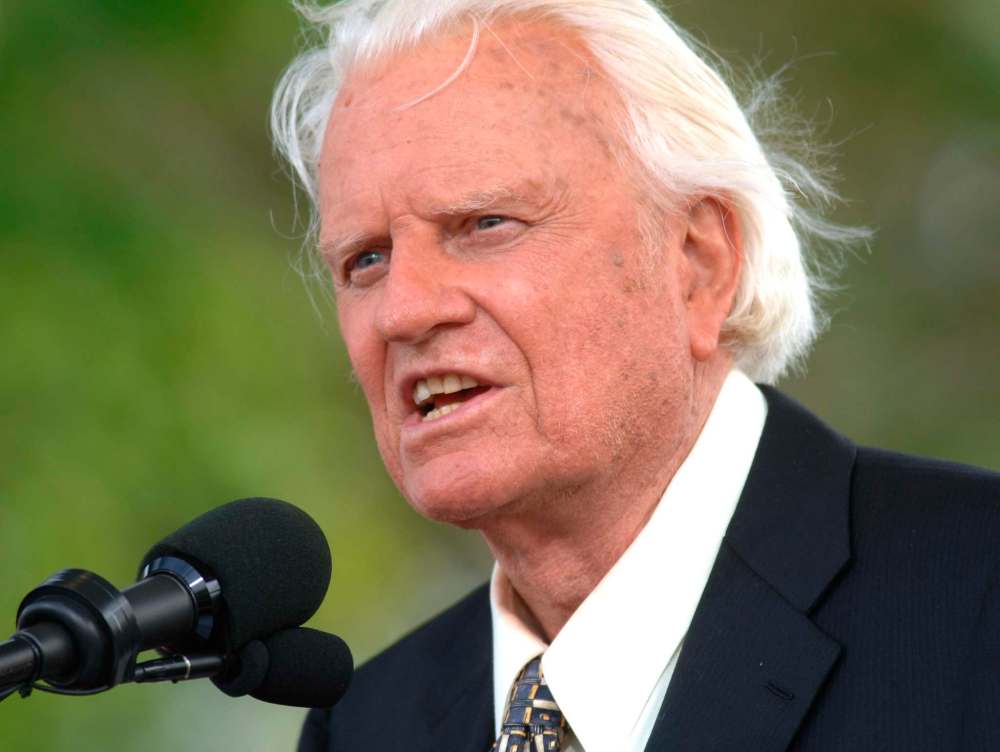
When Graham returned to England more than a decade later, he was greeted at one event by 52 Anglican clergmen sitting on the platform, all of whom had been converted during the Harringay crusade. London did for Graham internationally what the Los Angeles crusade did for him in America.
The story of the breakthrough crusade in Los Angeles that made Graham known across America has often been told. “Puff Graham,” William Randolph Hearst is supposed to have told his editors. The Hearst papers did so. Graham later acknowledged the support and the effect it had night after night for three weeks as people flocked to his 6,000 seat canvas cathedral. Thousands made commitments to Christ.
He became known around the world and in later years he would have crusades from Stockholm to Sydney, West Africa to West Germany, Paris to Paraguay. He was in Winnipeg as well as in Toronto during Canada’s Centennial year. His meetings in Winnipeg filled the old arena night after night.
In 2007, after Graham had retired, his organization estimated he had preached to more than 215 million people in countries around the globe and reached hundreds of millions more by videos, film and television.
Graham stood in a long tradition of American evangelists stretching back decades, but he also reimagined it in ways that were unique. No one has likely spoken to a wider audience spanning the entire globe than he. He preached in Moscow already in 1959 and even to a “repressive leader like Kim Il Sung of North Korea,” as the New York Times put it.
It helped, of course, that Graham’s father-in-law, physician L. Nelson Bell, had been a missionary to China, and Graham’s wife, Ruth, had spent part of her life in that part of the world.
Born in North Carolina and converted in a crusade by another evangelist, Mordecai Ham, and given a Bible college training in two southern schools, Graham might have followed a very traditional path. But that was not to be.
Early in his life, he also chose to attend the leading American evangelical school, Wheaton College, near Chicago, and then became part of the early Youth for Christ movement, an innovative ministry to post-Second World War youth. It was the training ground for a generation of leaders. They were known for engaging the imagination and energies of the young. Some of the circle of men who stayed with Graham virtually all of his years of public ministry came from time.
Graham was open to using every means to reach people with a Gospel message. Even during the London meetings, when the team learned that during war the British had found a way to use phone lines to pipe sound into gatherings, they were able to set up 400 such lines to communities around the country.
For years he could be heard weekly on radio, a publication called Decision entered hundreds of thousands of homes, television specials appeared periodically, he wrote a weekly column for newspapers, wrote 30 books, and films produced by his organization told stories of faith.
Graham and his father-in-law founded a paper in the 1950s called Christianity Today that remains the strongest voice for historic evangelicalism in America. Bell became its first executive editor. In later years, Graham became the major force for gatherings of evangelists from around the world at World Congresses on Evangelism in cities such as Berlin and Amsterdam.
If Graham is known as America’s pastor, it is perhaps as much for the relationship he had with national leaders as it is for the impact he had on John Doe in Peoria. He met and prayed with every president from Harry Truman to Barack Obama. With some he had a close relationship, starting with Richard Nixon and later Ronald Reagan. When Graham learned about some of Nixon’s actions, he was appalled. Nonetheless, he stayed close to other presidents. He was at the White House overnight in 1991 just before George H.W. Bush declared war on Iraq.
Later in life, Graham wrote that if he could do it over again, he “would avoid any semblance of involvement in partisan politics.” He says at times he “stepped over the line between politics and [his] calling as an evangelist.” It was something he regretted.
Graham’s son Franklin has not heeded his father’s advice, generating a great deal of criticism in recent years for his statements about Muslims and LGBT folk, more recently, his support for President Trump.

Graham’s crusades had a number of signature traits. In America’s south or in South Africa he refused to allow them to be segregated. He invited church leaders of all Christian denominations to join his crusades as long as they were comfortable to do so. He often invited well-known figures to tell their faith stories. While crusades had large choirs led by Cliff Barrows, a longtime associate, they also included the wonderful bass soloist George Beverly Shea, and very often guest soloists like Johnny Cash or Ethel Waters.
Throughout his life, Graham never had a whiff of scandal relating to his personal life or his finances. He drew a salary, but it was modest. He was never alone with a woman other than his wife. He took opportunities wherever he could to appear in public if they allowed him to explain the gospel.
Above all, as an evangelist Graham saw himself—as he explained it in his autobiography Just As I Am — as “a person sent by God to announce the Gospel.” And that involves conveying the “unchanging” message “centered in Christ and what he has done for us by his death and resurrection and the need for us to respond by committing our lives to him.” No crusade ended without an invitation to come forward to indicate the desire to repent of sin and follow Jesus.
In his declining years, his wife already gone, Graham suffered from several ailments, including prostate cancer and symptoms of Parkinson’s disease. He is survived by his sons, Franklin and Ned, and daughters Virginia Tchividjian, Anne Graham Lotz and Ruth Graham McIntyre.
Harold Jantz was the founding editor of ChristianWeek, a national evangelical newspaper printed locally in Winnipeg.
The Free Press is committed to covering faith in Manitoba through our Religion in the News project. This reporting continues because readers like you step forward to fund it.
Donate now to support our reporting on religion.
Your donation is eligible for a charitable tax receipt.
BECOME A FAITH JOURNALISM SUPPORTER
The Free Press acknowledges the financial support it receives from members of the city’s faith community, which makes our coverage of religion possible.