

Young justice
Students' crusade for gun control recalls anti-segregation protests
Advertisement
Read this article for free:
or
Already have an account? Log in here »
To continue reading, please subscribe:
Digital Subscription
One year of digital access for only $75*
- Enjoy unlimited reading on winnipegfreepress.com
- Read the E-Edition, our digital replica newspaper
- Access News Break, our award-winning app
- Play interactive puzzles
*Billed as $5.77 plus GST every four weeks. After 52 weeks, price increases to the regular rate of $19.95 plus GST every four weeks. Offer available to new and qualified returning subscribers only. Cancel any time.
Monthly Digital Subscription
$4.99/week*
- Enjoy unlimited reading on winnipegfreepress.com
- Read the E-Edition, our digital replica newspaper
- Access News Break, our award-winning app
- Play interactive puzzles
*Billed as $19.95 plus GST every four weeks. Cancel any time.
To continue reading, please subscribe:
Add Free Press access to your Brandon Sun subscription for only an additional
$1 for the first 4 weeks*
- Enjoy unlimited reading on winnipegfreepress.com
- Read the E-Edition, our digital replica newspaper
- Access News Break, our award-winning app
- Play interactive puzzles
*Your next Brandon Sun subscription payment will increase by $1.00 and you will be charged $17.95 plus GST for four weeks. After four weeks, your payment will increase to $24.95 plus GST every four weeks.
Read unlimited articles for free today:
or
Already have an account? Log in here »
Hey there, time traveller!
This article was published 24/02/2018 (3003 days ago), so information in it may no longer be current.
The school gates were locked. But that didn’t keep hundreds of students from crawling up and over the fences, defying their parents, teachers and school principals to march against segregation.
It was May 1963 in Alabama, and Birmingham’s brutal public safety commissioner, Eugene (Bull) Connor, was waiting. His police moved in, herding the children into squad cars, paddy wagons and school buses for the trip to jail.
When the students kept coming, Connor turned fire hoses on them, knocking the children to the ground and spinning them down the street. To fight the high-powered blasts, some children joined hands trying to keep their balance in a human chain. But the torrents were too fierce; hit by the rocket-bursts of water, the kids whirled one way, then the other, dragging down their comrades.
The 1963 children’s crusade changed history. Now, 55 years later, the students of Marjory Stoneman Douglas High in Parkland, Fla., are rising up — planning protests and walkouts, speaking at rallies and on radio and television in the aftermath of the Feb. 14 slaughter of 17 people at their school.
The students are putting elected officials on notice: they want America’s gun laws changed, and they will be quiet no more. As if channelling the young African-Americans who faced down the water cannons, junior Cameron Kasky declared on Meet the Press Sunday, “We’re not going to let the 17 bullets we just took take us down. If anything, we’re going to keep running, and we’re going to lead the rest of the nation behind us.”
History shows that kids, with their innocence, honesty and moral urgency, can shame adults into discovering their conscience. It worked in Birmingham. During the children’s crusade, young people swarmed in to redirect the arc of history.
In 1963, Rev. Martin Luther King Jr. had targeted the Alabama city as the key to ending the segregation throughout the South. As his close aide, Wyatt Tee Walker, put it, “We knew that as Birmingham went, so would go the South.”
But the Birmingham movement was flagging. In need of a radical shift in strategy, James Bevel, an adviser to King, recommended turning young black people into foot soldiers for equal rights. King was hesitant, fearing for the children’s safety. He prayed and reflected and finally accepted that putting children in danger could help determine their future.
King had witnessed the youthful energy that propelled the 1961 Freedom Rides. As John Lewis, who at age 21 was beaten bloody during the rides, recalled: “We considered it natural and necessary to involve children — adolescents — in the movement. We weren’t far from being teenagers ourselves, and we shared many of the same basic feelings of adolescence: unbounded idealism, courage unclouded by ‘practical’ concerns, faith and optimism untrampled by the ‘realities’ of the adult world.”
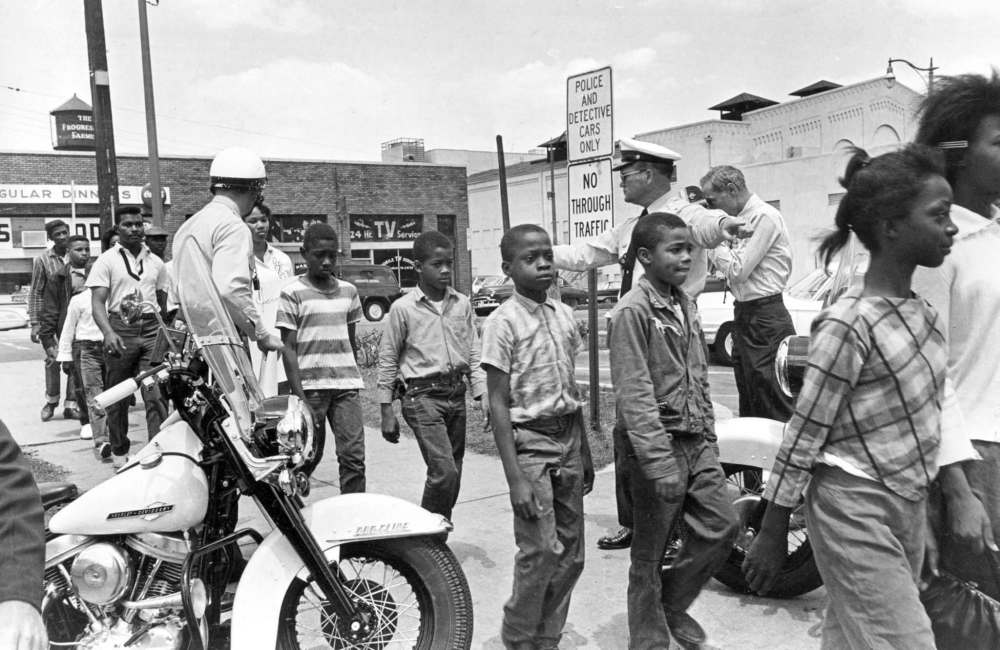
On May 2, 1963, the first day of the Birmingham children’s crusade, some 800 students skipped class, high schoolers all the way down to Grade 1 students. Sneaking over the fences, they scampered to the Sixteenth Street Baptist Church, the march’s staging ground. (Four months later, the church would be dynamited by the Ku Klux Klan, killing four black girls.)
The youngsters then emerged from the church under its brick arch and proceeded down the front steps: girls in dresses and light sweaters; boys in slacks and walking shoes; some wore hats; some had pants held up with suspenders; they were laughing and singing and carrying handmade picket signs reading “Segregation is a sin” and “I’ll die to make this land my home.”
By the end of the day, under Bull Connor’s orders, more than 500 kids were behind bars charged with parading without a permit, some 75 youngsters crammed into cells meant for eight adults.
The children’s crusade was national news. The Birmingham movement had been revived. And U.S. President John F. Kennedy was now paying attention.
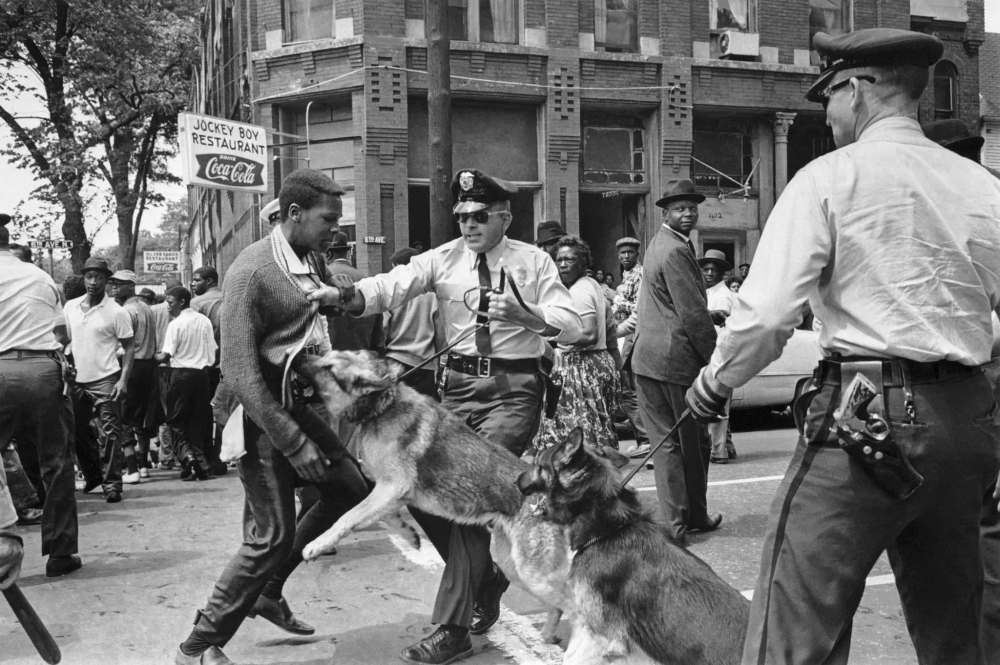
Over the next two days, the young protesters hit the streets en masse, confronting police armed with snarling German shepherds in addition to the water cannon blasts.
To supercharge the water jets, firefighters had funnelled the flow of two hoses into one nozzle, packing it with such ballistic fury it dislodged bricks from buildings. These jets were driven across the kids’ bodies, lacerating their flesh, tearing clothing off their backs; hitting the elm trees in nearby Kelly Ingram Park, the blasts ripped off the bark. The children, knocked to the pavement, crawled away; some struggled to their feet with bloody noses and gashes on their faces.
The morning newspapers that landed on Kennedy’s breakfast table showed students braving the assaults on the front lines. In one shot, a uniformed officer in round shades and a narrow tie yanked on high school sophomore Walter Gadsden’s sweater while a German shepherd lunged toward the student’s stomach with mouth open, fangs bared.
Gazing at the images of water cannons and police dogs, Kennedy was disgusted. U.S. Attorney General Robert F. Kennedy later noted the students’ impact: “What Bull Connor did down there, and the dogs and the hoses and the pictures with (the black people), is what created a feeling in the United States that more needed to be done.”
It was then that the president and the attorney general began considering a path toward comprehensive civil rights legislation. Until students took to the streets, John Kennedy had failed to act; for 2½ years, he had been slow to recognize the plight of black people in America. Throughout his brief term, he had been focused on other matters: foreign affairs, the national economy, the space program. But now, his eyes had been opened.
A little more than a month after the children’s crusade, Alabama Gov. George Wallace gave the president further reason to act. On June 11, Wallace famously stood in the schoolhouse door to prevent two qualified black students from enrolling at the University of Alabama. On that same evening, Kennedy hastily went on national television to decry the immorality of segregation and to announce plans to introduce civil rights legislation.
“Looking back,” King wrote later, “it is clear that the introduction of Birmingham’s children into the campaign was one of the wisest moves we made. It brought a new impact to the crusade, and the impetus that we needed to win the struggle.”
More than 50 years later, that history is alive. Of course, we live in different times. Students are highly independent now; they have social media, television and radio outlets to get their message out and organize — and they are comfortable in front of the camera. In 1963, adults were the organizing force behind the children’s marches, and the media landscape was far more limited.
But the Douglas high school students who survived a mass shooting on Feb. 14 are motivated by the same idealism and hope that inspired Birmingham’s school kids.
When the Florida teens lead a countrywide walkout from classrooms on March 14 and march in Washington, D.C., and other cities on March 24, they will be following in the footsteps of children who were willing to risk their lives to change the country — and succeeded.
— Washington Post