

Italy’s election playing out like a satire
Advertisement
Read this article for free:
or
Already have an account? Log in here »
To continue reading, please subscribe:
Digital Subscription
One year of digital access for only $1.44 a week*
- Enjoy unlimited reading on winnipegfreepress.com
- Read the E-Edition, our digital replica newspaper
- Access News Break, our award-winning app
- Play interactive puzzles
*Billed as $5.77 plus GST every four weeks. After 52 weeks, price increases to the regular rate of $19.95 plus GST every four weeks. Offer available to new and qualified returning subscribers only. Cancel any time.
To continue reading, please subscribe:
Add Free Press access to your Brandon Sun subscription for only an additional
$1 for the first 4 weeks*
- Enjoy unlimited reading on winnipegfreepress.com
- Read the E-Edition, our digital replica newspaper
- Access News Break, our award-winning app
- Play interactive puzzles
*Your next Brandon Sun subscription payment will increase by $1.00 and you will be charged $17.95 plus GST for four weeks. After four weeks, your payment will increase to $24.95 plus GST every four weeks.
Read unlimited articles for free today:
or
Already have an account? Log in here »
Hey there, time traveller!
This article was published 03/03/2018 (3017 days ago), so information in it may no longer be current.
Just one month before Italy’s national elections on March 4, Luca Miniero’s satirical movie Sono Tornato (I’m Back) hit the screens all over the country. It imagined the fascist dictator Benito Mussolini returning to the Italy of 2018 — and its timing was perfect.
“The Italians, unlike the Germans, never dealt with their dictator, they have never removed him,” said Miniero. “Watching what is happening today in our country, I am convinced that if Mussolini came back, he would win the election.” But of course, Mussolini isn’t coming back. It’s only Silvio Berlusconi again.
The Italian counterpart of U.S. President Donald Trump has already been prime minister four times and he has been banned from political office for six years because of a conviction for tax fraud. He is also 81 years old. But they forgot to put a stake through his heart — and Berlusconi is back in business as the man behind the right-wing coalition that may form the next government in Italy.
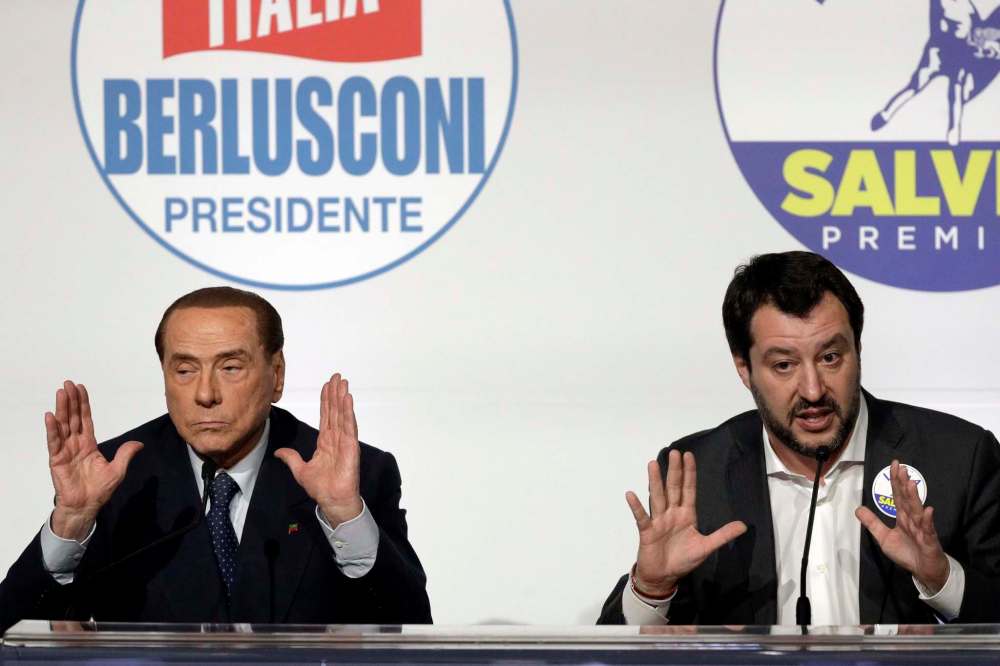
It certainly won’t be the populist Five-Star Movement, which refuses to enter coalitions with other parties. According to the last opinion poll, it will emerge as the largest single party, with around 28 per cent of the vote, but that’s not nearly enough.
The governing centre-left coalition, whose parties are running separately because of their many disagreements, will end up in about the same place. Its biggest member, the Democratic Party, will get around 23 per cent, but with various smaller allies it might make it up to 30 per cent. Again, not enough.
Whereas Berlusconi’s Forza Italia (“Let’s Go, Italy”), running in tandem with the hard-right, anti-immigrant Northern League, could get as much as 40 per cent of the vote. If they then make deals with a few small parties that verge on fascism, they could form a majority government. Berlusconi’s great wealth, derived from his huge media holdings, would give him a dominant role behind the scenes in such a coalition, but he is legally barred from even running for parliament, let alone becoming prime minister. So who would it be?
The dark-horse candidate is Giorgia Meloni, the Trump-lite leader of one of the smaller parties, Brothers of Italy, but it would probably the Northern League’s leader, Matteo Salvini. You might call Salvini Trump-heavy: he hailed The Donald’s election as “the revenge of the people, of courage, of pride… and one in the eye for the bankers, the speculators and the journalists.”
Italians are quite justifiably fed up with the way their country has been run in recent years. Unemployment is 11 per cent, but among the under-25s it is close to 40 per cent, and over 100,000 young people left the country last year in search of work elsewhere. Average family incomes, which fell dramatically after the 2008 financial crisis, have still not recovered to the 2007 level.
But the biggest issue is immigration: in the past four years, Italy has received 600,000 illegal migrants — mostly from African countries — and all the major parties are promising to do something about it. Berlusconi talks bluntly about mass deportations and his prospective coalition partners in the Northern League actually put a number on it: 100,000 forced “repatriations” a year, presumably until they are all gone.

The outgoing coalition government has managed to cut the numbers arriving by making a deal with Libya, the point of departure for most of the migrant boats crossing the Mediterranean to Italy. In return for subsidies for the Libyan Coast Guard and various other considerations, the Libyans have been persuaded to try to stop the migrants from setting sail in the first place.
As a result, migrant arrivals dropped by a third in 2017. That ought to have won the centre-left coalition some credit with the electorate, but since the number of migrants who made it ashore last year was still 119,000, gratitude for the government’s efforts was notably sparse. The centre-left coalition is the only major political grouping in Italy that has not fallen into the hands of populists — but that is why it is trailing both the others in the polls.
The Berlusconi-Salvini coalition’s highly implausible commitment to send all the migrants home resonates strongly with an electorate that has had enough of politics-as-usual. The Italian constitution makes it very hard to form a majority government without an even broader coalition, so the result Sunday may well be a hung parliament and another election, but anger and despair could still give the two men victory.
Since Trump’s election in November 2016, three western European countries — the Netherlands, France and Germany — have had elections in which nationalist, anti-immigrant parties that are hostile to the European Union, or at least to the euro common currency, have done better than ever before, but have not won power. In Italy, they may actually win.
Gwynne Dyer is an independent journalist whose articles are published in 45 countries.