

Strong women make politics better
Advertisement
Read this article for free:
or
Already have an account? Log in here »
To continue reading, please subscribe:
Digital Subscription
One year of digital access for only $1.44 a week*
- Enjoy unlimited reading on winnipegfreepress.com
- Read the E-Edition, our digital replica newspaper
- Access News Break, our award-winning app
- Play interactive puzzles
*Billed as $5.77 plus GST every four weeks. After 52 weeks, price increases to the regular rate of $19.95 plus GST every four weeks. Offer available to new and qualified returning subscribers only. Cancel any time.
To continue reading, please subscribe:
Add Free Press access to your Brandon Sun subscription for only an additional
$1 for the first 4 weeks*
- Enjoy unlimited reading on winnipegfreepress.com
- Read the E-Edition, our digital replica newspaper
- Access News Break, our award-winning app
- Play interactive puzzles
*Your next Brandon Sun subscription payment will increase by $1.00 and you will be charged $17.95 plus GST for four weeks. After four weeks, your payment will increase to $24.95 plus GST every four weeks.
Read unlimited articles for free today:
or
Already have an account? Log in here »
Hey there, time traveller!
This article was published 12/04/2018 (2978 days ago), so information in it may no longer be current.
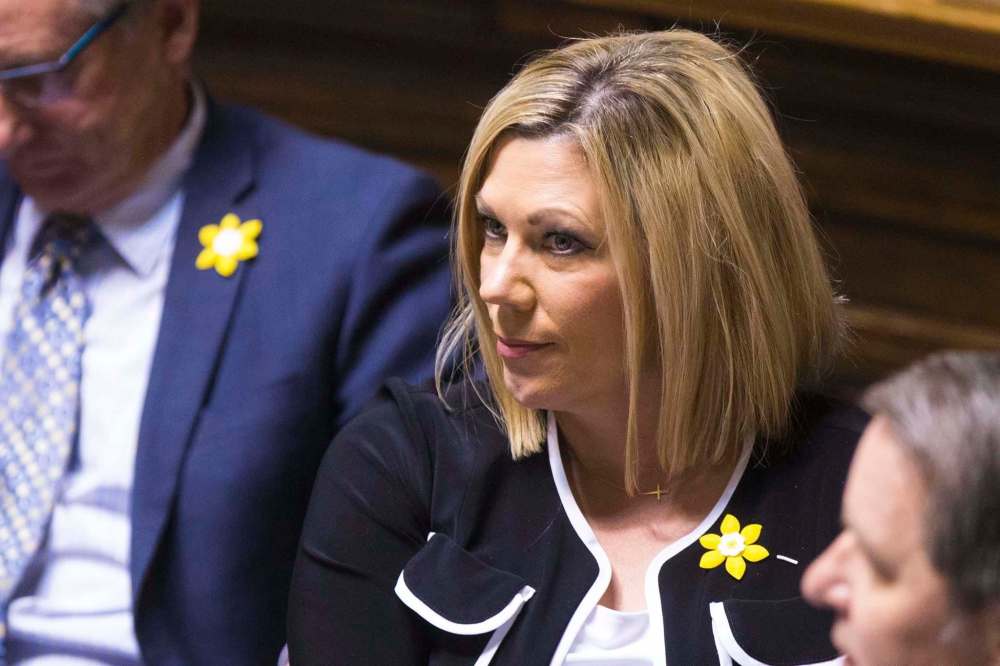
When a visibly shaken cabinet minister stood up last week in the Manitoba legislature and shared the shocking news that she had been sexually assaulted as a 13-year-old, she bravely revealed decades of pain she had previously kept hidden from view.
In that moment, Rochelle Squires was speaking as more than a woman and an MLA. As minister for the status of women, her voice and role-model presence had the potential to have a mighty impact, both on victims of sexual assault and harassment and on political policy-makers.
This is particularly crucial in cabinet, where she now, rightly, will be perceived as a game-changer on the issue of sexual assault and harassment — sadly, as the result of having experienced it first-hand, through no fault of her own.
In 1990, while acting as a senior adviser to then-premier Gary Filmon, I sat in that same cabinet room, many months pregnant, at a time when important discussions were taking place regarding legislation to extend parental benefits.
My pregnant presence in the room was not lost on the mostly male cabinet members as they moved to create and pass stronger legislation for women and families.
Quite frankly, I didn’t care if their action was partly motivated by guilt because I was sitting there; what concerned me was that they would get it done — and they did.
These stories are just two of many examples of the critical importance of having women in politics, at both the elected and senior advisory levels.
I often think of those women who had it even tougher than we did, in this rough-and-tumble profession that is still largely populated by men.
My hometown of Manitou played a formative role in the development of political pioneer Nellie McClung, whose shoes are impossible to fill. It also produced Thelma Forbes, the first woman to serve in a provincial cabinet and first female Speaker of the legislature, and MLA Carolyne Morrison, who served from 1960 to 1969. I am rooted in grand political traditions.
When I look back at the achievements of women in politics, I also think of the gutsy Bonnie Mitchelson, who always got her way with a smile on her face, and Judy Wasylicia-Leis, whose determination to breastfeed her infant at the legislature, despite taunts and shaming, set new boundaries. Today, I also think of our Indigenous sisters in the house who are fighting new fights and breaking down new barriers.
These things are important.
Whether the accomplishments are big or small, what matters is that women are involved in the political process, in all parties and in growing numbers. They are in the right rooms with the right people, speaking their minds and affecting change along the way.
During my earliest days in politics, a powerful journalist once barked, “Can you get me a cup of coffee?” Yes, it was clearly sexist, as he knew that was not why I was sitting in on his interview with the leader of the Opposition. And, no, I didn’t get him that cup of coffee.
The full-circle irony is that, a few weeks ago, after I wrote a rather contentious column that appeared on this page, more than one powerful man suggested that I had been “told” what to write.
The implication was clear: as a woman, I needed a man to tell me what to think.
After I finished laughing out loud, I thought about how I wished he had known me back in grade school, when I bucked tradition and donned pants instead of the mandatory dress in order to walk the half-mile to school in January.
Or, perhaps, had he known me during my lengthy career, during which I have spoken truth to power in cabinet rooms, boardrooms and backrooms, where what mattered most was not the sex of the adviser but the quality of the advice.

I’ve never been one to use the gender excuse for things that have happened — or not happened — to me in politics. It is a rough game and if you want to play it, you need to be tough enough to play it well.
All of this makes me even more proud of the #MeToo generation and the fact that its members have seized the moment to champion what we all need them to fight for — equal pay for equal work, and treatment in life and at work that is free of gender bias and harm.
The courage of Squires and many others has demonstrated that sharing leads to healing, and healing can lead to healthier relationships.
There is much more work to be done, but we should be thankful to all these women. At the end of the day, across all political lines, #WeAreOne.
Barbara Biggar served as a senior adviser to premier Gary Filmon and is currently the president and CEO of Biggar Ideas, a communications consulting firm in Manitoba. She regularly shares her insider’s perspective on politics and policy.