Saving seats for friends a busy bar faux pas

Hogging stools a pet peeve of bartenders

Advertisement

Advertise with us

Ask a bartender about their least-favourite customer behaviours, and you’ll get a variety of answers: boors who snap their fingers to get attention, “gerbils” who nervously shred napkins and beer labels and leave trash on the bar, groups who don’t know what everyone wants when it’s their turn to order.

Read this article for free:


or

Already have an account? Log in here »

To continue reading, please subscribe:

Subscribe and receive a limited-edition Free Press branded hat or tote.

Digital Subscription

One year of digital access for only $205*

  • Enjoy unlimited reading on winnipegfreepress.com
  • Read the E-Edition, our digital replica newspaper
  • Access News Break, our award-winning app
  • Play interactive puzzles

*First annual payment billed as $205.00 + GST for one year. This annual subscription will automatically renew at $233.00 + GST every 52 weeks (10% off the regular annual price of $259.35). Offer available to new and qualified returning subscribers only. Cancel any time.

To continue reading, please subscribe:

Add Free Press access to your Brandon Sun subscription for only an additional

$1 for the first 4 weeks*

  • Enjoy unlimited reading on winnipegfreepress.com
  • Read the E-Edition, our digital replica newspaper
  • Access News Break, our award-winning app
  • Play interactive puzzles
Start now

*Your next Brandon Sun subscription payment will increase by $1.00 and you will be charged $17.95 plus GST for four weeks. After four weeks, your payment will increase to $24.95 plus GST every four weeks.

Hey there, time traveller!
This article was published 09/08/2018 (2973 days ago), so information in it may no longer be current.

Ask a bartender about their least-favourite customer behaviours, and you’ll get a variety of answers: boors who snap their fingers to get attention, “gerbils” who nervously shred napkins and beer labels and leave trash on the bar, groups who don’t know what everyone wants when it’s their turn to order.

But if you ask me what behaviour I’d like to abolish, it’s easy: people who save bar stools for their absent friends when the room is full of customers looking for a seat.

In my decade-plus reporting on bars, I’ve heard all the excuses from stool-guardians: “My friend is in the bathroom.” “She is outside having a cigarette.” “My husband is parking the car.” Then, 20 minutes later, the friend “in the bathroom” inevitably rushes in and sits, wearing a winter coat and apologizing for being late.
Jonathan Newton / The Washington Post
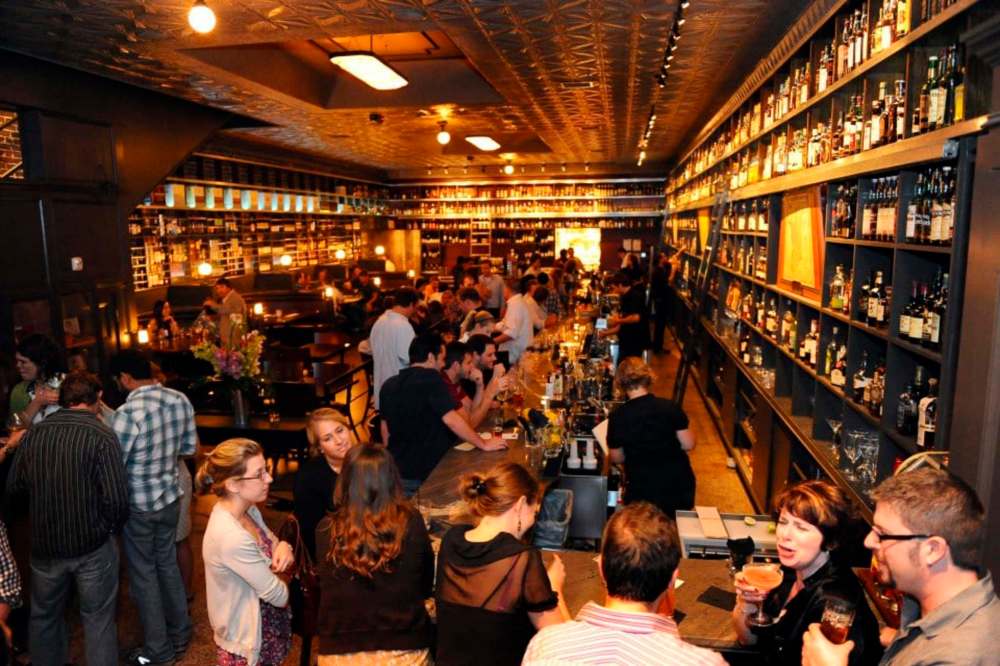
If a bar is crowded you should think twice before saving an empty bar stool for a friend who’s on the way.
Jonathan Newton / The Washington Post If a bar is crowded you should think twice before saving an empty bar stool for a friend who’s on the way.

The seat-saver knows their behaviour is wrong — why else would they feel compelled to lie about their companion’s whereabouts? — and they do it anyway.

A bar is full of unspoken rules, most of which are basic behaviours you should have picked up in elementary school: be polite. Wait your turn. Don’t act obnoxiously. Always tip your bartender. (OK, I said most.) But watch enough people hogging chairs at crowded bars and you realize there is no good rule about when you should and shouldn’t try to save a stool.

David Wondrich, the cocktail historian and author who once picked the best bars in America for Esquire, thinks there’s a sliding scale: “a few minutes while your friend is parking or making it over from the subway is fine,” he says.

“Half an hour is not fine at all. After 10 minutes it starts to be annoying, and after 15, it’s very dodgy unless there are extreme extenuating circumstances. I would give up the seat or at least start buying rounds at that point.”

It’s not hard to find defenders of the practice: they say that it’s impractical to assume that a group will arrive at a bar at the same time or that early birds should reap the benefits of arriving first. To which I reply: fine.

If your group is turning up over the course of 30 minutes and you want to make sure everyone gets a seat, reserve a table. Can’t do that? Then maybe your friend who’s always running just a little behind will eventually get the message.

Beyond the general rudeness to other patrons, leaving a stool empty costs the bar (and the bartender): There are a finite number of seats, and an empty one is not buying cocktails or tipping on them.

If two customers walk into a bar and decide to leave because two otherwise empty seats are being held for friends who are “on the way,” that money isn’t going into the bartender’s pocket at the end of the night.

But the main reason that extended seat-saving rubs me the wrong way is that it goes against the traditional openness of bars. You don’t need to make reservations to enjoy a great bar, as you must for a hot restaurant. Sure, you might have to stand for a while, or stalk fellow customers to see who’s getting the check or where seats are opening up, but at least there’s a level playing field.

Obviously, if I show up at a bar on a Tuesday and half the stools are empty, I have no problem saving the one next to me for a friend who swears they’re on the way. But if the bar is busier, it becomes a judgment call: what if only three of the dozen-or-so stools are empty? Or two?

“Context matters,” says Andrea Tateosian, the president of the D.C. Craft Bartenders Guild and a bartender at the Passenger in Washington.

“If you’re saving seats on a Friday night at 10:30, that’s no good. But if the bar just opened, there are two people there and you’re saving seats in the corner, that’s fine.”

But, she says, “There’s always those people who feel entitled to the space or don’t think about others. Holding a seat at the bar for 20 or 25 minutes isn’t cool.”

So if a bartender notices someone “waiting for a friend” for a long time at peak hours, do they have an obligation to step in and ask the seat-saver to let someone else sit down? Negative, Tateosian says: “as a bartender, you don’t want to police it. You’re a facilitator of fun.”

My wife and I try to practise what we preach: when one of us arrives before the other and finds two seats together, we hold the spare for only 10 minutes (possibly less if the bar is really crowded). After that, if someone asks for the seat, they can have it. If that means the one taking their sweet time has to stand — and, to be fair, it’s often me — so be it.

Treat people the way you’d want to be treated — that sounds like something I learned in kindergarten.

— Washington Post

Report Error Submit a Tip

More Stories

Mayoral candidates roll out pledges

Joyanne Pursaga 5 minute read Preview

Mayoral candidates roll out pledges

Joyanne Pursaga 5 minute read 6:26 PM CDT

Mayoral contender Kevin Klein would seek new election rules to “level the playing field” for all future candidates, if elected.

“This is meant to strengthen our democracy,” said Klein.

He would ask city council to approve several changes, including a municipal announcement blackout to start 30 days before each election, except when one is legally required or shares emergency/public safety notices.

City staff could also release information without elected officials present.

Read
6:26 PM CDT

Wab Kinew as ‘communicator in chief’

Paul G. Thomas 6 minute read Preview

Wab Kinew as ‘communicator in chief’

Paul G. Thomas 6 minute read 2:00 AM CDT

Premier Wab Kinew and his party have been riding high in the polls longer than normal for a government one year or less away from its first re-election contest. One reason is his ubiquitous, dominating communications presence as NDP leader and premier.

The argument here is that Kinew has supplemented his prerogatives as premier and party leader (such as appointing cabinet ministers and approving party nominations) with the skilful use of communications to advance his policy agenda, boost his personal popularity and maintain the competitive advantage of his party over the opposition Progressive Conservatives.

Communications has always been a significant part of politics and policy making. However, in the contemporary political and media environments, communications considerations have moved from the background to the foreground of decision-making by political parties, including when they are performing in the role of government. Campaigning and governing now overlap in what has been described as a permanent election campaign.

Political parties use communications strategies for several purposes: to establish an image of the leader which makes a positive emotional connection with voters; to promote a coherent message and to keep party members on message; and to gain favourable media coverage for its policies and other actions on almost a daily basis.

Read
2:00 AM CDT

Canada resorting to its tried and true playbook

Niigaan Sinclair 5 minute read Preview

Canada resorting to its tried and true playbook

Niigaan Sinclair 5 minute read 6:00 AM CDT

In 1846, Britain faced an emergency influenced by the Irish famine, so leaders repealed the country’s “Corn Laws” and restrictions on imported food and grain, transitioning to a system of free trade.

This created a crisis in the then Province of Canada, which had relied on British “preferential” status to prop up its agricultural and resource industries.

As a result, Canada looked south for new markets and eventually negotiated a free trade agreement with the United States.

This required land to be acquired and converted for industrial use quickly, so Canada quickly dispatched Commissioner William Robinson to negotiate with Indigenous communities along Lake Huron and Lake Superior for land.

Read
6:00 AM CDT

Manitoba PC leader Khan survives confidence vote

Carol Sanders 3 minute read Preview

Manitoba PC leader Khan survives confidence vote

Carol Sanders 3 minute read Updated: 8:33 PM CDT

Manitoba Progressive Conservative Leader Obby Khan survived a confidence vote last week.

Caucus communications director Alison Sutherland confirmed the vote was held Friday and that Khan still has “the full confidence” of the PC caucus.

She did not provide further details.

The party under Khan’s leadership is floundering, a recent poll suggests.

Read
Updated: 8:33 PM CDT

Crown seeks two years for mother convicted of failing to provide necessaries of life

Erik Pindera 4 minute read Preview

Crown seeks two years for mother convicted of failing to provide necessaries of life

Erik Pindera 4 minute read 5:18 PM CDT

A mother whose infant child died with methamphetamine in her bloodstream should serve two years in jail, the Crown argued Monday.

Alison Kimberly Muise, 43, was found guilty in February of failing to provide the necessaries of life in the 2022 death of Layla Mattern-Muise after a trial last year.

On Feb. 2, 2022, Muise and the child’s father awoke to find Layla, three months, not breathing and called 911.

The child was rushed to hospital and pronounced dead that day. Her blood was later found to contain methamphetamine.

Read
5:18 PM CDT

Saving seats for friends a busy bar faux pas

Fritz Hahn 5 minute read Preview

Saving seats for friends a busy bar faux pas

Fritz Hahn 5 minute read Thursday, Aug. 9, 2018

Ask a bartender about their least-favourite customer behaviours, and you’ll get a variety of answers: boors who snap their fingers to get attention, “gerbils” who nervously shred napkins and beer labels and leave trash on the bar, groups who don’t know what everyone wants when it’s their turn to order.

But if you ask me what behaviour I’d like to abolish, it’s easy: people who save bar stools for their absent friends when the room is full of customers looking for a seat.

In my decade-plus reporting on bars, I’ve heard all the excuses from stool-guardians: “My friend is in the bathroom.” “She is outside having a cigarette.” “My husband is parking the car.” Then, 20 minutes later, the friend “in the bathroom” inevitably rushes in and sits, wearing a winter coat and apologizing for being late.

The seat-saver knows their behaviour is wrong — why else would they feel compelled to lie about their companion’s whereabouts? — and they do it anyway.

Read
Thursday, Aug. 9, 2018