Little-known Cold War scientist’s death a mystery
Advertisement
Read this article for free:
or
Already have an account? Log in here »
To continue reading, please subscribe:

Digital Subscription
One year of digital access for only $205*
- Enjoy unlimited reading on winnipegfreepress.com
- Read the E-Edition, our digital replica newspaper
- Access News Break, our award-winning app
- Play interactive puzzles
*First annual payment billed as $205.00 + GST for one year. This annual subscription will automatically renew at $233.00 + GST every 52 weeks (10% off the regular annual price of $259.35). Offer available to new and qualified returning subscribers only. Cancel any time.
To continue reading, please subscribe:
Add Free Press access to your Brandon Sun subscription for only an additional
$1 for the first 4 weeks*
- Enjoy unlimited reading on winnipegfreepress.com
- Read the E-Edition, our digital replica newspaper
- Access News Break, our award-winning app
- Play interactive puzzles
*Your next Brandon Sun subscription payment will increase by $1.00 and you will be charged $17.95 plus GST for four weeks. After four weeks, your payment will increase to $24.95 plus GST every four weeks.
Read unlimited articles for free today:
or
Already have an account? Log in here »
Hey there, time traveller!
This article was published 13/10/2018 (2855 days ago), so information in it may no longer be current.
Dudley Buck broke enemy codes in the Second World War, travelled to postwar Europe for the CIA and became a well-known MIT researcher working on Cold War-era projects related to nuclear missile guidance and the space war before dying in suspicious circumstances.
Yet the general public is just learning about him now.
Buck was the nerdy kid always building something electrical from parts he found or begged, yet while his projects were scientific in nature, he very often turned them into practical jokes.

That kid became a brilliant scientist and MIT professor, doing work for his university, private business, the U.S. navy and government organizations such as the National Security Agency (NSA) and CIA.
He was the quintessential Cold War scientist/researcher who invented the cryotron, an early form of microchip that, it was hoped, could guide the new nuclear intercontinental ballistic missiles to their targets in the event of war with the U.S.S.R.
So, why isn’t Dr. Dudley Allen Buck better known? His story has the makings of a great Cold War thriller and his inventions should have made his name in the burgeoning computer world. This was a man who has developed an ultra-fast computer that could fit in a pocket instead of on several floors of a building.
Well, Buck died at 32 (in 1959), a sudden, unexplained death that the authors suggest was actually a KGB hit — one that came on the same day another noted scientist with NSA connections also died suddenly.
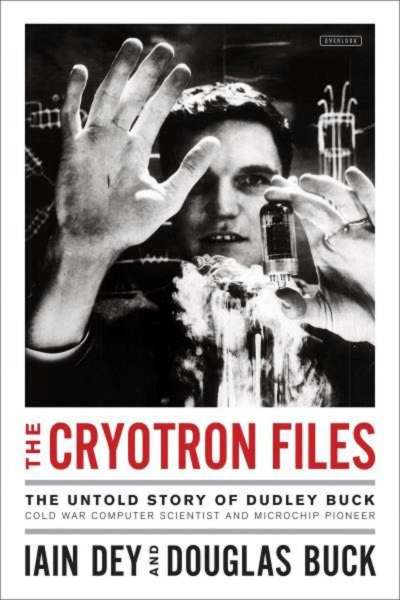
Iain Dey, business editor of the Sunday Times, and Douglas Buck, only a toddler when his father died, combined forces to produce the first biography of the obscure (and undeservedly so) computing pioneer. They use Dudley Buck’s lab books, diaries, correspondence, research papers, patent filings and other recently discovered papers collected by his son to build their account.
Buck seemed like an affable, work-driven researcher and professor willing to share his knowledge far and wide, but his students and assistants didn’t know he was a former code breaker for the navy, had been on covert missions in eastern Europe for the CIA and served as a consultant to the NSA on top secret projects such as spy satellites, missile defence systems and early space race projects.
Those academic and military lives started to collide with the invention of the cryotron. The aim of his research was to create an electronic switch that could flip between on and off very quickly, creating the ones and zeros that form the binary code, or core language of computers.
Other ideas were being pursued as well, including the semiconducting silicon chip that eventually won the race and that drives most computers today. But Buck was considered to have the edge at the time.
General Electric, IBM, RCA and the U.S. military all mounted major cryotron-research programs in the late 1950s and early 1960s before shifting focus to silicon microchips. Still, the cryotron is at the root of efforts at IBM and elsewhere to make superconducting quantum bits — qubits — in pursuit of quantum computing.
Buck had been on the radar of the Soviets for years as his work on the cryotron was well-known, even if it was not even near being used in a missile guidance system, as the Soviets feared.
Academic, government and private computer developers shared research in those times, and Buck was a frequent speaker at scientific conventions, so the aim of his work was clear to the Soviets as well.
About a month after a delegation of Soviet scientists visited the U.S., Buck received a shipment of chemicals he hoped would push his experiments forward.

Chuck Crawford, one of the students who ran Buck’s experiments, was with him as he opened the package and recounts: “He didn’t eat any of them, he might have stuck a finger in a bottle. We paid no attention whatsoever to the potential hazard of taking a bunch of organic chemicals that hadn’t really been studied that carefully and messing around with them. The thought hadn’t entered our heads.”
Buck died within a couple of days.
The book overreaches in its final chapter with its theory that Buck’s death was a KGB assassination by poison. Official records do offer conflicting accounts and mentions of his death in archives are heavily redacted, so there is enough to warrant newspaper headlines and internet theories. But no autopsy was ever performed, and the hypothesis by Dey and Douglas Buck is unprovable.
Their book, however, is a fascinating story of a bright young scientist in the pressure cooker world of Cold War research, a tale of how much he accomplished in a short life and an indication of how much more he undoubtedly would have done.
Chris Smith is a Winnipeg writer.