

‘The Happy Yemen’ offer diversion from strife
Soccer team from war-torn country competing for Asian Cup
Advertisement
Read this article for free:
or
Already have an account? Log in here »
To continue reading, please subscribe:

Digital Subscription
One year of digital access for only $205*
- Enjoy unlimited reading on winnipegfreepress.com
- Read the E-Edition, our digital replica newspaper
- Access News Break, our award-winning app
- Play interactive puzzles
*First annual payment billed as $205.00 + GST for one year. This annual subscription will automatically renew at $233.00 + GST every 52 weeks (10% off the regular annual price of $259.35). Offer available to new and qualified returning subscribers only. Cancel any time.
To continue reading, please subscribe:
Add Free Press access to your Brandon Sun subscription for only an additional
$1 for the first 4 weeks*
- Enjoy unlimited reading on winnipegfreepress.com
- Read the E-Edition, our digital replica newspaper
- Access News Break, our award-winning app
- Play interactive puzzles
*Your next Brandon Sun subscription payment will increase by $1.00 and you will be charged $17.95 plus GST for four weeks. After four weeks, your payment will increase to $24.95 plus GST every four weeks.
Read unlimited articles for free today:
or
Already have an account? Log in here »
Hey there, time traveller!
This article was published 04/01/2019 (2819 days ago), so information in it may no longer be current.
To look upon Taiz’s Abu Walad Stadium, even in a set of photographs, is to survey the destruction and desolation of Yemen’s ongoing civil war. There is a shell hole, several feet in diameter, blown through one of the gates; twisted steel from a destroyed section of the stands looms over artificial turf pockmarked by craters, one of which has sprouted foliage defiantly growing over the debris of a recent airstrike.
This is where Al Saqr, the Falcons, used to play their home matches, the most recent of which, back in 2014, saw them celebrate a third title. They lost just one game that season, after which the country’s top league was suspended and many of the players, already displaced by war, forced to latch onto clubs in Qatar, find menial employment or simply flee the violence.
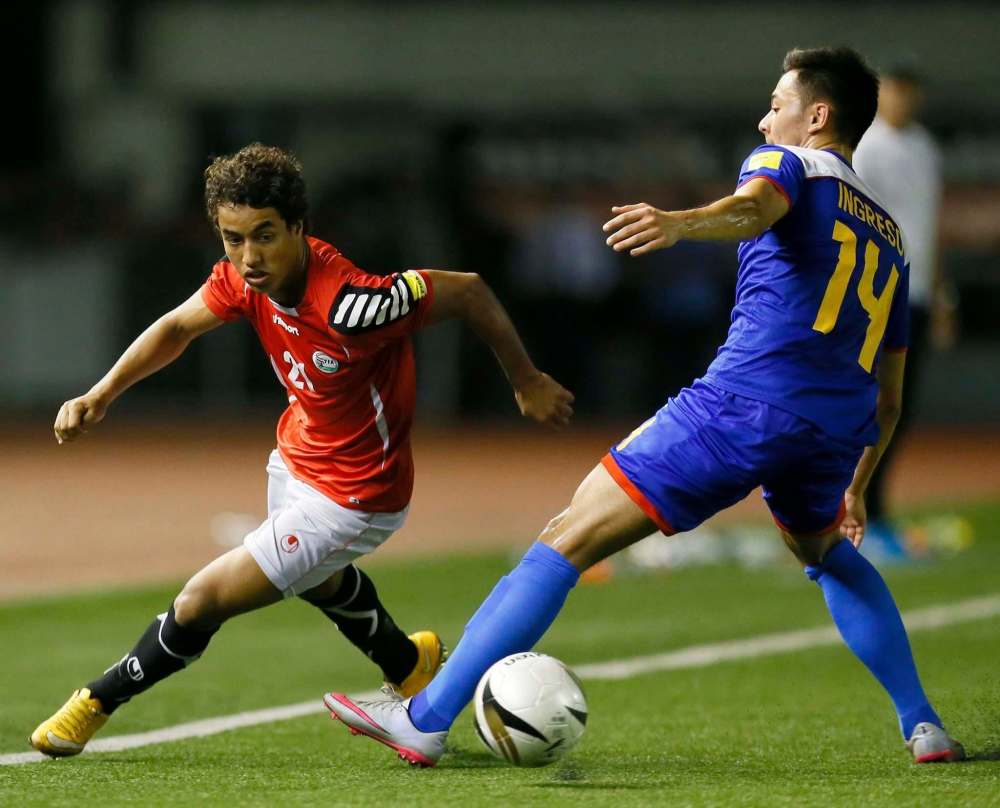
However, guided by a football association that somehow remained apolitical as tensions between a Saudi Arabia-backed government coalition and Houthi separatists heightened and then exploded into a full-blown war and humanitarian emergency, Yemen’s national soccer team managed to not only continue existing, but also make history.
In March, thanks to a 2-1 victory over Nepal in their adoptive city of Doha, Yemen qualified for a first Asian Cup. On Tuesday, the poignantly nicknamed Al Yaman A’Sa’eed, the Happy Yemen, will kick off their campaign in the United Arab Emirates with a Group D match against Iran. No one, not even the players, expect much from FIFA’s 135th-ranked country on the pitch. No, their triumph is simply being present.
“Realistically, all three teams in our group (which also includes Iraq and Vietnam) are better than us,” Yemen captain Ala Al Sasi said in an interview with the Asian Football Confederation’s official website. “Iran have just played in the FIFA World Cup a few months ago… but football is a game of surprises, so we hope that we will be on our day when we meet them and can get a result.”
Al Sasi, who plays his club soccer with Doha’s Al Sailiya, scored the winning goal in his side’s crucial 2-1 triumph over Tajikistan in early 2017. A midfielder who will look to support striker Ayman Al Hagri in attack, the 31-year-old will also be counted on to provide leadership in a setup that, however inspirational, has been cobbled together from throughout the Arabian peninsula and as far away as Brazil.
Abdulwasea Al Matari, who played for Sanaa’s Al Yarmuk Al Rawda until the Houthis occupied the ancient city in 2014, is another player who could make an impact at the Asian Cup. The 24-year-old winger, now with Dibba Al Hisn in the U.A.E.’s northeast, scored against the Maldives in the playoff stage of qualifying, and also found the back of the net in an important 2-2 draw in the Philippines. Additionally, it was his brace on the final match-day that provided victory over Nepal and entry into the Asian tournament proper.
Goalkeeper Mohammad Ayash — a government employee — will no doubt be a key figure for Yemen over the next few weeks as well, but as Slovak manager Jan Kocian told U.A.E. newspaper the National this week, it will require a collective effort for Yemen to even be competitive in its bracket.
“Yemen can dream of big victories against Iran and Iraq. It’s normal,” he said. “It may not be real, but we will try.”
Of course, even Kocian knows that success for Yemen at the Asian Cup will not be determined by trophies, but rather by the moment when they first take the field at Mohammed bin Zayed Stadium.
“We hope the team will honour Yemen and give Yemenis some relief,” said Ahmed Sabahi, an Aden-based fan, when interviewed by the National back in April. “In the shadow of war,” added Ahmed Hussein Husseini, who works with a sports organization in Aden, “we are trying, as much as possible, to bring back the spirit and adapt our lives.”
Not that participation in the Asian Cup, or even an unlikely championship, will be much of a lift to the nearly 10 million Yemenis at risk of conflict-caused starvation or the more than 20 million people requiring humanitarian assistance, never mind the 10,000 killed since the war’s outbreak. For the most part, sports stories such as this (think Iraq’s incredible capture of the 2007 Asian Cup) hearten the players, supporters who don’t have to worry about the basic necessities of life and those watching from the outside.

What Yemen’s soccer team will do, however, is bring the reality of what Amnesty International has called “the forgotten war” into another realm of mainstream discourse. And there is hope in that, however faint.
“Qualification has brought Yemenis together. They’re doing us proud,” said Sabahi, the fan in Aden. “All Yemenis are behind their team.”
At the very least, that team, The Happy Yemen, will perhaps show the hope and beauty that is possible in a place that right now seems to offer neither.
It can be the foliage, the hint of defiant life, growing out of a crater and overtop the rubble of the stadium in Taiz — the stadium everywhere.
jerradpeters@gmail.comTwitter: @JerradPeters
Our newsroom depends on a growing audience of readers to power our journalism. If you are not a paid reader, please consider becoming a subscriber.
Our newsroom depends on its audience of readers to power our journalism. Thank you for your support.
Our newsroom depends on a growing audience of readers to power our journalism. If you are not a paid reader, please consider becoming a subscriber.
Our newsroom depends on its audience of readers to power our journalism. Thank you for your support.
Related Articles
Thailand fires coach Rajevac after Asian Cup loss to India





Advertisement Advertise With Us
Advertisement Advertise With Us