

Dumpster divers seek food justice
Advertisement
Read this article for free:
or
Already have an account? Log in here »
To continue reading, please subscribe:
Monthly Digital Subscription
$1 per week for 24 weeks*
- Enjoy unlimited reading on winnipegfreepress.com
- Read the E-Edition, our digital replica newspaper
- Access News Break, our award-winning app
- Play interactive puzzles
*Billed as $4.00 plus GST every four weeks. After 24 weeks, price increases to the regular rate of $19.95 plus GST every four weeks. Offer available to new and qualified returning subscribers only. Cancel any time.
Monthly Digital Subscription
$4.99/week*
- Enjoy unlimited reading on winnipegfreepress.com
- Read the E-Edition, our digital replica newspaper
- Access News Break, our award-winning app
- Play interactive puzzles
*Billed as $19.95 plus GST every four weeks. Cancel any time.
To continue reading, please subscribe:
Add Free Press access to your Brandon Sun subscription for only an additional
$1 for the first 4 weeks*
*Your next subscription payment will increase by $1.00 and you will be charged $16.99 plus GST for four weeks. After four weeks, your payment will increase to $23.99 plus GST every four weeks.
Read unlimited articles for free today:
or
Already have an account? Log in here »
Hey there, time traveller!
This article was published 25/01/2019 (2642 days ago), so information in it may no longer be current.
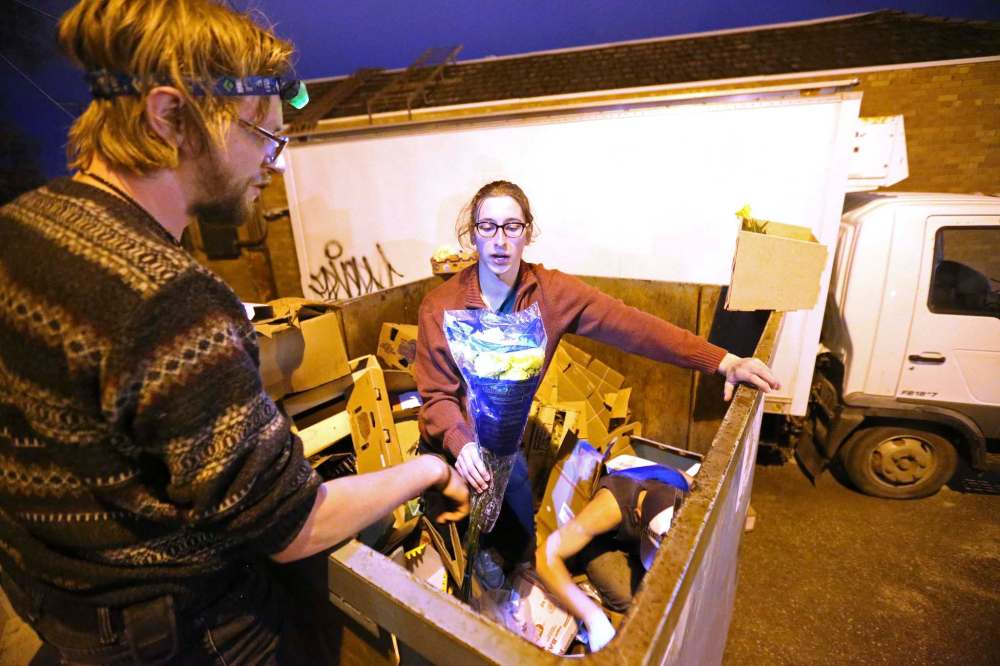
Before entering a Dumpster to retrieve food behind a grocery store or restaurant, don’t forget to tap the metal side with your flashlight and listen for the scurrying of rodents, such as squirrels, that could be trapped inside. It’s dangerous to get into a Dumpster with an animal that feels threatened.
But your taps on the Dumpster shouldn’t be so loud that they attract the attention of other people because, well, Dumpster diving is illegal in Winnipeg and someone might call the cops.
That advice was offered by experienced Dumpster divers with whom I had several conversations. I thought of these food foragers recently with the release of a survey that concludes much more food is wasted in Canada than previously thought.
Lamentably, 58 per cent of all food in Canada is not eaten. About 86 per cent of the wasted food comes directly from the food industry, not private households, according to the survey by Value Chain Management International, which was released Jan. 17.
The disheartening results of the survey helped me realize the Dumpster-divers of my acquaintance were right all along: garbage bins behind Winnipeg grocery stores and restaurants are laden with shamefully large amounts of food that is nutritious, delicious and safe to eat.
I met these garbage-pickers as a sessional journalism instructor at Canadian Mennonite University. Every semester’s class seemed to include several students who identified themselves with terms such as “waste reclaimer.”
I invited conversations about their nocturnal forays because, frankly, they didn’t seem like the type of people who would pick through garbage. They didn’t seem hungry, and most had family and community support to provide food if needed. They also seemed to have high ethical standards, not like thieves who would choose to break trespassing laws and flout Winnipeg Bylaw 110/2012; Sec. 5(3), which says no person other than the owner, unless lawfully authorized to do so, shall pick over or remove solid wastes placed for collection.
Why break the law and endure the slime, bugs and stench of garbage bins? They see themselves as counter-cultural advocates of food justice, outlaws for a commendable cause. They’re outraged about a food distribution system in which Canadians waste more than half of their food while so many people are malnourished.
“How can we fight against a system that is so broken?” Rebecca Klassen Wiebe asked in the newsletter of her church, Charleswood Mennonite. “What can we do as the distance between land and plate keeps getting increasingly larger? I believe that, in many ways, my faith and my community have actually encouraged me to Dumpster dive.”
Nathaniel De Avila describes how his team of Dumpster divers began operating a donation-based community food share in the basement of Sargent Avenue Mennonite Church. They have moved tonnes of food.
“This food is what is left after we give our friends as much as they can reasonably store. Our fridges are packed and our freezers often don’t close properly. Why is there a single hungry person on the planet when we waste this much food?”
It’s important to note not all Winnipeggers who enter Dumpsters are motivated by social conscience. Some are hungry and don’t have enough money to buy food for themselves and their children.
The Winnipeg Dumpster Diving Society, which claims 900 members, has a Facebook page on which divers are encouraged to share locations that are particularly bountiful, stores that have ruined it all by using garbage compactors and advice for fellow divers. (“Always go out at least an hour after closing so managers/employees aren’t around.”)
The social obscenity of good food going to waste while many people starve has prompted places around the world to attempt positive solutions.
Food rescue programs have sprung up to repurpose unwanted food from supermarkets, restaurants and manufacturers. In New York City, for example, City Harvest rescues nearly 23 million kilograms of food a year and delivers it free to soup kitchens and shelters.

Several businesses in the U.S. sell at a great discount cosmetically challenged fruit and vegetables that are discarded as ugly.
In 2016, France made it illegal for supermarkets to throw away food that is still edible. The stores must give unwanted items to charity or to farms for animal feed.
By contrast, it remains illegal in Winnipeg for food-justice crusaders to explore the Dumpsters of supermarkets and restaurants. Winnipeg should change Winnipeg Bylaw 110/2012. People who rescue good food should be praised, not prosecuted.
carl.degurse@freepress.mb.ca
Carl DeGurse is a member of the Free Press editorial board.