

Building a foundation of reconciliation
Winnipeg group contributes $1.3 million for initiatives to create community harmony

Advertisement
Read this article for free:
or
Already have an account? Log in here »
To continue reading, please subscribe:

Digital Subscription
One year of digital access for only $205*
- Enjoy unlimited reading on winnipegfreepress.com
- Read the E-Edition, our digital replica newspaper
- Access News Break, our award-winning app
- Play interactive puzzles
*First annual payment billed as $205.00 + GST for one year. This annual subscription will automatically renew at $233.00 + GST every 52 weeks (10% off the regular annual price of $259.35). Offer available to new and qualified returning subscribers only. Cancel any time.
To continue reading, please subscribe:
Add Free Press access to your Brandon Sun subscription for only an additional
$1 for the first 4 weeks*
- Enjoy unlimited reading on winnipegfreepress.com
- Read the E-Edition, our digital replica newspaper
- Access News Break, our award-winning app
- Play interactive puzzles
*Your next Brandon Sun subscription payment will increase by $1.00 and you will be charged $17.95 plus GST for four weeks. After four weeks, your payment will increase to $24.95 plus GST every four weeks.
Read unlimited articles for free today:
or
Already have an account? Log in here »
Hey there, time traveller!
This article was published 26/01/2019 (2812 days ago), so information in it may no longer be current.
For decades, Indigenous children were physically and sexually abused after being forced from their home communities to attend residential schools across the country.
The Truth and Reconciliation Commission of Canada, whose chairman, Murray Sinclair, is now a senator, heard from witnesses and received reports as it travelled across the country to examine the damage caused by the residential school system.
After the truth became known, the commission wanted the country to work towards reconciliation. It issued 94 calls to action to the federal, provincial, territorial and Indigenous governments, hoping to spark the creation of programs and implement policies.
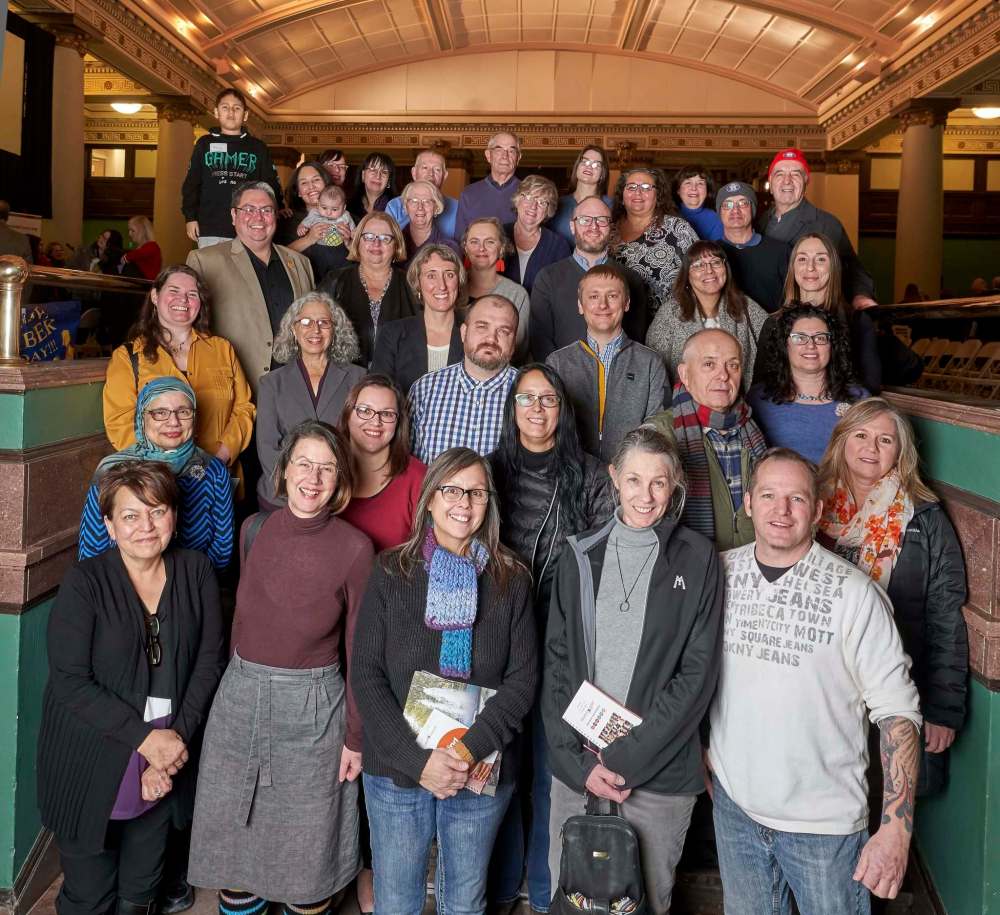
The Winnipeg Foundation, the country’s oldest community foundation, accepted the call. Earlier this month, it issued $1.3 million in grants to 20 local organizations. To get the grants, each of the organizations had to propose projects that work towards reconciliation.
Some of those programs will wrap up this year, others will continue over the next three years.
Mentoring Artists for Women’s Art is an organization that provides numerous programs for female artists, including visual arts education.
Shawna Dempsey, the group’s co-executive director, said the foundation gave it $79,600 for two projects.
In the first, 500 packages of artworks, each on 22-by-28-centimetre cardstock, will be created by 50 Canadian Indigenous female artists. They were part of this past year’s Resilience exhibition, which was featured on billboards across the country. The packages will be distributed to every public school Winnipeg.
“Right now in schools, when children learn about art, they learn about the Italian Renaissance and (American pop artist) Andy Warhol, but we have such a wealth of artists in Canada, particularly Indigenous women artists,” Dempsey said.
“We want to create educational tools to get them into schools, so teachers can use them to learn about the artists and learn about the meaning of the artwork in the artists’ own words.”
For the second project, Resilience curator Lee-Ann Martin has been commissioned to put together a textbook about the history of Indigenous women, which will be told through contemporary artwork. The books, with around 100 full-colour illustrations, would be geared towards high school and post-secondary students.
Local artists involved in the project include Jaime Black, Lita Fontaine and KC Adams. Others whose work will be featured include Daphne Odjig, Annie Pootoogook, Christi Belcourt and Skawennati.
Another grant recipient, the Immigrant and Refugee Committee Organization of Manitoba (IRCOM), received almost $100,000 to create a community-engagement project between new Canadians and Indigenous people.
Dorota Blumczynska, executive director of IRCOM, said many refugees are surprised when they get to Canada to learn about the country’s treatment of its Indigenous people.
“Newcomers are often deeply saddened, and they feel misled by Canada’s grandiose stories of being a land of freedom and great opportunity and human rights, but then they learn about this dark reality,” Blumczynska said.
“We have an opportunity to change the narrative that is known even beyond our borders about Canada and Indigenous people.”
IRCOM plans to take several steps, including engaging a cultural adviser to help deliver workshops, sharing circles and cultural sharing — creating opportunities for cultural exchange between newcomers and Indigenous community members and forming a community advisory committee made up, in part, with Indigenous community members.
Winnipeg Foundation chief executive officer Rick Frost said the grants range from $800 — so Westworth United Church can hold Interfaith workshops on the Truth and Reconciliation Commission’s calls to action — to a few that are worth $100,000. The average grant is $60,000.
Frost said 82 organizations made $6 million in requests, but the amount available for grants was $1.3 million.
“We, obviously, are interested in reconciliation, and this is a way we are reacting to it,” he said. “Reconciliation is on our mind.”
Megan Tate, the foundation’s director of community grants, said “reconciliation isn’t just an issue for the one community, it is an issue for all Winnipeggers. They all have a role in reconciliation.”
Other projects funded by the foundation include the Manitoba Craft Council’s art exhibition, which focuses on contemporary Indigenous beading practices; the Rainbow Resource Centre’s culturally relevant programming for Indigenous LGBTTQ* people; and the Sandy-Saulteaux Spiritual Centre’s culturally oriented retreats for Indigenous parents who are working to reunite with their children.
Patricia Mainville, who was chairwoman of the reconciliation grants advisory committee, admits it was tough to turn down so many organizations.
“There were a lot of great projects,” Mainville said. “There would have been more grants we would have loved to support.”
Dempsey thanked the foundation, not only for her organization’s grant, but for the grant program itself.

“Across the board, the Winnipeg Foundation makes Winnipeg a better place. So much happens because of their funding,” Dempsey said.
“I think the reconciliation grants are phenomenal… change is essential.”
Frost said the foundation won’t know until after the projects are evaluated if there will be more reconciliation grants.
“Reconciliation can’t be led or accomplished by one organization,” he said. “There has to be leadership in a lot of places, but hopefully this helps.”
kevin.rollason@freepress.mb.ca
Kevin Rollason
Reporter
Kevin Rollason was a general assignment reporter at the Free Press.
Our newsroom depends on a growing audience of readers to power our journalism. If you are not a paid reader, please consider becoming a subscriber.
Our newsroom depends on its audience of readers to power our journalism. Thank you for your support.
Funding recipients
Camerata Nova
Dakota Ojibway Child and Family Services
Immigrant and Refugee Community Organization of Manitoba
Islamic Social Services Association
Ka Ni Kanichihk
Lake Winnipeg Foundation
Ma Maw-Wi-Chi-Itata Centre
Manitoba Craft Council
Mentoring Artists for Women’s Art
Rainbow Resource Centre
Red Road Lodge
Sandy-Saulteaux Spiritual Centre
Sarasvati Dramatic Theatre Productions
Seven Oaks School Division
Social Planning Council of Winnipeg
Centre for Indigenous Environmental Resources
Diocese of Rupert’s Land
Urban Circle Training Centre
Urban Shaman
Westworth United Church
Coming events
Flea market helps children with disabilities
Manitoba Riding for the Disabled Association’s 20th annual flea market, with 80 vendor booths, is being held at Assiniboia Downs on Feb. 2, from 9 a.m. to 4 p.m., and Feb. 3 from 10 a.m. to 3 p.m. The event helps children living with disabilities receive horseback riding therapy. Admission is $5, and there is free parking. For more information, contact MRDA at 204-925-5905.
Learn about celiac disease
The Manitoba chapter of the Canadian Celiac Association is holding its annual pancake brunch and celiac disease information session Feb. 2. The event, at the Maranatha Church, 910 Sturgeon Rd., from 11 a.m. to 1 p.m., features gluten-free pancakes and sausages for $5, while children under 12 eat free. There will be a gluten-free 101 session for people newly diagnosed with celiac disease from 9:15 a.m. to 10:30 a.m. For more information, go here.
Date with a Star
The 18th annual Date with a Star is Jan. 30. It’s the annual chance to help the Learning Disabilities Association of Manitoba, meet a local celebrity, and eat at a top Winnipeg restaurant — but you won’t know who or where until you get to the event. Tickets are available for $140 by contacting ldamanitoba7@mymts.net, and can be purchased either individually or for tables of up to 10.
Children’s Wish fundraising gala
The Children’s Wish is holding its Night of Wonders fundraiser Feb. 22, to help children facing life-threatening illnesses get their wishes. The event, being held in the RBC Convention Centre, costs $250, and tickets can be purchased here.
Coming sign of spring
Oak Hammock Marsh kicks off its “first goose of the year” contest at an event Sunday. If you guess the time and date the first Canada goose arrives at the marsh, you could win an annual membership to the facility. The day also includes crafts, a migration presentation, goose scavenger hunt, and face painting. Geese usually arrive sometime between the end of February and the end of March. For more information go here.
Main Street Project fundraiser
The coldest night of the year isn’t just an evening in Winnipeg, but a new event. The Main Street Project is holding its Coldest Night of the Year fundraiser Feb. 23 to help raise funds to create new shelter space. The event begins with registration online to walk either a two-, five- or 10-km route. Registration is $25 up until Feb. 18, and then rises to $40 — but registration is free if adults raise $150 in donations and youth aged 11 to 17 raise $75. For more information, go here.
Brain injury fundraising event
A “bud, spud and chicken” fundraiser is being held by the Manitoba Brain Injury Association. The event, being held at the Canad Inns TYC Event Centre Polo Park, costs $20. To buy tickets, call 204-975-3280 or email info@mbia.ca
Jeanne Beker keynote speaker
Advance tickets are now on sale for the annual Jewish Foundation of Manitoba Luncheon in support of the Women’s Endowment Fund. This year’s keynote speaker is Canadian television personality, fashion editor and author Jeanne Beker, best known for hosting FashionTelevision from 1985 to 2012. The luncheon is May 10 at the RBC Convention Centre Winnipeg. Admission $200, with a charitable tax receipt of $150 issued. Tickets can be purchased by calling 204-477-7520, 1-855-284-1918, or go here.
Save the date for Negev Gala
The Jewish National Fund (JNF) of Canada’s Manitoba/Saskatchewan regional branch is asking people to save the date of May 27 for its annual Negev Gala. The JNF recently announced it will be honouring Steven Schipper, longtime artistic director of the Royal Manitoba Theatre Centre, at the gala. Schipper has already chosen to support Beit Halochem, an organization which helps rehabilitate and reintegrate Israel’s wounded veterans and terror victims back into society. The gala is being held at the Centennial Concert Hall, starting at 7 p.m.
Kevin Rollason
Reporter
Kevin Rollason was a general assignment reporter at the Free Press.
Our newsroom depends on a growing audience of readers to power our journalism. If you are not a paid reader, please consider becoming a subscriber.
Our newsroom depends on its audience of readers to power our journalism. Thank you for your support.
Advertisement Advertise With Us
Advertisement Advertise With Us
History
Updated on Saturday, January 26, 2019 9:09 AM CST: Minor typography changes.