

A more budget-friendly eye in the sky?
Advertisement
Read this article for free:
or
Already have an account? Log in here »
To continue reading, please subscribe:
Monthly Digital Subscription
$1 per week for 24 weeks*
- Enjoy unlimited reading on winnipegfreepress.com
- Read the E-Edition, our digital replica newspaper
- Access News Break, our award-winning app
- Play interactive puzzles
*Billed as $4.00 plus GST every four weeks. After 24 weeks, price increases to the regular rate of $19.95 plus GST every four weeks. Offer available to new and qualified returning subscribers only. Cancel any time.
Monthly Digital Subscription
$4.99/week*
- Enjoy unlimited reading on winnipegfreepress.com
- Read the E-Edition, our digital replica newspaper
- Access News Break, our award-winning app
- Play interactive puzzles
*Billed as $19.95 plus GST every four weeks. Cancel any time.
To continue reading, please subscribe:
Add Free Press access to your Brandon Sun subscription for only an additional
$1 for the first 4 weeks*
*Your next subscription payment will increase by $1.00 and you will be charged $16.99 plus GST for four weeks. After four weeks, your payment will increase to $23.99 plus GST every four weeks.
Read unlimited articles for free today:
or
Already have an account? Log in here »
Hey there, time traveller!
This article was published 09/02/2019 (2632 days ago), so information in it may no longer be current.
The sound and sight of a police helicopter hovering overhead has become common since Air-1 first lifted off in 2010. But Winnipeg may soon decide it can’t afford the helicopter program.
An independent consultancy firm, MNP, was hired to review whether Air-1 is worth the money, and is expected to report by spring.
It’s possible the report will prompt a decision that the cost of the copter — $2,600 for every hour it operated in 2016 — is not worth the value to taxpayers.
The cost has become a big concern because funding to the Winnipeg Police Service changed in 2017 and Air-1’s expenses can no longer be billed separately to the province.
It’s now up to the police service, possibly in consultation with the police board, to decide whether Air-1 is worth the expense.
If they decide the police budget doesn’t have room for Air-1, there is an option that hasn’t yet been openly discussed.
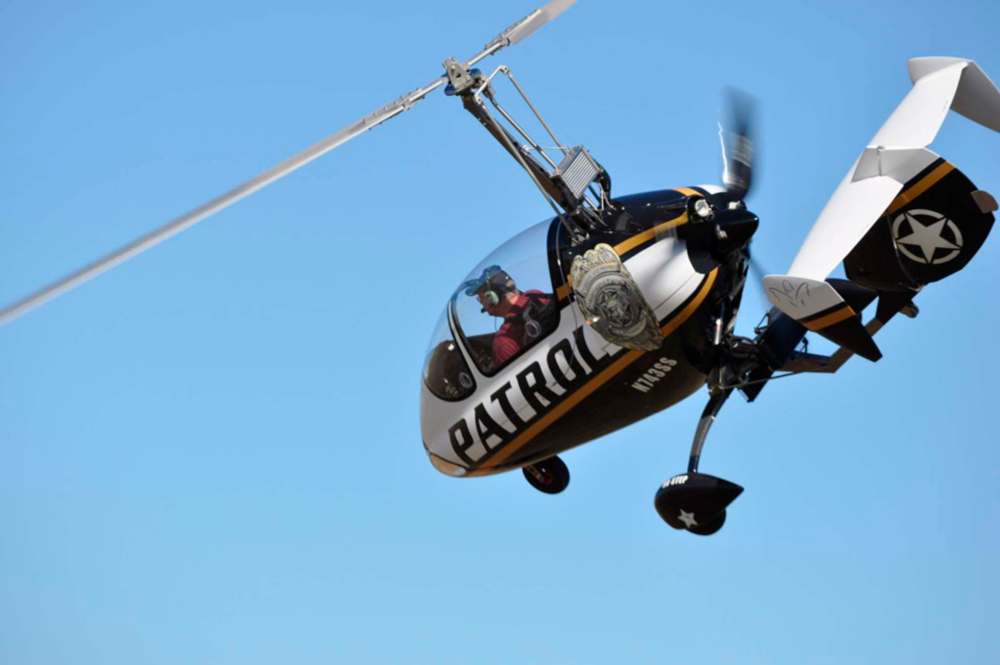
Gyrocopters have improved greatly in recent years. They can perform most functions of a police helicopter, although not always as well. And they do it at a fraction of the cost.
The compact fliers have been around since the 1920s, usually built by hobbyists and sport flyers. Serious aviators smiled tolerantly at the quirky crafts with their open cockpits, sometimes called “motorbikes of the sky.”
Of course, any aircraft with an open cockpit couldn’t be considered for year-round police use in Winnipeg. But since 2010, gyrocopter manufacturers have introduced higher-end models that are fully enclosed and outfitted with such amenities as heaters, radios, computer instrumentation and video cameras.
A typical single-seat gyrocopter is about five metres long, and weighs about 225 kilograms.
It can run on regular unleaded gasoline. Top models cruise at 90 km/h and can hit 120 km/h.
Unlike a helicopter, a gyrocopter must use an open stretch as a runway. It requires a takeoff distance of 10 to 100 metres and a landing distance of up to 50 metres.
Of particular interest to the people who pay the bills at the police service, maintenance on gyrocopters is much easier and less expensive than maintenance on helicopters. Air-1 is known for spending lots of time in the shop. In 2016, it flew 733 hours, a drop of 27 per cent from 2015. In 2017, 30 days of scheduled maintenance were accompanied by another 48 days of unscheduled maintenance.
Unfortunately, Air-1’s costs are soaring even when the copter can’t. Since it was bought for $3.5 million in 2010, Air-1’s annual costs have risen steadily to $1.8 million in 2017 from $1.2 million in 2011
How does this cost compare to gyrocopters? Aviation journalist Marc C. Lee, who is also a California flight instructor and aviation professor, wrote in an article updated in 2018 on the website of Plane & Pilot magazine, “Gyroplanes (another name for gyrocopters) can be purchased and operated for about 10 per cent of the acquisition cost of a helicopter. Helicopters are famous for their vast mechanical complexity with their host of moving parts that rely on each other to operate properly. A gyroplane, however, will provide 90 per cent of the capability of the helicopter for one-tenth the price. The gyroplane’s simplicity makes it as easy to maintain as a motorcycle.”
Winnipeg police have praised the effectiveness of Air-1 as a crime-fighting tool. Annual reports show it’s used most often to provide overhead help in responding to crimes such as break-ins and assaults, to chase suspicious vehicles during police pursuits, to search for missing people and to illuminate and photograph crime and collision scenes. Most of these functions can be done to some degree by gyrocopters, which are being used by law enforcement and rescue service operations in European countries and at least three U.S. states.
It needs to be noted that helicopters have several advantages over gyrocopters for police work. While gyrocopters can fly at very low speeds without stalling, they can’t hover over one spot like helicopters, a big disadvantage when trying to monitor a crime in progress.
Gyrocopters need a small distance for forward momentum when they take off, which means they can’t use helicopter pads atop buildings.
Helicopters can fly faster and transport more people and cargo, including rushing the K-9 squad to remote locations in emergencies.
There’s also the question of Winnipeg’s notoriously extreme weather. Before purchasing, it would be necessary to study how gyrocopters function in winter climates such as Yukon, where they are currently in use.

Helicopters are superior to gyrocopters in many ways, and are the clear choice if cost isn’t a factor. But if the upcoming discussion determines Air-1 is too expensive, it would be a shame if Winnipeg police didn’t have some form of eye in the sky.
Gyrocopters are not as good as helicopters, but they’re better than nothing.
carl.degurse@freepress.mb.ca
Carl DeGurse is a member of the Free Press editorial board.