WEATHER ALERT

How ‘completely avoidable’ measles cases continue to climb

Advertisement

Advertise with us

WASHINGTON - The U.S. has counted more measles cases in the first two months of this year than in all of 2017 — and part of the rising threat is misinformation that makes some parents balk at a crucial vaccine, federal health officials told Congress Wednesday.

Read this article for free:

or

Already have an account? Log in here »

To continue reading, please subscribe:

Subscribe and receive a limited-edition Free Press branded hat or tote.

Digital Subscription

One year of digital access for only $205*

  • Enjoy unlimited reading on winnipegfreepress.com
  • Read the E-Edition, our digital replica newspaper
  • Access News Break, our award-winning app
  • Play interactive puzzles

*First annual payment billed as $205.00 + GST for one year. This annual subscription will automatically renew at $233.00 + GST every 52 weeks (10% off the regular annual price of $259.35). Offer available to new and qualified returning subscribers only. Cancel any time.

To continue reading, please subscribe:

Add Free Press access to your Brandon Sun subscription for only an additional

$1 for the first 4 weeks*

  • Enjoy unlimited reading on winnipegfreepress.com
  • Read the E-Edition, our digital replica newspaper
  • Access News Break, our award-winning app
  • Play interactive puzzles
Start now

*Your next Brandon Sun subscription payment will increase by $1.00 and you will be charged $17.95 plus GST for four weeks. After four weeks, your payment will increase to $24.95 plus GST every four weeks.

Hey there, time traveller!
This article was published 27/02/2019 (2707 days ago), so information in it may no longer be current.

WASHINGTON – The U.S. has counted more measles cases in the first two months of this year than in all of 2017 — and part of the rising threat is misinformation that makes some parents balk at a crucial vaccine, federal health officials told Congress Wednesday.

Yet the vaccine is hugely effective and very safe — so the rise of measles cases “is really unacceptable,” said Dr. Anthony Fauci, infectious disease chief at the National Institutes of Health.

The disease was declared eliminated in the U.S. in 2000, which means it was not being spread domestically. But cases have been rising in recent years, and 2019 is shaping up to be a bad one.
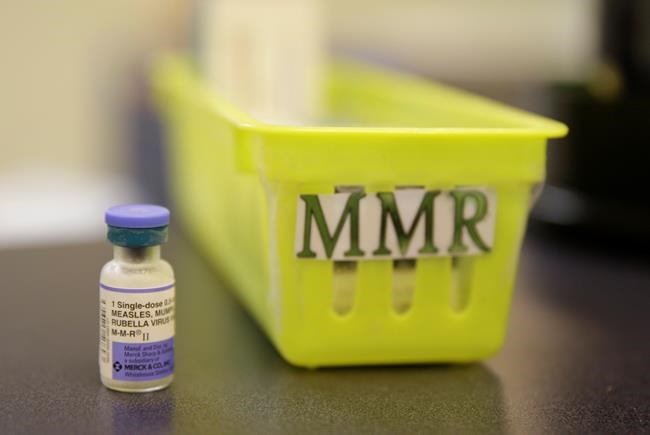
FILE - This Feb. 6, 2015, file photo shows a measles, mumps and rubella vaccine on a countertop at a pediatrics clinic in Greenbrae, Calif. The U.S. has counted more measles cases in the first two months of this year than in all of 2017 _ and part of the rising threat is misinformation that makes some parents balk at a crucial vaccine, federal health officials told Congress Wednesday, Feb. 27, 2019 .(AP Photo/Eric Risberg, File)

Republican and Democratic lawmakers at the House Energy and Commerce subcommittee hearing bemoaned what’s called “vaccine hesitancy,” meaning when people refuse or delay vaccinations.

“These outbreaks are tragic since they’re completely avoidable,” said Rep. Brett Guthrie, R-Ky.

“This is a public health problem for which science has already provided a solution,” agreed Rep. Frank Pallone, D-N.J.

Here are some questions and answers about measles:

Q: How dangerous is measles?

A: Measles typically begins with a high fever, and several days later a characteristic rash appears on the face and then spreads over the body. Among serious complications, 1 in 20 patients get pneumonia, and 1 in 1,000 get brain swelling that can lead to seizures, deafness or intellectual disability.

While it’s rare in the U.S., 1 or 2 of every 1,000 children who get measles dies, according to the Centers for Disease Control and Prevention.

Q: How does it spread?

A: By coughing or sneezing, and someone can spread the virus for four days before the telltale rash appears, Fauci warned.

The virus can live for up to two hours in the air or on nearby surfaces. Nine of 10 unvaccinated people who come into contact with someone with measles will catch it. Fauci called it “one of the most contagious viruses known to man.”

Q: How widespread is measles?

A: In the U.S., the CDC has confirmed 159 cases so far this year in 10 states: California, Colorado, Connecticut, Georgia, Illinois, Kentucky, New York, Oregon, Texas, and Washington. That compares to 372 cases last year, and 120 in 2017.

But measles is far more common around the world — the World Health Organization said it claimed 110,000 lives in 2017. The WHO says there’s been a 30 per cent increase in measles cases in recent years. Unvaccinated Americans travelling abroad, or foreign visitors here, can easily bring in the virus.

For example, a huge outbreak in Madagascar has caused more than 68,000 illnesses and 900 deaths since September. But you don’t need to go as far as Madagascar — common tourist destinations like England, France, Italy and Greece had measles outbreaks last year, noted CDC’s Dr. Nancy Messonnier. Nearly 83,000 people contracted measles in Europe in 2018, the highest number in a decade.

Q: How many U.S. children are vulnerable?

A: Overall about 92 per cent of U.S. children have gotten the combination vaccine that protects against measles, mumps and rubella, known as the MMR vaccine. Two shots are required, one around the first birthday and a second between age 4 and 6. Full vaccination is 97 per cent effective at preventing measles.

But the CDC says 1 in 12 children doesn’t receive the first dose on time, and in some places vaccination rates are far lower than the national average. For example, an outbreak in Washington state is linked to a community where only about 80 per cent of children were properly vaccinated.

Q: Is the vaccine safe?

A: Yes, said Fauci and Messonnier, who point to decades of use by millions of children each year — and who made sure their own children were vaccinated.

In the late 1990s, one study linked MMR vaccine to autism but that study was found to be a fraud, and Fauci said later research found no risk of autism from the vaccine.

Still, misinformation about MMR safety is widespread. Fauci said the solution isn’t to criticize people who have no way to know what’s false. Instead, “we need to education them to show them what the evidence is.”

Q: Why isn’t everyone vaccinated?

A: Some people can’t be immunized for medical reasons — including infants and people with weak immune systems — and most states allow religious exemptions. But while vaccination against a list of contagious diseases is required to attend school, 17 states allow some type of non-medical exemption for “personal, moral or other beliefs,” according to the National Conference of State Legislatures.

In Washington state, lawmakers are debating ending that personal or philosophical exemption, as are several other states. California ended a similar exemption in 2015 after a measles outbreak at Disneyland sickened 147 people and spread across the U.S. and into Canada.

___

The Associated Press Health & Science Department receives support from the Howard Hughes Medical Institute’s Department of Science Education. The AP is solely responsible for all content.
Report Error Submit a Tip

More Stories

Exclusive: In a Ukrainian bomb shelter, Laura Loomer explains shift on Russia’s war

Illia Novikov, Volodymr Yurchuk And Jill Colvin, The Associated Press 6 minute read Preview

Exclusive: In a Ukrainian bomb shelter, Laura Loomer explains shift on Russia’s war

Illia Novikov, Volodymr Yurchuk And Jill Colvin, The Associated Press 6 minute read Updated: Yesterday at 5:36 PM CDT

KYIV, Ukraine (AP) — Laura Loomer became infamous for spreading conspiracy theories online. Now, as she travels across Ukraine to see the damage inflicted by Russia in its yearslong war, she wants to admit that she fell for some falsehoods of her own.

A close ally of President Donald Trump, Loomer has completely reversed her longtime criticism of Ukraine and is urging fellow conservatives to be wary of Moscow's propaganda, which she blames for duping large swaths of the American right.

“You don’t need to listen to a podcaster and let them influence your opinion about a country. You can look at those facts yourself,” she told The Associated Press in Kyiv shortly after returning from a trip close to the front line in Ukraine's east. The interview was supposed to take place in Loomer's hotel, but it had to be moved to the building's underground bomb shelter as the city faced another ballistic missile attack.

Loomer has remained influential with Trump despite not having an official role, and she said they spoke over the phone after she sat down with Ukrainian President Volodymyr Zelenskyy. She also said that she expects to meet with Trump after returning from her trip.

Read
Updated: Yesterday at 5:36 PM CDT

Automation reaches new heights on farm

Laura Rance-Unger 4 minute read Preview

Automation reaches new heights on farm

Laura Rance-Unger 4 minute read Saturday, Jul. 25, 2026

LANGHAM, Sask. — The thousands of farmers from across the Prairies who flock to the annual Ag in Motion show every July seem oblivious to the possibility the technology on display could one day replace many of them.

Families with children in tow, Hutterite colony workers, grandparents and young couples just starting out roamed through the 600 or more exhibitor displays, amazed at how everything about farming just keeps getting bigger, more efficient and increasingly more automated.

It’s now possible to seed using a 100-foot-wide drill — a 12-foot jump over the widest available a few years ago — provided the farmer can afford a tractor with enough horsepower to pull it. Those sell for around $850,000 and up.

Granted, the number of farms with enough acres to justify that kind of width and drawing power is still relatively small, but farms continue to grow. And it’s no secret the number of people who have the interest, skills and financial wherewithal to run them continues to shrink.

Read
Saturday, Jul. 25, 2026

Puzzles Palace

1 minute read Monday, Jul. 13, 2026

To solve our puzzles, please subscribe with this special offer: |

An eroding Winnipeg neighbourhood looks to new foundations

Ian Bickis, The Canadian Press 5 minute read Preview

An eroding Winnipeg neighbourhood looks to new foundations

Ian Bickis, The Canadian Press 5 minute read Updated: Yesterday at 1:34 PM CDT

WINNIPEG - The lot Jesse Bettcher lives on in Winnipeg's north end used to be a pile of burnt rubble. Same with the one next door. And the one across the street.

But he's now the proud owner of a two-storey house with blue-grey siding and white trim, so new the orange construction fencing is still out front.

It's a dream home for Bettcher, and the latest hope for a city seeking to knock down, clean up and revitalize neighbourhoods that have seen hundreds of homes left vacant, leading to safety hazards and worries about the future.

He bought the house as part of a pilot project aimed at creating affordable home ownership. It let him and his family move out of a rental that he said was falling apart.

Read
Updated: Yesterday at 1:34 PM CDT

A 39-year-old woman has been charged after police say a retail theft attempt led to a knife being used against a security guard at a store on Portage Avenue.

The Winnipeg Police Service said Central District General Patrol officers arrested the woman at about 5:30 p.m. on Thursday in connection with a robbery at a retail store in the 300 block of Portage Avenue.

Police said the woman entered the store shortly before 2 p.m. and attempted to steal merchandise before being confronted by store security. Police said the suspect then brandished a knife and assaulted a security guard.

Security was able to gain control of the suspect, and police were contacted.

An eroding Winnipeg neighbourhood looks to new foundations

Ian Bickis, The Canadian Press 6 minute read Preview

An eroding Winnipeg neighbourhood looks to new foundations

Ian Bickis, The Canadian Press 6 minute read Updated: Yesterday at 8:32 PM CDT

WINNIPEG - The lot Jesse Bettcher lives on in Winnipeg's north end used to be a pile of burnt rubble. Same with the one next door. And the one across the street.

But he's now the proud owner of a two-storey house with blue-grey siding and white trim, so new the orange construction fencing is still out front.

It's a dream home for Bettcher, and the latest hope for a city seeking to knock down, clean up and revitalize neighbourhoods that have seen hundreds of homes left vacant, leading to safety hazards and worries about the future.

He bought the house as part of a pilot project aimed at creating affordable home ownership. It let him and his family move out of a rental that he said was falling apart.

Read
Updated: Yesterday at 8:32 PM CDT