Butterflies abound in mountainous Mexican winter habitat
Advertisement
Read this article for free:
or
Already have an account? Log in here »
To continue reading, please subscribe:

Digital Subscription
One year of digital access for only $205*
- Enjoy unlimited reading on winnipegfreepress.com
- Read the E-Edition, our digital replica newspaper
- Access News Break, our award-winning app
- Play interactive puzzles
*First annual payment billed as $205.00 + GST for one year. This annual subscription will automatically renew at $233.00 + GST every 52 weeks (10% off the regular annual price of $259.35). Offer available to new and qualified returning subscribers only. Cancel any time.
To continue reading, please subscribe:
Add Free Press access to your Brandon Sun subscription for only an additional
$1 for the first 4 weeks*
- Enjoy unlimited reading on winnipegfreepress.com
- Read the E-Edition, our digital replica newspaper
- Access News Break, our award-winning app
- Play interactive puzzles
*Your next Brandon Sun subscription payment will increase by $1.00 and you will be charged $17.95 plus GST for four weeks. After four weeks, your payment will increase to $24.95 plus GST every four weeks.
Read unlimited articles for free today:
or
Already have an account? Log in here »
Hey there, time traveller!
This article was published 06/03/2019 (2707 days ago), so information in it may no longer be current.
CERRO PELXD3N MONARCH BUTTERFLY SANCTUARY, Mexico – As the group made its way up the rugged mountain path toward the clearing, their heavy, crunching bootsteps turned to near-silent tiptoeing, their friendly chitchat dropped to whispers, giddy smiles appeared on faces and eyes brimmed with tears. The first-time visitors to this mountain monarch butterfly reserve were, in a word, gobsmacked.
It’s challenging to convey the sheer magic of witnessing tens of thousands of butterflies hanging from trees in giant clumps, sunning themselves on the hillside or fluttering in the sky like snowflakes. But after experiencing it, it’s easier to understand folks like these, most of whom had travelled from the U.S. to Mexico solely to see the monarchs.
“Our trip was amazing,” said Denise Siraco, who was visiting from New Hampshire. “There are really no words to describe it. When we found the colony, it seemed to go on forever.”
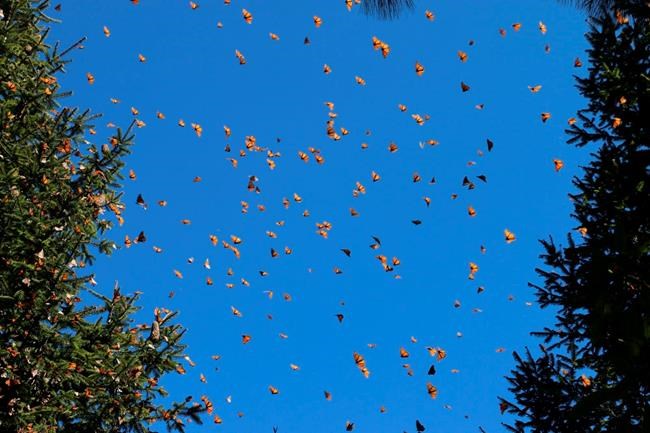
In the U.S., two separate populations of monarchs are divided by the Rocky Mountains. While the western population primarily sticks to the California coast, the eastern population makes its way down from southern Canada and the northeastern United States across thousands of miles to spend the winter at one of about 20 colonies in the Mexican states of Michoacán and Mexico. No single insect completes the entire journey as the average butterfly only lives about a month. Instead, it takes three or four generations to make the trip, with each one travelling part of the way.
The exception is a “super-generation” of monarchs that lives eight times longer than their relatives. These super-monarchs can travel 50 or 100 miles a day, riding on thermal air currents as high as a mile above the ground, according to the U.S. Department of Agriculture.
When they reach Mexico, they roost in trees, like the cedar and oak at Cerro Pelon, and cluster together to stay warm.
A recent group of butterfly watchers saw thousands clumped together in what looked like huge hornets’ nests hanging from branches that can break from the weight of the insects, explained guide Ellen Sharp, who, along with her husband, Joel Moreno Rojas, runs a butterfly business in nearby Macheros.
“No one is entirely sure why they choose these trees,” Sharp said. “But one of the reasons is the microclimate. The old-growth trees radiate heat, so they stay warm through the winter.” The monarchs generally arrive at the beginning of November and are headed north by mid-March.
The western population has declined dramatically in recent years. Last November, surveyors at 97 sites found 20,456 monarchs compared to 148,000 at the same sites in 2017, according to Xerces, a non-profit conservation group. Reasons for the decrease include climate change, habitat loss and pesticide use.
But the eastern population is rising. Several rangers at Cerro Pelón who were born and raised in the area said they haven’t seen butterflies in their current numbers since they were children. And the latest numbers support their observations.
At the end of January, Mexican officials announced that the overall population of monarch butterflies wintering in central Mexico was up 144 per cent over the previous year. The monarch population, like that of other insects, fluctuates widely depending on a variety of factors, but scientists say the recoveries after each big dip tend to be smaller, suggesting a decline in the number migrating from Canada and the United States. This winter’s population figure, however, was the largest since 2006-2007.
One of the biggest threats to monarch populations is believed to be the destruction of milkweed along their migration routes. There is a movement among gardeners across North America to plant milkweed, the sole host for the monarchs’ eggs and only food for the caterpillars.
In Mexico, the area of forest inhabited by monarchs has increased 144 per cent from 2017 to 2018, to nearly 15 acres of land, according to World Wildlife Fund Mexico and its partners. Researchers found eight butterfly colonies inside the Monarch Butterfly Biosphere Reserve and six colonies outside it. The largest colony covered a bit more than 6 acres of forest.
Sharp and Moreno began their business in 2012 and believe they’re doing their part to ensure the continued butterfly rebound. While locals always knew the butterflies were there — many believed they were the souls of people who had died in the past year — there was no tourism infrastructure.
After the butterflies’ overwintering sites in Mexico were discovered by naturalists and scientists in 1975, and then publicized by National Geographic magazine the following year, a patron from a nearby town decided to hire three men from Macheros to work as rangers to protect the forest. One of those men was Rojas’ father, who retired in 2014.
Since then, in addition to operating a growing bed-and-breakfast and butterfly-tour business with a dozen local workers, he and Sharp formed a non-profit and hired four full-time rangers who now spend their days in the forest. So now, a total of seven men are in the woods full-time from November to March. They help prevent illegal logging and keep the forest clean.
“It’s so much bigger than we are . It’s this constant cycle. They keep coming back again and again,” Sharp said. “It’s ‘awe’ in the old sense of the word. There should still be things in nature that are awe-inspiring.”