WEATHER ALERT

Want to help bees? Plant flowering herbs

Advertisement

Advertise with us

Herbs are among the most useful plants in nature. They can tantalize the taste buds, help cure what ails you, oil the body, perfume the air, and attract bees, butterflies and hummingbirds.

Read this article for free:

or

Already have an account? Log in here »

To continue reading, please subscribe:

Subscribe and receive a limited-edition Free Press branded hat or tote.

Digital Subscription

One year of digital access for only $205*

  • Enjoy unlimited reading on winnipegfreepress.com
  • Read the E-Edition, our digital replica newspaper
  • Access News Break, our award-winning app
  • Play interactive puzzles

*First annual payment billed as $205.00 + GST for one year. This annual subscription will automatically renew at $233.00 + GST every 52 weeks (10% off the regular annual price of $259.35). Offer available to new and qualified returning subscribers only. Cancel any time.

To continue reading, please subscribe:

Add Free Press access to your Brandon Sun subscription for only an additional

$1 for the first 4 weeks*

  • Enjoy unlimited reading on winnipegfreepress.com
  • Read the E-Edition, our digital replica newspaper
  • Access News Break, our award-winning app
  • Play interactive puzzles
Start now

*Your next Brandon Sun subscription payment will increase by $1.00 and you will be charged $17.95 plus GST for four weeks. After four weeks, your payment will increase to $24.95 plus GST every four weeks.

Hey there, time traveller!
This article was published 19/03/2019 (2689 days ago), so information in it may no longer be current.

Herbs are among the most useful plants in nature. They can tantalize the taste buds, help cure what ails you, oil the body, perfume the air, and attract bees, butterflies and hummingbirds.

“People are getting more into herbs, with herb sales definitely on the rise,” said David Trinklein, an Extension horticulturist with the University of Missouri. “They’re using fresh herbs from the garden for culinary purposes, but another important reason is to help pollinators.”

Many gardeners are trying to help declining pollinator populations by providing them with the plants they need to thrive.
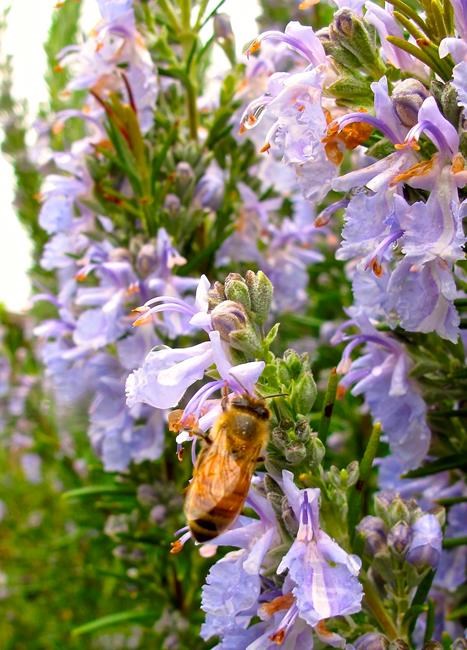
This April 19, 2013 photo shows a honeybee on Rosemary blooms in a garden near Langley, Wash. Some herbs, like fennel and dill, also serve as host plants for butterfly caterpillars. (Dean Fosdick via AP)

Herbs appeal to a great variety of bee species, said Francis Drummond, a professor of insect ecology and insect pest management at the University of Maine.

“It is mostly the abundant nectar that brings the bees in,” he said. “Some of the more attractive herbs to bees are thyme, comfrey, borage, oregano, bee’s friend, lemon balm, rosemary, hyssop, sage, lavender and chives.”

Most flowering herbs are attractive to pollinators, but some, like cilantro and basil, tend to lose other qualities when they blossom or bolt, said Ed Spevak, curator of invertebrates at the St. Louis Zoo. “So use the leaves earlier (for your own purposes) but then allow the plant to flower to support pollinators,” he said.

Some herbs, like cilantro, fennel and dill, produce very small blossoms that attract very small bees, Spevak said. “Fennel and dill also serve as host plants for black swallowtail caterpillars,” he said.

Bees find flowers by way of their colour, not their scent, said David Salman, founder and chief horticulturist for High Country Gardens. “Particularly honeybees, although some native bees will feed on them as well,” he said. “But herbs primarily have Old World origins, so their primary interest is (for) honeybees which also were imported here.

“In general, annual herbs tend to be more important for butterflies, primarily swallowtails,” Salman said.

Pollinators as a whole are necessary for a huge amount of the world’s food production, but the European honeybee is a critical species, Trinklein said.

“They’re the king of the pollinators,” he said. “They are morphologically designed to be pollinators, while other species are more accidental pollinators. They’re also greater in number and activity level than other species of pollinators.”

Bees need to collect syrup and pollen from early spring through late fall to support a healthy hive, Trinklein said. That means gardeners should plant a variety of flowers and herbs to prolong the bloom season.

Many beekeepers maintain that the herbs used for attracting pollinators should be natives, but Trinklein disagrees.
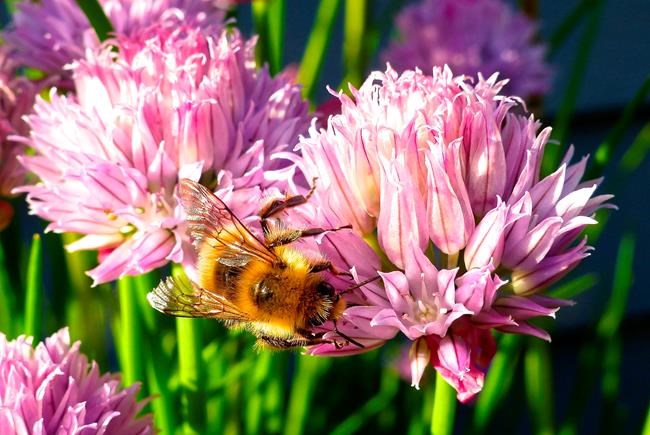
This May 20, 2015 photo shows Containerized chive blossoms in a yard near Langley, Wash., which attract a variety of bee species. Gardeners are opting for more herbs in their yards for culinary use but also to attract pollinators. (Dean Fosdick via AP)

“I don’t think a bee minds if an herb is native or non-native,” he said. “Lavender and anything in the catnip family are particularly attractive to bees.”

Gardeners seeking to support pollinators might consider planting scent gardens made up entirely of herbs. They would provide pleasing fragrances around the home as well as nutrition for the bees, he said.

“However, it is advisable to avoid (wearing) strong-smelling perfumes, hairsprays or other fragrances which might attract to the gardener confused bees seeking out nectar,” Trinklein said.

___

Online:

For more about growing pollinator friendly herbs, see this fact sheet from University of Illinois Extension: https://web.extension.illinois.edu/cfiv/downloads/56964.pdf

You can contact Dean Fosdick at deanfosdick@netscape.net

Report Error Submit a Tip

More Stories

A stealthy tax increase

Gage Haubrich 4 minute read 2:00 AM CDT

About $2,100. That’s how much Premier Wab Kinew’s bracket creep tax hike could cost your family by 2030, depending on how much you make.

Bracket creep is an income tax hike that happens when the government stops indexing tax brackets to inflation. That means that after getting a cost-of-living raise, taxpayers can be bumped into a new tax bracket and have their tax bill increased even though they can’t afford to buy more.

Think about it this way: A raise that only covers higher grocery prices isn’t a real raise. You’re not richer. Your cart costs the same. But the bigger number on your paycheque bumps you into a higher bracket. That means higher taxes on a paycheque that buys the exact same number of groceries as last year.

That’s why most provincial governments and the federal government adjust income tax brackets with inflation.

Men’s title turning into two-horse race between clubmates Fanning and Doyle

Mike McIntyre 6 minute read Preview

Men’s title turning into two-horse race between clubmates Fanning and Doyle

Mike McIntyre 6 minute read Yesterday at 8:11 PM CDT

Angela Martens was once a rising star on the Manitoba golf scene, with the 1999 provincial amateur title serving as Exhibit A.

But life eventually took precedence over sport as she faded from the competitive spotlight, with a runner-up finish at the Amateur in 2010 marking her most recent appearance near the top of the leaderboard.

Now, all these years later, Martens is back — and on the cusp of another championship.

The Elmhurst member takes a one-shot lead into Wednesday’s final round of the 2026 Hodson Financial Women’s Senior Championship at Breezy Bend after posting rounds of 80 and 79.

Read
Yesterday at 8:11 PM CDT

Mayor backs new way to handle 911 mental health, addiction calls

Malak Abas 7 minute read Preview

Mayor backs new way to handle 911 mental health, addiction calls

Malak Abas 7 minute read Updated: Yesterday at 5:47 PM CDT

Mayor Scott Gillingham is enthusiastically endorsing a proposal to change the city’s crisis-response system, potentially diverting 10,000 calls away from overburdened police, fire and paramedic services every year.

The “fourth crisis response pathway” would allow 911 calls that aren’t violent or criminal in nature to be transferred to citywide crisis-response teams, staffed in part through current community resources, which could include the Downtown Community Safety Partnership and The Link’s mobile crisis teams.

A community crisis dispatch and co-ordination hub would receive triaged calls and match them with the teams, which would move them out of the Winnipeg Police Service and Winnipeg Fire and Paramedic Service calls for service.

“Every day, our 911 dispatchers receive calls from Winnipeggers who are in distress, dealing with complex mental health struggles, addiction, or wellness concerns,” Gillingham said after releasing a report on the proposal Tuesday.

Read
Updated: Yesterday at 5:47 PM CDT

CMHR ‘fans flames of antisemitism,’ Asper says, ending support from family that led effort to create it

Carol Sanders 7 minute read Preview

CMHR ‘fans flames of antisemitism,’ Asper says, ending support from family that led effort to create it

Carol Sanders 7 minute read Monday, Jul. 27, 2026

The Winnipeg family that led the effort to build the Canadian Museum for Human Rights will not provide support going forward, philanthropist and honorary board member Gail Asper says.

Read
Monday, Jul. 27, 2026

Report draws link between missing Indigenous women and trafficking across Canada

Marsha McLeod 6 minute read Preview

Report draws link between missing Indigenous women and trafficking across Canada

Marsha McLeod 6 minute read Yesterday at 7:07 PM CDT

A new analysis of online sex advertisements featuring Indigenous women has identified cross-country corridors that are highly indicative of sex trafficking, while revealing insight into how women and girls are exploited in Winnipeg.

Read
Yesterday at 7:07 PM CDT

Students continue to criticize handling of MITT’s closure

Morgan Modjeski 5 minute read Preview

Students continue to criticize handling of MITT’s closure

Morgan Modjeski 5 minute read Monday, Jul. 27, 2026

Students at a Manitoba trade college say their education has been hampered as a result of its impending closure and they blame government for a poor transition.

The provincial government announced in January it would close the Manitoba Institute of Trades and Technology because it was no longer financially viable following the federal government’s decision to cut the number of international students allowed to study in Canada.

Officials have said students would remain the top priority as 19 programs from MITT are set to be absorbed by Red River College Polytech.

Kieran Smith, an electrical applications student at MITT, said it feels like those in charge “don’t really care.”

Read
Monday, Jul. 27, 2026