CMHR ‘fans flames of antisemitism,’ Asper says, ending support from family that led effort to create it
Read this article for free:
or
Already have an account? Log in here »
To continue reading, please subscribe:

Digital Subscription
One year of digital access for only $205*
- Enjoy unlimited reading on winnipegfreepress.com
- Read the E-Edition, our digital replica newspaper
- Access News Break, our award-winning app
- Play interactive puzzles
*First annual payment billed as $205.00 + GST for one year. This annual subscription will automatically renew at $233.00 + GST every 52 weeks (10% off the regular annual price of $259.35). Offer available to new and qualified returning subscribers only. Cancel any time.
To continue reading, please subscribe:
Add Free Press access to your Brandon Sun subscription for only an additional
$1 for the first 4 weeks*
- Enjoy unlimited reading on winnipegfreepress.com
- Read the E-Edition, our digital replica newspaper
- Access News Break, our award-winning app
- Play interactive puzzles
*Your next Brandon Sun subscription payment will increase by $1.00 and you will be charged $17.95 plus GST for four weeks. After four weeks, your payment will increase to $24.95 plus GST every four weeks.
Read unlimited articles for free today:
or
Already have an account? Log in here »
The Winnipeg family that led the effort to build the Canadian Museum for Human Rights will not provide support going forward, philanthropist and honorary board member Gail Asper says.
“We do not want to support any institution that, in our view, fans the flames of antisemitism,” said Asper, who has personally donated more than $1 million to the museum. Her father, CanWest Global Communications founder Izzy Asper, pushed for its creation before his death in 2003.
“I think my father would be deeply disappointed in us doing that with his funding, and I have no stomach for it at all.”
The family’s decision was fuelled by the current, contentious exhibition, Palestine Uprooted: Nakba Past and Present, which explores the forced displacement of Palestinian Canadians from 1948 through to today.
“I think my father would be deeply disappointed in us doing that with his funding, and I have no stomach for it at all.”
Nakba, Arabic for “catastrophe,” refers to the mass displacement and dispossession of 750,000 Palestinians during the 1948 Arab-Israeli war that followed Israel’s declaration of Independence. The exhibition features personal stories told through artifacts and video testimonies and presents Palestinian Canadians reflecting on their ongoing struggle for human rights.
What’s missing, said Asper and others, including former federal justice minister Irwin Cottler and former CMHR board member and human rights lawyer Mark Berlin — who co-authored a column about it for the Globe and Mail, is context.
The refugee crisis of 1948 didn’t occur in a vacuum, their June 25 opinion piece said, pointing to the exhibition’s failure to reference the estimated 850,000 Jews expelled from Arab countries after Israel’s creation.
The CMHR — the only one of Canada’s nine national museums that is located west of Ontario — opened in 2014. The Asper Foundation donated nearly $24 million towards its construction.

The museum, which did not make CEO Isha Khan available for comment Monday, stands by the exhibit as is.
“Like all our content, it centres human experiences, and focuses on the impact forced displacement continues to have on the Palestinian community here in Canada,” museum spokesperson Amanda Gaudes said in an email.
“Building an understanding of the personal stories and experiences of Palestinian Canadians is squarely within our mandate. Their stories belong in this museum, and we stand behind our curatorial process.”
Asper said she has seen the video and artifacts and wants the Palestinian story to be told but with some historical background that she says is especially crucial now.
“This is coming at a time when antisemitism in Canada is on the rise, hugely,” she said. “They have not done anything to assuage my concerns that this isn’t going to foment more antisemitism.”
BROOK JONES/FREE PRESS FILES Protesters gather outside of the Canadian Museum for Human Rights over the current Nakba exhibit. Gail Asper (centre), whose late father Izzy Asper founded the museum, holds a sign.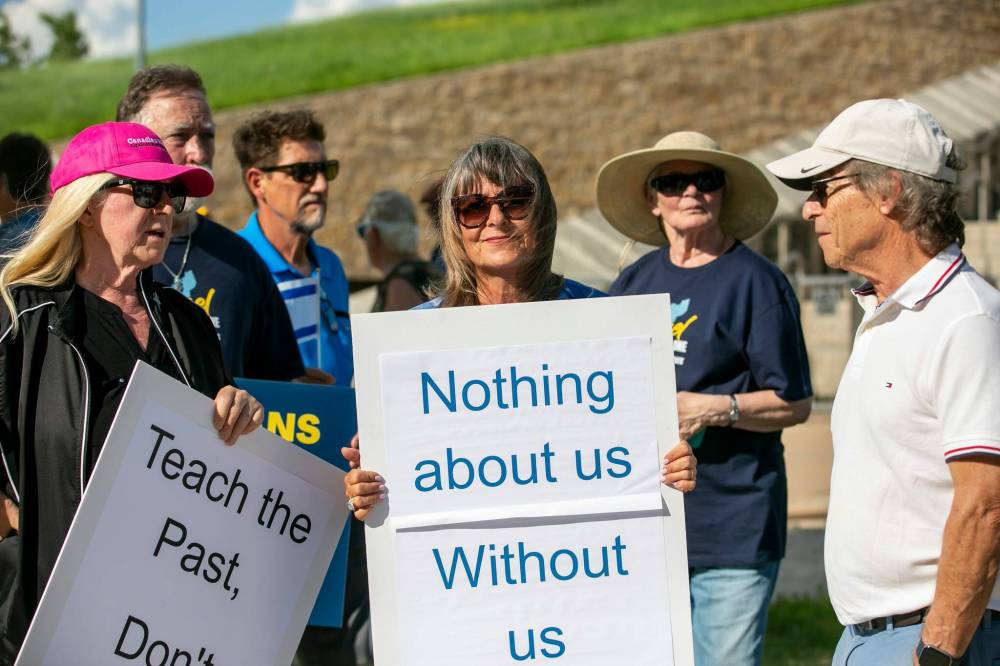
The federal government is providing millions of dollars to beef up security at Jewish gathering places, and Prime Minister Mark Carney announced a committee to get at the root causes of antisemitism, she said.
“I really hope that we can get back on track and that this museum returns to being a special place of dialogue and bridge building,” she said. “Right now, it’s going in the opposite direction. You have one of the federal government institutions funded by the taxpayer weaponized as an institution that promotes a very misguided view of Jewish and Israeli history. It can’t help but create misunderstandings.”
Asper said she was given 30 minutes to raise her concerns about the planned exhibit before it opened.
“I begged the board to find compassion in these difficult times for Jewish communities — to be scrupulously careful not to be unbalanced and to provide the facts and be fair and be accurate,” she said.
“And when they didn’t do that and they didn’t change one thing, I threw up my hands and said, ‘I’m done.’”
“I don’t even think he would say it’s got to be changed. He’d be calling for due process.”
She said the board members listened but indicated that it was the CEO’s job to oversee the exhibits.
“I think it was a huge mistake for the board to be so hands-off,” she said.
Asper and her family’s foundation had been regular museum donors.
“You have to make sure that the institution that you believe in has the funding to fulfil its true potential,” she said, noting the museum still doesn’t have a theatre, which is a fundraising project they’d typically support.
The family has supported the Holocaust gallery’s exhibition featuring survivors’ holograms and was about to announce new funding to expand it when news of the Nakba material came to light.
Gaudes said the museum has not received funding from the Asper Foundation since 2023.
“Organizations will regularly make decisions about how to allocate their resources, but we thank and appreciate every donor who has supported the work of the museum,” Gaudes said.
“We are grateful to have seen an influx of new donors over the past few months, and we continue to enjoy strong partnerships with many donors and sponsors who see the essential value of our work.”
Asper explained why the Asper Foundation stopped its annual funding.
“We did not feel the tone the CMHR was taking regarding the Hamas invasion of Israel on Oct. 7, 2023 properly conveyed the horror of the attacks, and the plight of the 251 hostages held in Gaza,” she said.
Since the Nakba exhibition opened on June 27, the museum has had a 25 per cent increase in attendance when compared with the same period last year, Gaudes said. Attendance has increased to 6,152 visitors from 4,938, with a higher percentage of local visitors than usual, she noted.
“Telling the stories of one community in no way negates the experiences of another.”
Asper said she doesn’t think her dad would want to see the Nakba exhibition shut down.
“I don’t even think he would say it’s got to be changed. He’d be calling for due process,” and seeking an independent review of what it has and what’s missing, she said.
“I’m sure he would be talking to everyone that he knows to get this exhibit properly reviewed,” she said.
It has received both criticism and praise from elected politicians and others, including some Jewish organizations.
“Focusing on Palestinian Canadian experiences of forced displacement in this one exhibit does not detract or minimize experiences of Jewish people who were displaced and who have also faced human rights violations, which our galleries also share stories about,” Gaudes said.
“Telling the stories of one community in no way negates the experiences of another.”
Asper said she feels a duty to Canadians who helped build the museum.
“We owe it to them to get this museum’s reputation cleaned up and to restore its reputation as a trusted source of scholarly research with balanced and accurate information and context on complex human rights issues,” she said.
carol.sanders@freepress.mb.ca

Carol Sanders
Legislature reporter
Carol Sanders is a reporter at the Free Press legislature bureau. The former general assignment reporter and copy editor joined the paper in 1997. Read more about Carol.
Every piece of reporting Carol produces is reviewed by an editing team before it is posted online or published in print — part of the Free Press‘s tradition, since 1872, of producing reliable independent journalism. Read more about Free Press’s history and mandate, and learn how our newsroom operates.
Our newsroom depends on a growing audience of readers to power our journalism. If you are not a paid reader, please consider becoming a subscriber.
Our newsroom depends on its audience of readers to power our journalism. Thank you for your support.
Related Articles
Coalition calls on minister to withdraw criticism of museum's Palestinian exhibit


History
Updated on Monday, July 27, 2026 8:49 PM CDT: Updated for additional quote from Gail Asper.