
The hard life of a wild Sable Island horse:’Eking out a living on this sandbar’

Advertisement

Advertise with us

HALIFAX - Researchers studying the carcasses of Sable Island's fabled wild horses have discovered many had unusual levels of parasites and sand, suggesting they are tougher than most horses, even as many died of starvation.

Read this article for free:


or

Already have an account? Log in here »

To continue reading, please subscribe:

Subscribe and receive a limited-edition Free Press branded hat or tote.

Digital Subscription

One year of digital access for only $205*

  • Enjoy unlimited reading on winnipegfreepress.com
  • Read the E-Edition, our digital replica newspaper
  • Access News Break, our award-winning app
  • Play interactive puzzles

*First annual payment billed as $205.00 + GST for one year. This annual subscription will automatically renew at $233.00 + GST every 52 weeks (10% off the regular annual price of $259.35). Offer available to new and qualified returning subscribers only. Cancel any time.

To continue reading, please subscribe:

Add Free Press access to your Brandon Sun subscription for only an additional

$1 for the first 4 weeks*

  • Enjoy unlimited reading on winnipegfreepress.com
  • Read the E-Edition, our digital replica newspaper
  • Access News Break, our award-winning app
  • Play interactive puzzles
Start now

*Your next Brandon Sun subscription payment will increase by $1.00 and you will be charged $17.95 plus GST for four weeks. After four weeks, your payment will increase to $24.95 plus GST every four weeks.

Hey there, time traveller!
This article was published 21/03/2019 (2764 days ago), so information in it may no longer be current.

HALIFAX – Researchers studying the carcasses of Sable Island’s fabled wild horses have discovered many had unusual levels of parasites and sand, suggesting they are tougher than most horses, even as many died of starvation.

A team from the University of Saskatchewan and Parks Canada performed necropsies on more than 30 dead animals during trips to the isolated sandbar about 160 kilometres off Nova Scotia in 2017 and 2018.

“We showed up in 2017 not knowing whether there would be any dead horses to find,” said researcher Emily Jenkins.
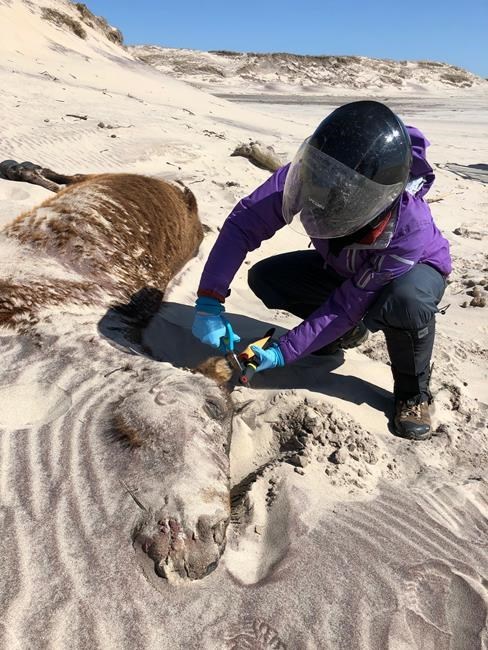
University of Saskatchewan graduate student and Vanier scholar Julie Colpitts collects samples for DNA testing and places an ear tag on a dead horse on Sable Island, N.S. in this undated handout photo. Researchers studying the carcasses of Sable Island's fabled wild horses have discovered many had unusual levels of parasites, suggesting they are tougher than most horses, even as many died of starvation.
University of Saskatchewan graduate student and Vanier scholar Julie Colpitts collects samples for DNA testing and places an ear tag on a dead horse on Sable Island, N.S. in this undated handout photo. Researchers studying the carcasses of Sable Island's fabled wild horses have discovered many had unusual levels of parasites, suggesting they are tougher than most horses, even as many died of starvation. "We showed up in 2017 not knowing whether there would be any dead horses to find," said Emily Jenkins, part of a team from the University of Saskatchewan and Parks Canada. THE CANADIAN PRESS/HO, Emily Jenkins *MANDATORY CREDIT*

“Scientifically we really didn’t know anything about the causes of mortality in this population because the last work that was done was in the 1970s.”

The horses have roamed there since the 18th century and become synonymous with the island’s romantic and untamed image.

Jenkins said conditions on the wind-swept, 42-kilometre long island were particularly harsh in the early spring of 2017, and that had an effect on the horse population.

“It was very hard on the horses,” she said. “When we got there they were taking shelter behind anything they could find.”

With the help of Parks Canada, Jenkins said she and other University of Saskatchewan researchers were able to find 30 carcasses that were suitable for examination during their initial foray to the island.

Jenkins said they estimated there were another 20 carcasses that were either unsuitable for examination or that were just too inaccessible to get to.

She said the overall findings were “very similar” to a previous study carried out by graduate student Daniel Welsh in 1972.

“The main finding was emaciation or starvation and hypothermia, especially for the young horses,” said Jenkins, who noted vegetation is sparse on Sable during that time of the year.

The researchers found the yearlings in particular, had little or no reserves of body fat to rely on.

“All of the young horses we looked at were just basically out of reserves,” Jenkins said. “They had nothing left, they were emaciated.”

However, the adult animals, who would have higher social status and better access to the best grazing, were generally in better body condition and died of a combination of other causes.

Jenkins said Sable Island’s omnipresent sand tends to grind down teeth, affecting nutrient intake, and also ends up in the horses’ system, blocking their gastrointestinal tract.

“In several horses that we looked at there was quite a lot of sand. We were picking up the intestines and the stomach and saying ‘these weigh a tonne,’ because there was in many cases more sand than plant content.”

Jenkins also noted that some pregnant mares had died while giving birth.

The 2018 trip, meanwhile, focused more on looking for pathogens and diseases, and that’s where Jenkins said the researchers were able to find things such as respiratory and reproductive diseases including a parasite lungworm.

She said, in fact, research over the last 10 years has turned up astounding levels of parasitic worms in these small horses, many of whom are no bigger than 14 hands long. The average fecal egg count from the live horse study was 1,500 per gram.

“I just about fell over because we call a high fecal egg count in a domestic horse 500 eggs per gram,” said Jenkins. “So the average Sable horse is walking around shedding three times more parasites than our domestic horses.”

Jenkins said the horses’ genetic resistance to the parasites could render clues for horses in the domestic world, where veterinarians are “fighting a losing battle” to worms with a growing resistance to various treatments.

The scientist said she believes domestic horses are dewormed too much to begin with, and the Sable research could help bear that out.

“Look at what those guys are surviving with — massive levels of parasitism and no treatment. So we are probably overdoing it for most horses that are just companion animals.”

Jenkins said the overall mortality rate in 2017 was about 10 per cent of the population, while the 2018 figure represented about one per cent, which is more the norm.

She said the current population sits at around 500 horses, up from the 300 or so recorded in the 1970s.

From a scientific perspective, Jenkins said it’s fascinating to see a system of untreated and unmanaged horses living in what amounts to their ancestral conditions.

“But there’s the little girl in me who has always loved horses who can’t believe these horses are eking out a living on this little sandbar,” she said.

Report Error Submit a Tip

More Stories

Creatures’ comfort key to coping with loss

Maureen Scurfield 4 minute read Yesterday at 2:00 AM CDT

DEAR MISS LONELYHEARTS: Not long ago I lost my husband to illness at far too young an age. My spouse was a great guy, but I do want another one.

I just want to pass on a little tip. When my husband was dying, he encouraged me to bring home warm and loving pets to our acreage just outside the city. They were my saviours when my husband was ill.

Since he has died, they continue to help me keep warm, happy and affectionate. They were my greatest comfort in the later stages when my man was in too much pain to hold me or be held. The cats and the dog would welcome me home from the hospital and transfer their cuddling to me, giving me all the attention I needed, and I always felt so loved.

I have been dating a fair bit for a fairly recent widow because I’m ready to be held and loved, and I feel my husband and the pets saying, “Way to go.”

Lobster Trap wins Dafoe book prize

Ben Sigurdson 1 minute read Preview

Lobster Trap wins Dafoe book prize

Ben Sigurdson 1 minute read 2:00 AM CDT

Greg Mercer’s The Lobster Trap: The Global Fight for a Seafood on the Brink has won the 2026 J.W. Dafoe Book Prize.

Read
2:00 AM CDT

‘We know we’re not going to beat Mother Nature’: Ice prep begins at Princess Auto Stadium for Heritage Classic

Mike McIntyre 6 minute read Preview

‘We know we’re not going to beat Mother Nature’: Ice prep begins at Princess Auto Stadium for Heritage Classic

Mike McIntyre 6 minute read Yesterday at 5:56 PM CDT

Derek King typically has ice in his veins.

But the Manitoban admits there may be a few more butterflies than usual as he prepares for the ultimate home game — the 2026 Heritage Classic between the Winnipeg Jets and Montreal Canadiens.

“This is so exciting to be back,” King, the NHL’s vice-president of hockey operations and facilities operations, said Tuesday afternoon.

“It’s definitely going to be a fun event to be part of.”

Read
Yesterday at 5:56 PM CDT

Jets top line powers win over Wild

Ken Wiebe 7 minute read Preview

Jets top line powers win over Wild

Ken Wiebe 7 minute read Yesterday at 11:08 PM CDT

Cole Perfetti has made it clear he doesn’t want to get ahead of himself.

The Winnipeg Jets winger has first-hand knowledge on how humbling the NHL can be, coming off a quiet campaign as he worked his way back from a high ankle sprain.

But with the benefit of a full summer of training and a return to health, Perfetti has taken advantage of his promotion to the top line and quickly shown he belongs.

The latest proof came Tuesday, with Perfetti scoring a pair of goals — including the game-winner — in a 5-2 victory over the Minnesota Wild at Canada Life Centre.

Read
Yesterday at 11:08 PM CDT

Developer ‘anxiously’ awaits judge’s decision on Granite Curling Club construction

Joyanne Pursaga 4 minute read Preview

Developer ‘anxiously’ awaits judge’s decision on Granite Curling Club construction

Joyanne Pursaga 4 minute read Yesterday at 6:19 PM CDT

The developer of a hotly debated project that would add 110 housing units to the Granite Curling Club’s parking lot has begun investigative work at the site while awaiting a judge’s decision on construction.

While some digging took place at the city-owned property last week, its developer said construction has yet to begin.

“I would call (the digging so far) investigative site work. It’s not preparing in any way for construction, other than to ensure that the reports that are required for any site have been completed,” said Jeremy Read, chief executive officer of UWCRC 2.0 Inc.

A heritage resources impact assessment will determine if the site has archeological significance. That work will check for everything from fossils to unmarked graves, said Read.

Read
Yesterday at 6:19 PM CDT

Storm costs not factored in to MPI request for 2.38% rate increase

Nicole Buffie 5 minute read Preview

Storm costs not factored in to MPI request for 2.38% rate increase

Nicole Buffie 5 minute read Yesterday at 6:43 PM CDT

Manitoba Public Insurance told the Public Utilities Board Tuesday it didn’t factor in reinsurance costs related to devastating summer storms in its application for an increase to vehicle insurance rates.

Cara Low, the Crown corporation’s chief actuary, told the board that given MPI anticipates an increase to reinsurance premiums, the 2.38 per cent increase listed in its application won’t be adequate to cover its costs.

“There’s going to be a significant increase. We still have to decide how much we want to retain, what we want the coverage to look like, and what the upper end needs to be,” she said on the opening day of a three-week hearing.

Nearly 41,000 claims have been submitted in relation to summer storms that swept across southern Manitoba from June to August. Floods, tornadoes and hail pummelled several communities and forced MPI to open satellite claims centres to deal with the record number of calls.

Read
Yesterday at 6:43 PM CDT


