B.C. researcher says device mimics parent’s touch to help babies cope with pain

Advertisement

Advertise with us

VANCOUVER - Researchers in British Columbia have designed a "robot" that helps reduce pain for premature babies by simulating skin-to-skin contact with a parent who may not be available during around-the-clock procedures in a neonatal intensive care unit.

Read this article for free:


or

Already have an account? Log in here »

To continue reading, please subscribe:

Subscribe and receive a limited-edition Free Press branded hat or tote.

Digital Subscription

One year of digital access for only $205*

  • Enjoy unlimited reading on winnipegfreepress.com
  • Read the E-Edition, our digital replica newspaper
  • Access News Break, our award-winning app
  • Play interactive puzzles

*First annual payment billed as $205.00 + GST for one year. This annual subscription will automatically renew at $233.00 + GST every 52 weeks (10% off the regular annual price of $259.35). Offer available to new and qualified returning subscribers only. Cancel any time.

To continue reading, please subscribe:

Add Free Press access to your Brandon Sun subscription for only an additional

$1 for the first 4 weeks*

  • Enjoy unlimited reading on winnipegfreepress.com
  • Read the E-Edition, our digital replica newspaper
  • Access News Break, our award-winning app
  • Play interactive puzzles
Start now

*Your next Brandon Sun subscription payment will increase by $1.00 and you will be charged $17.95 plus GST for four weeks. After four weeks, your payment will increase to $24.95 plus GST every four weeks.

Hey there, time traveller!
This article was published 22/03/2019 (2704 days ago), so information in it may no longer be current.

VANCOUVER – Researchers in British Columbia have designed a “robot” that helps reduce pain for premature babies by simulating skin-to-skin contact with a parent who may not be available during around-the-clock procedures in a neonatal intensive care unit.

Lead inventor and occupational therapist Liisa Holsti said the Calmer device is a rectangular platform that replaces a mattress inside an incubator and is programmed with information on a parent’s heartbeat and breathing motion.

The robotic part of Calmer is that the platform rises up and down to mimic breathing, and a heartbeat sound is audible through a microphone outside the device, said Holsti, adding a pad on top resembles a skin-like surface.
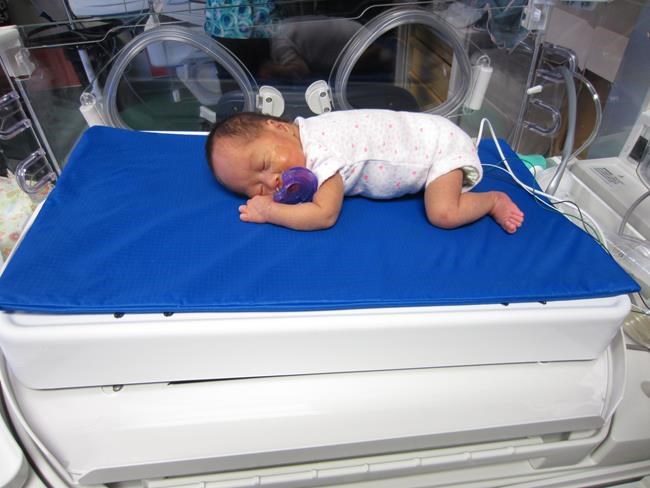
A premature baby on Calmer is shown in a handout photo. Researchers in British Columbia have designed a
A premature baby on Calmer is shown in a handout photo. Researchers in British Columbia have designed a "robot" to help premature babies cope with painful procedures by mimicking skin-to-skin contact with a parent. The rectangular platform fits inside an incubator and is programmed with information on a parent's heartbeat and breathing motions. THE CANADIAN PRESS/HO-University of British Columbia MANDATORY CREDIT

The aim is to help babies cope with pain through touch instead of medication as much as possible while they’re exposed to multiple procedures, such as the drawing of blood, which can be done multiple times a day over several months.

A randomized clinical trial involving 49 infants born prematurely between 27 and 36 weeks of pregnancy at BC Women’s Hospital and Health Centre concluded Calmer provides similar benefits to human touch in reducing pain when the babies had their blood drawn.

The findings of the study, completed between October 2014 and February 2018, were published this week in the journal Pain Reports.

A parent’s or caregiver’s touch is the most healing and the Calmer isn’t intended to replace that, said Holsti, the Canada research chair in neonatal health and development. She worked with four other researchers on the project that involved a prototype built by engineering students at the British Columbia Institute of Technology.

“We purposely did not design it to look anything like a human being,” she said, adding her work since 1985 in neonatal intensive care units, where she taught parents how to support their babies at home after leaving the hospital, sparked an interest in assessing infant pain and trying to relieve it.

“We have about 30,000 babies born prematurely in Canada alone every year so my hope would be that we would be helping all of those babies with Calmer.”

Holsti said nurses often provide so-called hand hugging by placing their hands around an infant’s head, arms and legs in a curled position during blood collection, but the study suggests the device would save almost half a million dollars in staffing costs every year at just the neonatal intensive care unit where the study was done.

Lauren Mathany, whose twin daughters Hazel and Isla were born 24 weeks into her pregnancy last April and weighed less than two pounds each, said that while the Calmer research had been completed by then, it would have been a reassuring tool for her and her spouse when they went home to sleep or take a shower after doing plenty of hang hugging and skin-to-skin touching.

“The NICU is the most difficult place to be. It challenges you in every single way,” she said.

Methany’s children spent over four months at the hospital and were medically fragile when they were bought home but are now thriving at almost a year old.

Dr. Ran Goldman, who has been a pain researcher at the BC Children’s Hospital Research Institute for 20 years but wasn’t involved with the Calmer study, said the device shows promise because there’s a greater understanding that healing is delayed when pain is part of an infant’s treatment.

Scientists in the late 1960s believed babies didn’t feel pain but there’s now an increasing understanding that they’re more sensitive to it than older children or adults because their pain-inhibiting mechanisms haven’t fully developed, said Goldman, who is also an emergency room physician at BC Children’s Hospital.

“Research has shown that babies who suffered pain as neonates do keep this memory later on and respond differently when they get pain experiences later in life,” he said.

— Follow @CamilleBains1 on Twitter.

Report Error Submit a Tip

More Stories

Rise of social media reflects rise of self-promotion — to the detriment of genuine storytelling

Reviewed by Matt Henderson 4 minute read Preview

Rise of social media reflects rise of self-promotion — to the detriment of genuine storytelling

Reviewed by Matt Henderson 4 minute read Yesterday at 3:00 AM CDT

A conversation is overheard between two people; one congratulates the other on their success, evident through countless posts on LinkedIn, but the other confesses the prolific aggrandizement is due to slumping success.

A young man on an airplane spends three hours poring over selfies taken on a vacation, zooming in on his biceps and using AI to retouch photos before posting on Instagram.

Anonymous and cowardly trolls on Reddit attempt to end another person’s career.

All this “storytelling” was observed in one day by this reviewer.

Read
Yesterday at 3:00 AM CDT

Don’t be a big loser — check out Real Love Summer Fest ReunionBig Loser takes the stage at 8:20 p.m. tonight as part of the Real Love Summer Fest Reunion, a one-day event put on by the indie promotion company, which ran the festival in the Interlake area for a decade until last summer’s final edition near Teulon.

Bookers Gil Carroll and Adam Soloway have programmed a full day of music at Blue Note Park (220 Main St.), the outdoor venue adjacent to Times Change(d) High and Lonesome Club.

First up at 4 p.m. is folk-rock songwriter tofusmell, followed at 5 p.m. with a rare performance by indie-songwriting darlings Animal Teeth, a group with several summer fest bills under its belt. Up-and-coming pop-rockers Synthetic Friend take the stage at 6, followed at 7 by the fun electronic dance pop of French Class.

After playing with his full band at last month’s Winnipeg Folk Festival, Amos the Kid will perform a solo set at 8 p.m. Sans band, the performer shows off his affable roots as a Gord Downie acolyte with catchy earworms to match.

HSC weapons scanners effective, needed at other hospitals: nurses union

Carol Sanders 5 minute read Preview

HSC weapons scanners effective, needed at other hospitals: nurses union

Carol Sanders 5 minute read Yesterday at 9:57 AM CDT

The AI weapons scanners at Health Sciences Centre have detected close to 2,000 items since they were installed at Manitoba’s largest hospital.

From March 6, 2025 to the beginning of this month, a total of 1,973 items had been flagged by the scanners and identified for further review, Shared Health said this week.

Knives, Swiss army knives and other multi-tools, drugs, alcohol, box cutters, syringes and other injection devices were detected, it said. The technology set up at entrances to the adult and children’s emergency rooms and the crisis response centre is designed to identify a wide range of objects that may require review under site safety protocols.

But Manitoba Nurses Union president Darlene Jackson said the technology isn’t available everywhere at HSC, and a sawed-off rifle was discovered in the adult ER earlier this month.

Read
Yesterday at 9:57 AM CDT

Foster mom pleads guilty to assault that left six-year-old-girl paralyzed

Dean Pritchard 4 minute read Preview

Foster mom pleads guilty to assault that left six-year-old-girl paralyzed

Dean Pritchard 4 minute read Friday, Aug. 14, 2026

A Winnipeg foster mother has admitted to violently assaulting her ill foster daughter and leaving her paralyzed after the girl resisted the woman’s efforts to provide her with medication, a court has heard.

Marilyn Keno, 26, pleaded guilty Friday to one count of aggravated assault.

Keno remains in custody and will be sentenced at a later date following the completion of a court-ordered pre-sentence report.

The maximum sentence for aggravated assault is 14 years in prison. Crown attorney Alanna Littman and defence lawyer Jeremy Kostiuk did not disclose what sentences they will be recommending.

Read
Friday, Aug. 14, 2026

Oliveira shines in win over Redblacks, Collaros rocked again

Taylor Allen 5 minute read Preview

Oliveira shines in win over Redblacks, Collaros rocked again

Taylor Allen 5 minute read Yesterday at 8:57 PM CDT

It wasn’t a stellar performance by any stretch.

But at this point, the Winnipeg Blue Bombers will take a win no matter what it looks like.

The Blue and Gold outlasted the winless Ottawa Redblacks 33-21 on a rainy Friday night at Princess Auto Stadium to improve to 5-4.

“It’s great to finally get a win at home for our fans and to go out and play a better game is very encouraging,” said right guard Patrick Neufeld.

Read
Yesterday at 8:57 PM CDT

Trailblazing Western Scrap Metals heavy-equipment operator relishes role at massive crane’s control

David Sanderson 7 minute read Preview

Trailblazing Western Scrap Metals heavy-equipment operator relishes role at massive crane’s control

David Sanderson 7 minute read Friday, Aug. 14, 2026

Less than five per cent of heavy-equipment operators in the country are women but that number is trending upward, according to a study conducted by trade magazine Crane & Hoist Canada.

It was reported that in Ontario roughly eight per cent of jobs in the transport and heavy-equipment field are currently held by women. Furthermore, in 2024 almost 20 per cent of graduates at an Edmonton-based heavy-equipment operator training school were female, the article stated.

That brings us to Harmony Guspodarchuk, the first female crane operator in the 70-year history of Western Scrap Metals, a family-owned business at 18 Sutherland Ave.

Three years ago, Guspodarchuk literally stepped into the driver’s seat of a 27,500-kilogram, Liebherr C 924 Heavy Lift Litronic crane. The 29-year-old hasn’t looked back much since.

Read
Friday, Aug. 14, 2026